Yoga × Rolfing Five-Part Series · Part 5
Introduction
In Parts 1 through 4 of this series, the meeting points of yoga and Rolfing were explored from four angles — body schema, Tonic Function, the sense of space, and the principle of individualization.
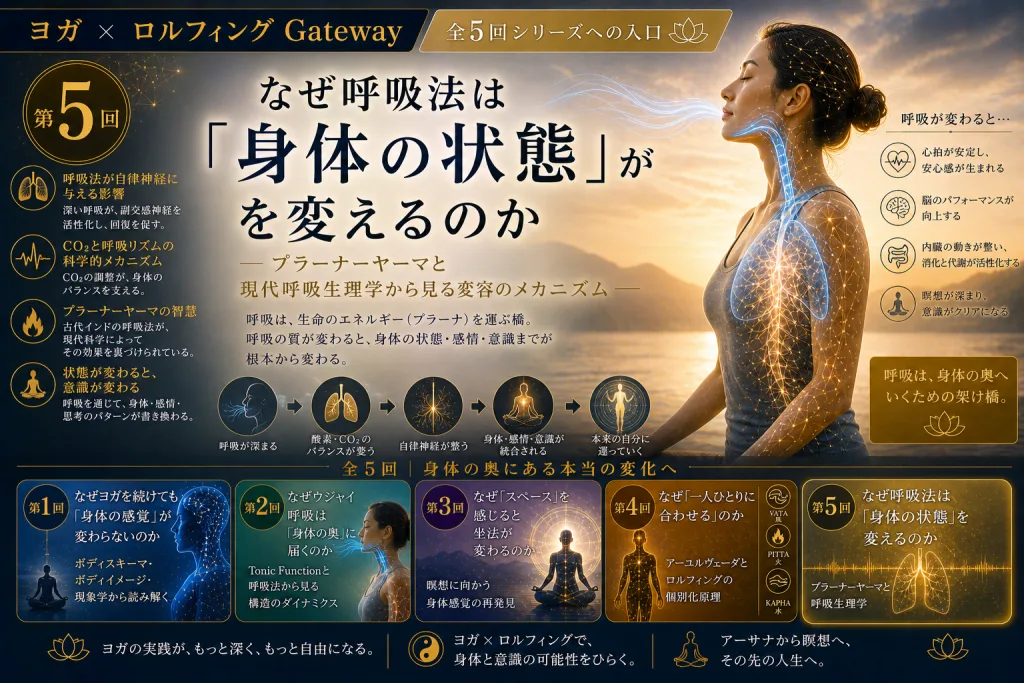
Part 5 returns to the breath. The theme is “pranayama (breathing methods).” Part 2 dealt with Ujjayi breathing, Tonic Function, and the Bohr effect surrounding the level of carbon dioxide. This article lies on that extension, and takes up the map of breathing methods spreading behind Ujjayi — eight preparatory exercises and four representative techniques.
I began Ashtanga Vinyasa Yoga in 2006. Ujjayi, practiced for about nine years, was by 2015 a breath that had soaked into the body. But in September of that year, through an encounter with a certain body-practitioner, I came to realize that Ujjayi is “no more than one part of traditional pranayama.” It happened three months after the four days of Ayurveda in Sri Lanka (Part 4).
The “Map of Breathing Methods” That Lay Beyond Ujjayi
The occasion was an introduction on August 15, 2015, from the Osaka Rolfer Mr. Hiroki Sato (who runs TEN — the space for your Life & Body). I met, for the first time, the Fukui-based yoga instructor Ms. Motoko Saito (who runs Yoga and Wellness Chandra), and heard that she would offer classes in Tsujidō on September 4 and in Fujisawa on September 5.
Ms. Motoko Saito is a yoga teacher who holds a medical license, and has studied pranayama in the lineage of the Kaivalyadhama Yoga Institute in Lonavla, India (insights learned from the institute’s director, Tiwari, were shared repeatedly throughout the course). Having taken workshops with various yoga teachers until then, this was the first time learning from a physician. It was a perfect chance to know how yoga is seen from a medical standpoint.
The September 4 class (held at Ms. Kyoko Tajima’s Traditional Ayurveda Japan) began with eight kinds of preparatory exercise. Uddiyana Bandha, Agni Sara, Kapalabhati, Nauli — unfamiliar names lined up. Until then the only breathing method I had done consciously in Ashtanga was Ujjayi, and after finishing this group of techniques experienced for the first time, a mild fatigue remained in the body. The sense that “this is different from Ashtanga” was vivid.
There was a phrase Ms. Motoko Saito repeated at that time — “The aim of yoga is to go beyond the influence of the workings (the disturbed workings) of the mind.” And that approaching the breath, which is closest to the mind, is the essence of pranayama.
Prompted by my drop-in participation in September, a practice class was held at Session Room ZERO on October 22, 2015 (16 participants). Then I also took part in the continuous course held in Shibuya on November 3, 4, 17, and 28, 2015 (four days, 12–13 participants). The schedule ran from 10 a.m. to 5 p.m., structured as practice ① → lecture → practice ②. Theory and practice went back and forth.
Ujjayi, treated in Part 2, was “a single point already known” within that map. But was that really so — what was Ujjayi for? — and I came to review it in a wider context.
The Eight Preparatory Exercises — the Foundation of Pranayama
What was taught first in the continuous course was not the techniques themselves, but eight kinds of preparatory exercise.
Ms. Motoko Saito explained the reason this way: pranayama is a technique that, by holding the breath, raises the level of carbon dioxide within the body cavity and works on the nervous system. But if there is unnecessary tension in the body, more pressure than needed is applied, or pressure that ought to be applied is not. The preparatory exercises exist to remove that unnecessary tension and to create a state in which “the part to relax and the part to tense can be controlled freely at will.”
The eight exercises are arranged in the following order:
- Abdominal breathing (supine): an exercise to release tension in the abdominal wall and observe the breath
- Uddiyana Bandha / Nauli (5 rounds): applying negative pressure within the abdominal cavity, massaging the viscera and vascular system from inside
- Agni Sara (5 rounds): applying positive pressure within the abdominal cavity, stimulating the viscera, nerves, and vascular system
- Simha Asana (5 rounds, the Lion pose): tensing from the neck down to release from the neck up
- Jihva Bandha (15 rounds, the tongue lock): a working on the carotid sinus and the cervical nerves
- Brahma Mudra (3 rounds, rotation of the neck): loosening tension in the neck
- Kapalabhati (20 pumps × 5, rapid exhalation): rapid repetition of the exhalation, stimulating the nervous system
- Nadi Shodhana (5 rounds, alternate nostril breathing / inhale 4 seconds : exhale 8 seconds, a ratio of 1:2)
Adding to these preparatory exercises the four main pranayama practices — Ujjayi, Sitkari, Shitali, and Bhramari — the whole took about 40 minutes. On the November mornings when I was taking the continuous course, I rose at 4:40 a.m., 20 minutes earlier than usual, to do these before the practice of Ashtanga and meditation.
As the days went on, there was an interesting change in sensation — three points: the sit bones grew stable and the back lengthened naturally; the breath settled and it became easier to enter meditation; and flexibility increased in Ashtanga’s sun salutation.
Here is an important viewpoint. Pranayama is not “a technique for blowing breath in.” Rather, it is a technique for setting in order the place where the breath arises. The very naming of “preparatory exercises” shows this stance.
Ujjayi Breathing — a Reunion with Tonic Function
After the eight preparatory exercises come the four main pranayama practices. The first is Ujjayi Pranayama.
Ujjayi breathing was dealt with in Part 2 (Why Does Ujjayi Breathing Reach “the Depths of the Body”). Narrowing the back of the throat to constrict the airway and breathing with a wave-like sound activates Tonic Function (the deep antigravity muscles) — that was the argument at the time.
What I learned anew in the continuous course was that Ujjayi has two meanings:
- Tightening the throat to narrow the airway makes a long exhalation possible without using excess force.
- Tightening the throat at the neck to fix the neck recruits the collarbones and ribs, so that the breathing muscles that ought to work (the diaphragm, the intercostals, the cervical muscles, the pelvic-floor muscles) work without using excess force.
The second point especially matters from the Rolfing viewpoint. Ujjayi works less as “a technique for changing the breath” than as a technique for rearranging the structure involved in breathing. The activation of Tonic Function treated in Part 2 occurs as a result of this rearrangement.
Until then I had thought Ujjayi was a technique peculiar to Ashtanga. But Ms. Motoko Saito said that Ujjayi is one among the traditional pranayama. In the process by which the modern yoga of Ashtanga was systematized in the 20th century, Ujjayi was chosen from among the traditional breathing methods and built in — reframed that way, the Tonic Function treated in Part 2 can be repositioned not as “Ujjayi’s exclusive property” but as the common ground of the group of breathing methods.
Nadi Shodhana — Alternate Nostril Breathing and the Autonomic Nervous System
What I learned after Ujjayi was Nadi Shodhana (alternate nostril breathing).
The technique looks simple. Closing the right nostril with the right thumb and the left nostril with the ring finger alternately, the pattern repeats: inhale from the left and exhale from the right, inhale from the right and exhale from the left. The ratio of the breath is basically inhalation 4 seconds : exhalation 8 seconds (1:2).
Trying it in practice, it is harder than it looks. In both the practice class held at ZERO (October 22) and the continuous course, Ms. Motoko Saito adjusted the position of my neck. In the movement of alternately closing the nostrils with the fingers, the neck moves unconsciously and the body axis shifts. “The movement of the hand closing the nostrils” and “the position of the head and neck” have to be kept separate.
For me this was a discovery that bridged Rolfing and breathing methods. A breathing method is not a technique of the breath alone; it is directly tied to the structure of the neck. The sense of head position treated in Part 3 (space and the way of sitting) and the observation of Pre-movement that Rolf Movement handles — all of these arise the moment there is an attempt to do Nadi Shodhana accurately.
The effect of Nadi Shodhana is traditionally explained as an adjustment of the balance of the autonomic nervous system. There is a tendency of left-nostril dominance = parasympathetic / right-nostril dominance = sympathetic, with a natural switch about every 90 minutes (the nasal cycle). Consciously balancing left and right becomes a clue for awakening the self-regulating capacity of the autonomic nervous system.
What I want to stress here is that a breathing method is not “an intervention into the nervous system from the outside.” The autonomic nervous system itself cannot be controlled by will. What pranayama can do is, through the indirect clue of the breath, awaken the self-regulating capacity the autonomic nervous system originally holds. The points of practice, too, come down to: without straining, evenly, without forcing.
Kapalabhati — Abdominal Pressure and Stimulation of the Nervous System
Among the eight preparatory exercises, the one with the strongest stimulation is Kapalabhati (rapid exhalation).
The technique performs rapid exhalations through the nose (one to two per second), 20 times × 5 sets. With each exhalation the abdominal muscles contract sharply, and the inhalation is allowed to occur passively. The diaphragm, the abdominal muscles, and the pelvic-floor muscles move in concert, and a vibration is transmitted to the viscera.
As a felt sense in the continuous course, during Kapalabhati the sharp change in abdominal pressure was marked, and afterward there was a sense of arousal rising for a while. It was explained that there are three effects: strengthening the breathing muscles, stimulating the viscera, and stimulating the nervous system.
However, the contraindications were conveyed clearly:
- During menstruation or pregnancy
- Hypertension or heart disease (especially the fast version of 120 times per minute)
- States requiring special care, such as a malignant tumor
- An acute state of strong stress
The last item especially becomes an important point as yoga therapy. It is treated in detail in a later section.
There is something I noticed in practicing Kapalabhati. Doing Kapalabhati after receiving Rolfing, the movement of the diaphragm is easier to feel. This is probably because in Rolfing’s first session, “organizing the breath,” the relationship of the diaphragm and the ribs is rearranged. The stronger the technique, the more it presumes that the body is prepared. Here lies the reason the eight preparatory exercises are necessary.
Kumbhaka — Breath Retention and the Carbon Dioxide Level
What was treated in the latter half of the continuous course was Kumbhaka (breath retention). The word pranayama itself means, in Sanskrit, “prana (breath, the energy of life) + ayama (to extend / to stop).” Kumbhaka — the technique of stopping the breath — is contained in the very etymology of pranayama.
There are two kinds of Kumbhaka:
- Abhyantara Kumbhaka (the inner Kumbhaka): retention after the inhalation
- The outer Kumbhaka: retention after the exhalation
Generally, what is practiced first is Abhyantara Kumbhaka, done after a deep inhalation. And to perform Kumbhaka safely, Jalandhara Bandha (the chin lock, bringing the chin toward the top of the sternum) is always used together. This has the role of softening, through stimulation of the carotid sinus (the vagal reflex), the fluctuations in blood pressure and heart rate while the breath is held — an example of a traditional technique that functions soundly even seen through modern physiology.
When the breath is held, the level of carbon dioxide in the blood rises. The respiratory center is then stimulated, and pressure builds in the direction of increasing the number of breaths. But the training to suppress that and keep the breath slow and deep — that is the essence of Kumbhaka. The Bohr effect treated in Part 2 (a rise in CO₂ → dissociation of oxygen from hemoglobin → promotion of oxygen delivery to the tissues) also works on this extension.
What Ms. Motoko Saito stressed repeatedly in the continuous course was that the essence of pranayama lies not in oxygen but in the level of carbon dioxide. Breathing methods are generally imagined as “taking in more oxygen,” but in fact it is the reverse: the body growing accustomed to a rise in the carbon dioxide level is precisely what opens the door to a parasympathetically dominant, relaxed state. The insight of Patrick McKeown’s The Oxygen Advantage, mentioned in Part 2, connects here as well.
What is useful in the context of modern respiratory physiology is the checking and training of “carbon dioxide tolerance.” As with the BOLT (Body Oxygen Level Test) score proposed by McKeown, there are attempts to measure how far a person’s respiratory system can tolerate a rise in the CO₂ level. Practicing a four-beat rhythm of inhale → hold → exhale → hold for about two minutes daily, according to the tolerance level (3 seconds for “low” tolerance, 5–6 for “medium,” 8–10 for “high”), gradually raises CO₂ tolerance. This is exactly the bodily state that traditional Kumbhaka has aimed at. The technique the classics have called “Kumbhaka” can be translated, in the language of modern respiratory physiology, as “training to raise carbon dioxide tolerance” — describing the same bodily phenomenon in a different language.
Because CO₂ tolerance rises gradually, staged training is necessary, and trying suddenly to hold for a long time brings out a fear response. The points of practice are three: do not force a long hold, build up day by day, and stay within a range where no fear response appears.
The seemingly simple technique of “stopping the breath” is directly tied to the body’s most basic chemical reaction — this settled in as a felt sense only as the continuous course drew toward its end.
“In Practice, Let Go of Knowledge Once” — the Basic Stance of Yoga Therapy
Six techniques have been taken up so far. But the message Ms. Motoko Saito conveyed repeatedly in the continuous course was not the techniques themselves.
“In practice, let go of knowledge once.”
It sounds contradictory: to let go, once, in the place of practice, of the breathing-method knowledge explained in detail in the classroom. But Ms. Motoko Saito went on: knowledge (especially knowledge that has settled in) helps as needed. But holding it as thought during practice pulls attention back to left-brain questions — is the count correct, is it being done correctly — and wastes extra energy.
This connects to the distinction between Intellectual understanding and Practical understanding. Pranayama and meditation alike are things understood only by practicing. They are not the kind of thing that can be understood from books alone.
On the final day of the continuous course (November 28), answering questions from participants, Ms. Motoko Saito named five points to observe during practice:
- How much thought is entering during practice
- Whether the rhythm can be kept even
- Whether a pleasant sensation comes afterward
- What attitude arises when practicing the method
- Whether there is a sense of being made to do it
“Letting go of knowledge” is not neglect. It is observing the self from a point away from thought.
And one more thing conveyed as the basic stance of yoga therapy — “it is not something done in expectation,” “not something whose effect is felt in a single time.” At the timing the body judges, a solution — the therapy — comes out from within. This resonates with the principle of individualization treated in Part 4: “responding to the state of the person, not to a manual.”
Finally, there is an important practical caution. Meditation that goes deep into sensation (especially long, unguided meditation) is contraindicated for a person in a depressed state. When trying to sit quietly, the words issuing from within cannot be stopped, and symptoms can worsen. Instead, approaches such as chanting sutras or mantras (which become a breathing exercise and also bring a sense of ease), or controlling the tension of the body with yoga poses, are recommended. Among pranayama too, the strongly stimulating techniques (such as Kapalabhati) are unsuited to an acute state of strong stress, and it is safer to enter from gentle techniques such as Nadi Shodhana or slow, deep breathing.
Why sensory meditation is counterproductive for some people — that mechanism is treated deeply as the neuroscience of meditation (comparing the DMN, Polyvagal theory, and psychedelic research) in the “Recognition OS and Meditation” series at another site, Mind Bodywork LAB. → Recognition OS and Meditation Gateway (MBL) (in Japanese)
In this article I focus on “cautions in practice” and leave the neuroscientific mechanism to MBL.
The link to Rolf Movement — Putting the Movement of Breath into Words
A breathing method is a conscious operation, but seen from another angle it is also an object of observation. What happens when the observation of Pre-movement — the movement before movement, a core concept of Rolf Movement® — is applied to breathing?
“What is the body doing before the inhalation?” “What moved in the instant the exhalation ended?” Turning such questions toward the breath, fine movements that had been outside awareness rise to the surface:
- Which side of the chest, left or right, opens first
- Whether there is a left-right difference in the movement of the ribs
- Whether the lower abdomen responds a moment late
- Whether something tenses just before the inhalation
These observations are not for “changing the breath.” They exist to make visible the habits of a person’s own breathing. Only by putting a noticed habit into words does a clue toward change first arise.
A breathing method is not only “a technique for changing the breath.” It is also a frame for observing the breath — this is the figure of pranayama seen from the Rolf Movement viewpoint.
The three-way circulation of Rolfing, Rolf Movement, and yoga introduced in the series Gateway is at work here too. Organizing the structure with Rolfing, observing the movement with Rolf Movement, and weaving it in as the daily breath with yoga breathing methods — within this circulation, pranayama functions as “a device for weaving the breath into daily practice.”
Closing — Pranayama and Bodily Structure
The essence of pranayama is not “organizing the breath.” It is growing a body in which the breath organizes itself — this single point was what settled in for me through the continuous course.
The eight preparatory exercises taught at the start of the continuous course show this stance plainly. Before entering the main pranayama, unnecessary tension in the body is removed, the nervous system is set in order, and the structure is rearranged — only when these foundations are in place do techniques such as Ujjayi, Nadi Shodhana, Kapalabhati, and Kumbhaka do their true work.
Ujjayi, treated in Part 2, was the entrance to a wider group of breathing methods. Part 5 traced that whole map. Organizing the structure with Rolfing, fixing it within movement with Rolf Movement, and weaving it in as the daily breath with pranayama — the three-way circulation drawn through this series works, in pranayama, in its most everyday form.
And one more thing. Pranayama sits at the fourth step of the eight limbs (Yama / Niyama / Asana / Pranayama / Pratyahara / Dharana / Dhyana / Samadhi). Before it comes Asana (the third step), and after it continues the inner yoga from Pratyahara (withdrawal of the senses) to Samadhi (absorption). Beyond pranayama lies meditation — this direction, shown repeatedly in the continuous course, is precisely the bridge that connects this series from “yoga and bodily structure” to “yoga and consciousness.”
Why pranayama is placed at the fourth step among yoga’s eight limbs, and how it connects to meditation — such an intellectual axis is handled in the “Recognition OS and Meditation” series at another site, Mind Bodywork LAB. → Recognition OS and Meditation Gateway (MBL) (in Japanese)
The five-part series is complete with this. Body schema (Part 1), Tonic Function (Part 2), the sense of space (Part 3), the principle of individualization (Part 4), and pranayama (Part 5) — the meeting points of yoga and Rolfing have been explored from five viewpoints. The two are separate systems, but they share a stance of observing and transforming the self through the body.
Reference: The 2015 Pranayama Continuous Course (Original Record)
The records of the time, which became the material for this article (held at Mind Bodywork LAB) (in Japanese):
- Pranayama Continuous Course (1) — Dropping In, and Yoga Philosophy
- Pranayama Continuous Course (2) — Meditation and Meditation Techniques
- Pranayama Continuous Course (3) — The Difference Between Western and Eastern Medicine
- Pranayama Practice Class — Held at ZERO
- Pranayama Continuous Course (4) — The First Day of the Shibuya Sessions
- Pranayama Continuous Course (6) — Breathing
- Pranayama Continuous Course (8) — Through Practice
- Pranayama Continuous Course (9) — Day Three and Dialogue
- Pranayama Continuous Course (11) — The Final Session and a Dream
Yoga × Rolfing (Five-Part Series)
→ Gateway: Yoga × Rolfing — 20 Years of Ashtanga, and the Encounter with Rolfing (Gateway Article)
Part 1: Why Does “the Sensation of the Body” Not Change Even After Continuing Yoga — Reading It Through Body Schema, Body Image, and Phenomenology
→ Read Part 1
Part 2: Why Does Ujjayi Breathing Reach “the Depths of the Body” — the Dynamics of Structure Seen from Tonic Function and Breathing Methods
→ Read Part 2
Part 3: Why Does Feeling “Space” Change the Way of Sitting — Rediscovering the Bodily Sense Toward Meditation
→ Read Part 3
Part 4: Why “Tailor to Each Person” — The Principle of Individualization of Ayurveda and Rolfing, Experienced in Sri Lanka
→ Read Part 4
Part 5: Why Do Breathing Methods Change “the State of the Body” — Pranayama and Modern Respiratory Physiology (this article)
The sensation of the body and the transformation of the body schema are deeply connected to the process of updating the “Recognition OS.” What handles more deeply the theme of the integration of thought, emotion, and body is Mind and Bodywork Lab.
→ Recognition OS and Meditation Gateway (MBL) (in Japanese)
→ Mind and Bodywork Lab: How to Navigate This Site (in Japanese)
It is possible to begin by confirming, in a trial session, what is happening in the body map.
→ Applying for a Trial Session
Hidefumi Otsuka (Ph.D.) | Certified Advanced Rolfer™ / Rolf Movement Practitioner / Yoga Alliance certified instructor (RYT200)
Completed a doctoral program at the Graduate School of Medicine, the University of Tokyo. After a career in the pharmaceutical industry, has offered Rolfing® sessions in Shibuya since 2015. Has practiced Ashtanga Vinyasa Yoga since 2006. Works under the theme of “the integration of thought, emotion, and body.”