On Thursday, March 16, 2017, the general meeting of the Japan Rolfing Association (JRA) was held at Ohashi Kaikan in Ikejiri-Ohashi, and I attended for the second year running. What I look forward to each time is the workshop by a visiting Rolfer held alongside the meeting.
When I first attended in 2016, the teachers were Carol Agneessens and Ray McCall, who had come to Japan for an Advanced Rolfing training (see “Attending the Japan Rolfing Association General Meeting — Learning the History of Rolfing“).
This year the guest was Lael Keen, an American based in Brazil, and her one-day workshop was held on March 15, the day before the meeting.

Lael is an advanced Rolfing instructor with thirty years of experience as a Rolfer and an instructor in Somatic Experiencing (SE) with twenty years in that field. Her theme was how to bring SE’s approach to trauma into a Rolfing session.
SE was developed by Peter Levine and approaches trauma through the body.
Levine’s Waking the Tiger – Healing the Trauma appeared on the reading list for the Rolfing training. I read it during the training period, but it did not teach me how to apply what I knew about trauma within a Rolfing session (see “Trauma Stays in the Body, Not in the Event — What Happens in the Deep Sessions“).
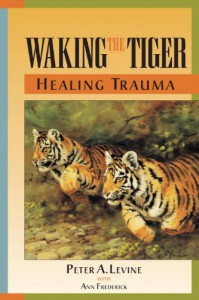
According to the book, an animal meeting an enemy has two options, fight or flight, and when neither is available, a third is known to appear: freeze.
SE views trauma as a state of long captivity following a psychological injury, or one carrying a lasting negative psychological effect.

Ordinarily, attention goes to what caused the trauma. Levine held that the causal event is not the problem. What produces trauma is the shock energy generated in the body remaining there in an incomplete form. And as with animals, only by going through a process in which that energy is fully discharged does trauma resolve — something he demonstrated in actual treatment.
What Levine emphasizes is that resolving trauma rests on calling up the physical sensations felt inside the person — on treating those sensations as what matters.
According to Lael, about fifty percent of Rolfing clients do well with the standard ten series. The other fifty percent need some approach to trauma. Even with hands-on work, something in them fears letting go, or does not want to let go; some external stress produced a change inside, and the body arrived at the state it is in.
Following Levine, Lael set out the underlying idea: rather than attending to the traumatic event itself, attend to what it did to the nervous system.
In understanding the nervous system, she went beyond the autonomic branches — sympathetic for fight and flight, parasympathetic for rest and digestion — to the Social Engagement System, mediated by the vagus nerve, which bears on freezing (see “The Face Makes Safety — Polyvagal Theory and the Two Vagus Nerves“).
There was plenty of practical work as well. In groups of four we shared positive experiences, and clients’ accounts of traumatic experience.

She then introduced the two categories that trauma symptoms fall into: discharge and catharsis. Discharge covers heightened emotional states — flushing, trembling, sweating, tears. Catharsis covers convulsive responses. Where energy remains incompletely held in the body, releasing it through discharge is what you want; once catharsis sets in, discharge becomes harder, so care is needed.
What matters, she said, is going slowly, and staying with the body.
With someone in catharsis, for instance, you have them open their eyes and you speak to them — this switches on social engagement. Then they stand and feel the ground. Sometimes it helps to have them look for something beautiful in the room and take it in. That is what brings them out of catharsis in the end.
There were also exercises done in pairs — when there is a person on the left and on the right, what kind of change occurs? — and she explained Hubert Godard’s concept of Space (on Hubert Godard’s Tonic Function and Space, see “Body and Mind (6) — Tonic Function (3): Space“). It was a one-day workshop that passed in a flash. Lael’s personality — a 5th dan in aikido, and unexpectedly able to understand Japanese — was wonderful, and there was much to learn.
Note, August 2026
Lael had not come to Japan for this workshop. She was here to run an SE training, and the day was arranged around that visit.
The previous year had taken the same shape. Carol Agneessens and Ray McCall came for an Advanced Rolfing training, and the general meeting’s workshop was held while they were in the country. A visiting teacher arrives for some other purpose, and in the gap in their schedule a single day opens up. That was the shape, in those years, of how you made contact with an overseas lineage without leaving Japan.
Set the terms introduced that day side by side and the following eight years are already in them. Fight, flight, freeze. Discharge and catharsis. The Social Engagement System. Go slowly, stay with the body. With someone in catharsis, have them open their eyes, speak to them, have them stand and feel the ground.
A one-day workshop. I took it in as an introduction.
Four years later, in February 2021, I began studying Somatic Experiencing myself. Twelve days of the beginning level with Ariel Girretto. The terms in this article stood there as the subject matter.
But once the beginning level was done, I judged that the intermediate levels were not for me. It was clear they went into quite specialized territory. I did not take the path of building the system to the top.
Then I came back to the field in a way I had not expected. Through a connection that came my way, I sat in on sixteen days of DARE with Patricia Meadows and five days of a Master Class with Dave Berger — as the interpreter. Translating, and taking the content in as I went.
Translating is work you cannot do without understanding. There is a clear gap between listening and feeling that you have followed, and putting something into another language. The passages you cannot translate are the passages you have not understood. The territory I had stopped short of by skipping the intermediate levels was, in the end, the territory I had to handle with nowhere to hide.
And the position had reversed.
On that day in 2017, Lael’s words reached me through an interpreter. I was on the receiving side, in Japanese. Five years later I was standing on the other side of that arrangement. The same kind of room, and I was the one handing things over.
In the post on Jonathan Martine’s workshop, I wrote that having an interpreter slowed the pace and that this suited me, since it left long stretches for questions and practice. Once you have been on the translating side, you can see where that slowness comes from. For the length of that pause, the interpreter is holding the content between two languages. What is open space for the person receiving is working time for the person handing over.
There is one more thing in this article that I read past at the time.
Lael closed by using a paired exercise to explain Hubert Godard’s concept of Space. An American living in Brazil, teaching SE, working with a concept from the European lineage.
Back then I sorted lineages by region — Europe for the functional line, Brazil for the psychobiological one. In practice, several lines converge within a single teacher. Lael is an SE instructor, an advanced Rolfing instructor, and someone who works with Godard’s framework. Sorting by region cannot account for where she stands.
While I am at it: this workshop was counted under Elective. The content is trauma and the nervous system, which in the classification belongs to the psychobiological domain. It falls under Elective because the teacher is not on the ERA faculty. Sharon Wheeler’s two workshops were classified the same way for the same reason. The category is set by the teacher’s standing, not by the content.
The name of the category tells you nothing about what the person taught.