Introduction
While giving sessions, there is a question I’m often asked:
“What kind of exercise should I do?”
When answering this, I first recommend thinking of “strategy” and “tactics” separately.
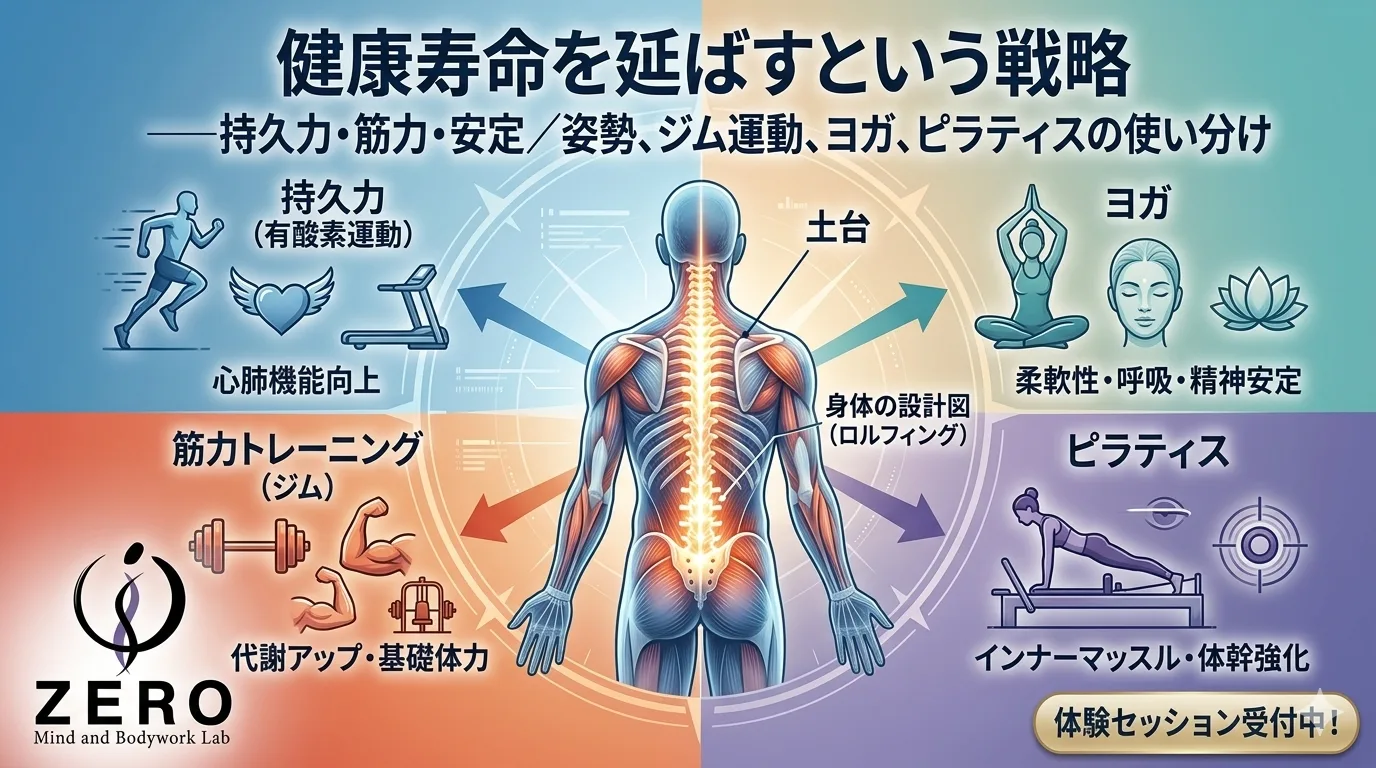
Three Strategic Pillars: Endurance, Strength, Stability/Posture
What Is Strategy?
Strategy is the direction to aim for. Here, the strategy is clear.
To extend healthspan.
To keep, even as the years add up, a body that can stand on its own feet, walk, breathe, think, and decide.
Organized from the viewpoint of bodily function, this strategy comes down to three pillars:
- Endurance
- Strength
- Stability and posture
These three form the structure supporting the large goal of health.
But it does not end here.
The body is not a mere machine, and health is not a matter of numbers alone.
There, always, is the relationship of:
- the brain (thought)
- the heart (emotion)
- bodily sensation (the hara, the tanden)
Endurance — the Foundation of Recovery
Endurance is not simply the ability to run for a long time.
It is raising the body’s capacity to supply the energy of life.
Maximal oxygen uptake (VO₂ max) is strongly linked to healthspan. The higher the cardiopulmonary function, the lower the risk of chronic disease, and the faster the recovery.
But the essence of endurance lies somewhere deeper. To train endurance is also to grow the power to recover from stress.
Seen from the viewpoint of the brain, aerobic exercise raises the working of the prefrontal cortex and strengthens tolerance to stress.
From the viewpoint of the heart, a body with endurance is less easily tossed about by anxiety and impatience.
From the viewpoint of bodily sensation, the breath deepens and a margin is born within.
Endurance can be grasped as a supple life force. Not the power to fight for a long time, but the power to return — what may be called resilience.
Strength — the Stability of Being
Strength is not simply the ability to lift heavy things.
It is what may be called the power to support the self within gravity.
Muscle mass and grip strength are directly tied to preventing falls and preventing frailty. Muscle is also involved in metabolism and blood-sugar control.
But the meaning of strength is not only that.
A body that can stand firmly. Legs that can hold their ground. Hands that can grip.
Unconsciously, these create the sensation that “I am supported.”
From the viewpoint of the brain, strength training raises self-efficacy.
From the viewpoint of the heart, it produces a sense of accomplishment and stability.
From the viewpoint of bodily sensation, it grows the sense of the hara being settled.
Strength is the stability of being itself.
Stability and Posture — the Structure That Integrates Force
Even with endurance and strength, if the structure has collapsed, force is dispersed.
Stability is the question of how the body is supported within gravity.
When posture comes into order, the breath changes, and the efficiency of transmitting force rises.
From the viewpoint of the brain, posture influences attention and concentration.
From the viewpoint of the heart, posture is closely related to emotional state.
From the viewpoint of bodily sensation, as the central axis passes through, a sense of integration across the whole body is born.
Stability is like a hub connecting the three pillars.
Three Tactical Pillars: Gym Exercise, Pilates, Yoga
What Are Tactics?
The above is strategy.
So, what are tactics?
Tactics are the concrete means for realizing a strategy.
The gym, Pilates, yoga. These are all tactics — means.
Gym Exercise
The gym is a tactic for efficiently raising endurance and strength.
It manages numbers, sets loads, and strengthens bodily function.
The brain (thought) designs, the heart (emotion) gains a sense of accomplishment, and the body grows functionally stronger.
The gym is a clear and rational tactic.
Pilates
Pilates is a tactic that raises stability through re-education of the nervous system.
It sharpens the precision of movement and sets the central axis in order.
The brain controls with precision, the heart concentrates, and the body regains the sense of support.
Yoga
Yoga is, originally, one of the exercises for preparing for meditation.
Its asanas (poses) are built so as to move with the breath, quiet thought, and turn sensitivity inward.
The brain grows still, the heart receives, and the body harmonizes with gravity.
It is a tactic that grows stability and inner integration.
The Positioning of Rolfing®
Rolfing is not a particular tactic.
It is one of the approaches that set in order the foundation of the whole strategy.
By integrating the body’s structure within gravity, endurance becomes easier to exercise, strength is transmitted efficiently, and stability rises naturally.
And above all, the brain (thought), the heart (emotion), and bodily sensation (the hara) stop separating.
Health is not a mere collection of functions.
It is a state in which the brain, the heart, and bodily sensation do not separate.
Conclusion: A “Foundation” for a Health Strategy
In an age of 100-year lives, extending healthspan makes every one of these indispensable: endurance (aerobic exercise), strength training, and the body’s stability (posture, range of motion).
But however excellent the gym exercise, yoga, or Pilates taken up, if the “bodily structure” that is their foundation has collapsed, not only will sufficient effect fail to come — the risk of injury also rises. By setting the fascia in order, Rolfing rewrites the body’s “blueprint” and prepares to maximize the effect of every kind of exercise.
To gain health strategically. As a step toward that, why not begin by regaining the “neutral state” the body originally holds?
[Experience] Steps to Build a Body That Can Move for a Lifetime
At the Shibuya studio, the current state of the body is analyzed, and conditioning best suited to extending healthspan is offered.
Building the “Foundation” That Dramatically Changes Exercise Efficiency: A Trial Session
For those who don’t quite feel the effects of the gym or yoga, or who feel something off in the body. By setting the fascia in order and gaining a posture in harmony with gravity, the sensation in which daily movement itself turns into training is there to be felt. It draws out the “ease of using the body” that accelerates an exercise strategy.
▶ Details and inquiries about the trial session here
Finally: Wisely, Supplely, Toward the Future.
Extending healthspan is nothing other than increasing a person’s own “free time.”
The gym, yoga, Pilates, and Rolfing. The intelligence to understand the character of each and choose what is needed now builds the body of decades from now.
So that a person can walk lightly on their own two feet for a lifetime and keep taking on what they want to do, I will support fully as a specialist in the body.