Introduction
Over the year-end and New Year, I had the chance to meet Takami Kamata, a Rolfer active in Frankfurt, Germany, who was back in Japan for a temporary stay. Taking the reunion as an occasion, we did three exchange sessions — our first since 2016 (three in total, on December 14, 19, and 26).
For reference, the photo below is from Christmas (December 25), when I met again with Ms. Setsuko Nakano and Mr. Hikaru Ishii of the Shinshū Naikan Training Center (Azumino, Nagano), which offers intensive Naikan, together with Takami. (I had once received Naikan together with Takami)

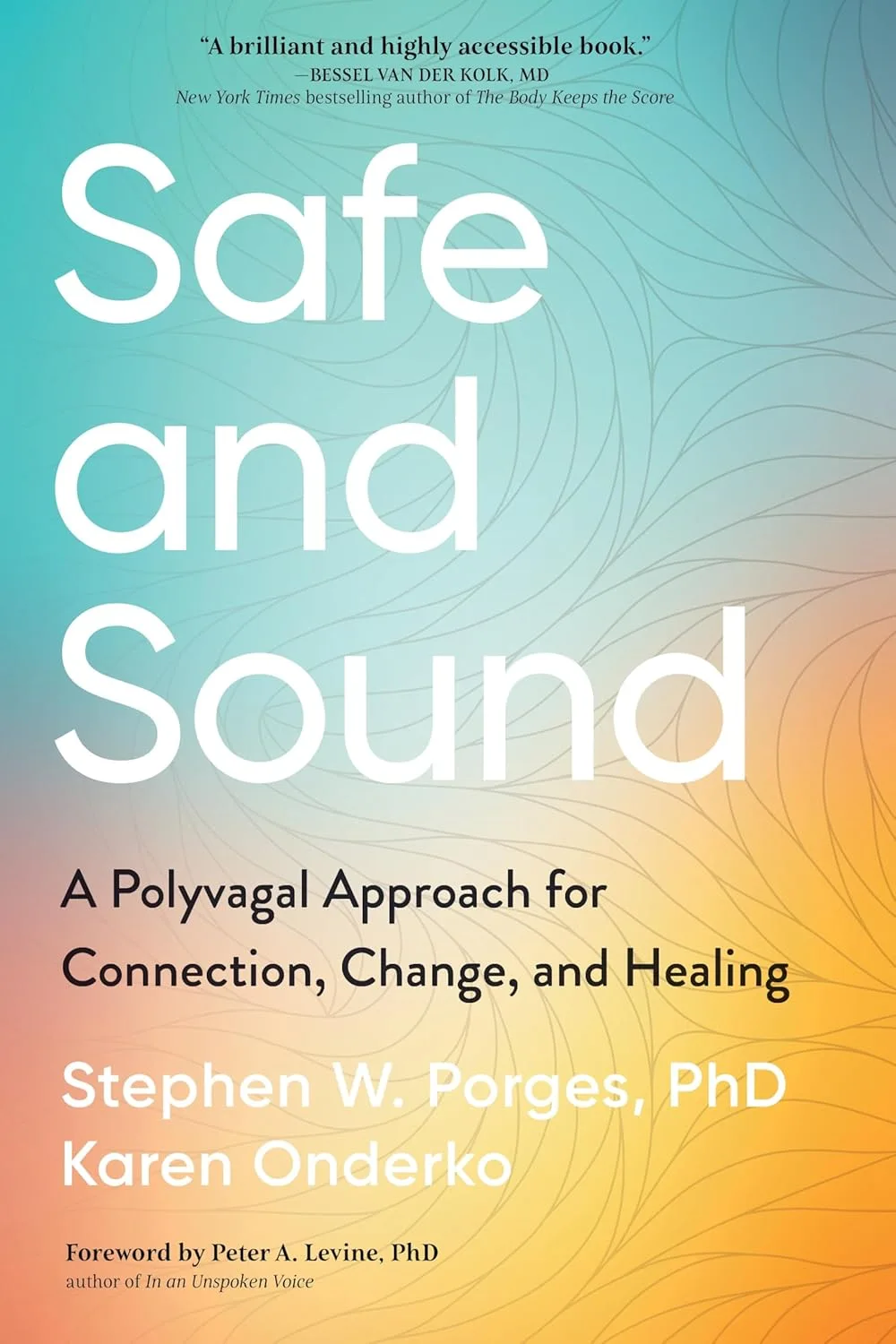
For this reunion, I read in advance Safe and Sound: A Polyvagal Approach for Connection, Change, and Healing, co-authored by Stephen W. Porges and Karen Onderko. Moved by its contents, I came to receive that book’s “Safe and Sound Protocol (hereafter abbreviated SSP)” under Takami. Since December 22, 2025, I have listened to the SSP audio every day.
This time I want to focus on SSP, which was the most striking part of the reunion.
Reunion with Takami — the Exchange Session
In the “exchange session,” where we each offer sessions to the other, I offered energy work and musculoskeletal work (Structural Work). From Takami, it became a session centered on the neck work needed in order to listen to the SSP audio.
As expected from Takami, active in Germany, I was able to experience a solid Rolfing session, and had a sense that the body was firmly set in order.
What concerned me this time were a left shoulder injured while doing a backbend pose in Ashtanga yoga, and a left upper arm that had come to feel off from Brazilian jiu-jitsu. In both, thanks to Takami’s structurally oriented approach, the range of motion widened and movement became easier.
Also, partly because of the divorce at the end of October 2025, the discomfort in the neck was not eased by the exchange sessions; but this, as described later, seems fair to say is gradually heading toward release through listening to the SSP audio.
Beginning to Listen to the SSP Audio
After the second exchange session, I began listening to SSP on December 22, 2025. To listen to SSP, an iPhone/Android app is downloaded in advance. By paying a license fee to an SSP provider, the audio within the app becomes available to listen to. The audio has various genres, so the content does not grow tiresome.
After one week of experience, points I felt included:
- The balance of the left and right inner ears was understood finely as bodily sensation, not as a balance thought out in the head
- Even when emotions or memories surfaced, a margin was born that let them pass through without being pulled in
- A sense that the memory of past trauma was gradually being purified
- A sense that muscular tension in the neck and lower jaw, brought on by trauma, was gradually being released
— and various other bodily changes.
Below, I want to introduce SSP, centered on Porges’s book and on the content from Takami.以下、SSPについて、Porgesの本及び、孝美さんからの内容を中心に紹介したい。
What Is SSP
SSP (the Safe and Sound Protocol; literally, “the procedure of safety and sound”) is a method for adjusting the autonomic nervous system using specially filtered music, based on the Polyvagal Theory proposed by Porges.
Polyvagal Theory considers the autonomic nervous system to consist of:
- the sympathetic nerve (fight / flight)
- the parasympathetic nerve
- the dorsal vagus (shutdown, freeze)
- the ventral vagus (social engagement, safety)
The main purpose of SSP is, by listening to the audio, to strengthen the ventral vagal complex through an approach from hearing.
Why the Nervous System Changes Through “Sound”
The key to SSP lies in the middle-ear muscles (the stapedius and the tensor tympani).
Seen from the autonomic nervous system:
In a fight/flight, or a freeze, state → the middle-ear muscles become chronically tense or inactive
As a result → human voices become hard to hear → environmental sound becomes “noise”
SSP → recovers the elasticity and plasticity of the middle-ear muscles through filtered music
What matters here is that this is not “training of hearing” but “making the nervous system safe.”
According to Takami, SSP is used in clinical settings, and is producing results, especially in the following areas:
- ASD (autism spectrum)
- ADHD / ADD
- Tics
- Sensory hypersensitivity
- Sleep disorders
- Anxiety and depression
- Chronic fatigue and brain fatigue
Grasping Developmental-Disability Traits as “Adaptation of the Nervous System”
From the viewpoint of Polyvagal Theory, developmental-disability traits are understood not as “personality” or “lack of effort,” but as an adaptive state of a nervous system that has trouble sensing safety.
SSP does not:
- teach behavior
- train sociality
- rewrite cognition
Instead, it sets in order the neural foundation for sociality to arise naturally. This can be said to be the greatest reason for its high compatibility with the developmental-disability domain.
Why Noise Cancelling Is Not Used
In SSP, using over-ear headphones and turning the noise-cancelling function OFF is a required condition.
The reason:
Noise cancelling → safety that shuts out the outer world
SSP → growing a nervous system that feels safe within the outer world
Especially for a person with developmental-disability traits, not “shut-out safety” but “safety within connection” becomes important.
Reactions That Can Occur with SSP
In the process of listening to the SSP audio, reactions like the following can apparently occur:
- Swings in mood
- Flashbacks
- Temporary flare-up of previous patterns
- Digestive symptoms
- Headache, dizziness, skin symptoms
These are the “thawing of frozen energy,” and are said to appear shorter and weaker than the reactions received in a Somatic Experiencing (SE) session.
I have received SE sessions in the past; SSP brings weaker reactions than that, but through listening to the audio, I do strongly feel, at times, swings in mood, flashbacks, and skin symptoms.
Conclusion
This time, I introduced the reunion with Takami Kamata, resident in Germany, the exchange sessions, and, centrally, SSP.