
Introduction
When someone receives the Rolfing Ten-Series, how does the body actually change? Is there anything known scientifically? I’m sometimes asked this.
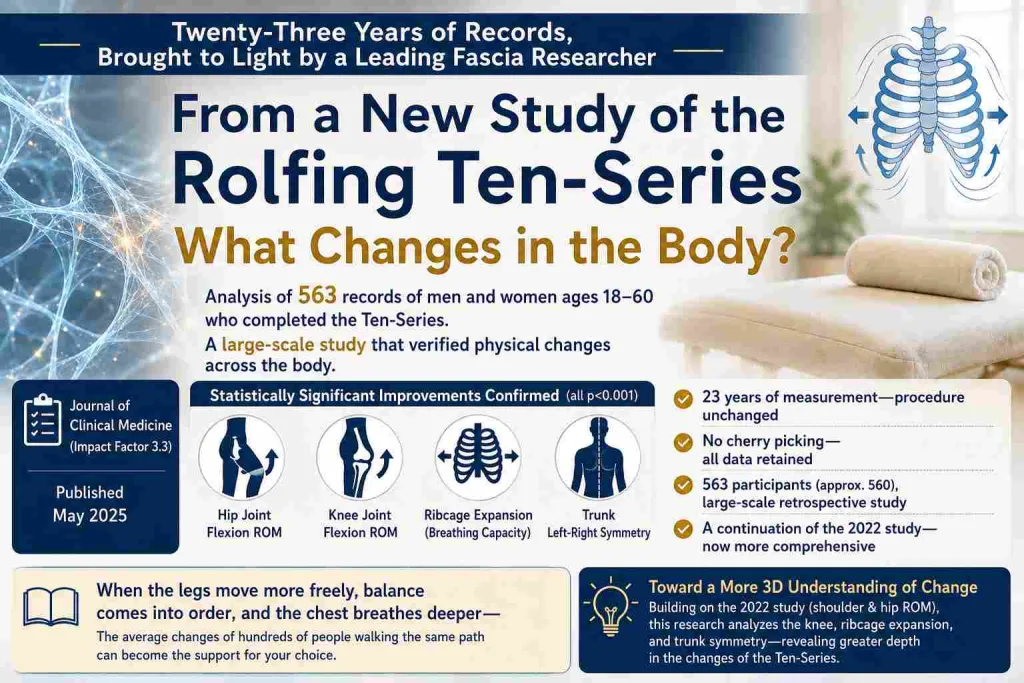
So, in this post, I want to introduce a paper reported in the Journal of Clinical Medicine (an international peer-reviewed journal with an Impact Factor of 3.3): “Influence of Rolfing Structural Integration on Lower Limb Mobility, Respiratory Thorax Mobility, and Trunk Symmetry: A Retrospective Cohort Study“
Fascia Researcher and Rolfer: Robert Schleip
The lead author, Robert Schleip, is one of the Germany-based Rolfers.
After his experience as a Rolfer in the lineage of Rolfing’s developer Ida Rolf, he moved to the teaching side (one of the Senior Instructors). After teaching in Munich at the European Rolfing Association (ERA), he turned his interest toward the very tissue he had thought was “mediating the change of the body” — the fascia — and obtained a PhD in physiology.
As an aside: by the time I received my basic training in Munich, he had already left the faculty, so I have never met Schleip directly.
The theme of Schleip’s doctoral research was the contractility and viscoelasticity of the fascia. He verified, in the language of science, how the tissue he had touched through Rolfing’s manual techniques physically behaves. For reference, in the year he took his degree at Ulm University, it was honored as the best doctoral dissertation in that field (the Vladimir Janda Prize for Musculoskeletal Medicine).
Afterward, in 2007, Schleip was involved in launching the world’s first Fascia Research Congress, held at Harvard Medical School. Since then, he has been deeply involved in every congress (seven in all, through 2025), and has continued to play a central role as a founding member of the Fascia Research Society. At the very center of the history by which the word “fascia” came to be recognized as an object of research stands Schleip.
The Rolfer at the Center of the Clinical Research: Helen James (Zimmer)
The one who played the central role in this study is Helen James (hereafter, Zimmer), both a Rolfer and a scientist. She was a former professor who taught Physical Therapy at a university, and at the same time a practitioner of Rolfing.
According to the X (post) of Rolf Movement Instructor Hiroyoshi Tahata:
In 1984, Zimmer began giving Rolfing to the figure skater Brian Orser, who afterward went on to contribute to becoming a World Championship and Olympic figure-skating champion.
Prompted by the Rolfing given to Brian, she came to work with the renowned choreographer Uschi Keszler as well. Through this, Zimmer came to work with many world champions — Michelle Kwan, Elvis Stojko, Isabelle Brasseur, Lloyd Eisler, and others. She has also been involved with other renowned professional athletes.
In 2020, the board of California State University, Fresno awarded Zimmer an Honorary PhD in Science, honoring her achievement in creating an outstanding educational program in physical therapy and gaining national recognition for its excellence.
Now, Zimmer — remarkably — kept measuring range of motion, breathing, and trunk symmetry for every one of her clients for 23 years. And, astonishingly, over those 23 years she never once changed the measurement procedure (for that episode, please see the YouTube interview with Schleip below).
In the peer review of the paper, this actually became a point of criticism — because over the course of 20 years, the “standard” for measuring range of motion had shifted. But she strictly recorded the procedure she had set at the start and kept to it to the very end. Evaluation must always be done under the same conditions or it cannot be compared — because, as a researcher, she knew this through and through.
Of more than 800 measurements, only the records meeting the quality criteria advanced to the analysis. And one more thing: she kept even the small number of cases she had not been satisfied with, without removing them. She did not do “cherry picking” — selecting only the convenient data.
These long-sleeping records were inside the laptop of the researcher Tom Finley, who had already passed from this world. Schleip, who received the records with the cooperation of Finley’s widow, Patricia Finley, together with his students Katja Bartsch and Andreas Brandl, spent several years deciphering the cryptic shorthand “like Sherlock Holmes,” as retrospective research.
In August 2025, it came together as a single paper. Zimmer, past 90 years old, is also listed as one of the authors.
The Same Change in More Than 500 Bodies
What the paper reported was this. Analyzing the records of about 563 men and women aged 18–60 who completed the Ten-Series, statistically significant improvement was confirmed on a number of indicators (all p<0.001).
Improvement was seen in the flexion range of motion of the hip joint, the flexion range of motion of the knee joint, the left-right symmetry of the trunk, and the expansion of the ribcage at rest and at maximal inhalation respectively — that is, the capacity of the breath. The legs came to move well, left-right balance came into order, and the chest came to open and breathe more fully. What happens day after day in the treatment room took form as figures on the scale of several hundred people. Precisely because Rolfing research has until now centered on small reports on the scale of a dozen or so people, this carries a thickness of a different order.
And this study is also a sequel to the shoulder and hip range-of-motion study reported in 2022. This time, with the knee joint, the expansion of the ribcage, and the left-right symmetry of the trunk newly becoming objects of analysis, the change of the Ten-Series can be grasped more three-dimensionally.
Being Honest About “What Cannot Be Asserted”
Even so, Schleip clearly acknowledges the limits of this study. Because no control group — a comparison object that did not receive Rolfing under the same conditions — was examined, the cause of the improvement cannot be attributed to Rolfing alone. Whether it is the effect of the manual technique itself, the effect of a setting where the body is faced over the time of ten sessions, or a change in life that overlapped — that cannot be said from this data alone.
On the other hand, Schleip says that while it is risky to speak of causation with a small study of 20 or 30 people, a record that follows several hundred people without bias and carefully carries weight of a different class. This large-scale clinical study suggests the possibility of becoming a foundation for launching a rigorous clinical trial. In fact, the paper’s title itself adopts the expression “Influence” rather than “Effect.”
The Quiet Reassurance of an “Average Result”
For a client wavering over whether to receive Rolfing, what is it that this study is saying? To borrow Schleip’s words, it is a clue as to “what change occurred, on average, in the several hundred people who walked the same path ahead.”
The fact that the legs came to move more freely, left-right bias came into order, and the chest came to breathe more deeply — not as the account of one or two people, but as a pattern that appeared repeatedly in several hundred bodies. When in the midst of hesitation, this may be a support that is not small.
What One Procedure Opened in Countless Bodies
One of the reasons Schleip was drawn to this record is that what Zimmer used was not some eccentric, original technique, but the standard Ten-Series learned at the Rolf Institute — the basic “recipe,” so to speak. That same procedure brought a change in a common direction to several hundred bodies utterly different in age, build, and habits.
This suggests that Rolfing is not symptomatic treatment chasing individual complaints, but works on the very makeup of the body as a single system. Body as an Operating System — a viewpoint that grasps the body not as an assembly of parts, but as a single order that moves as a whole.
Toward not the surface symptom, but the foundation that supports the body beneath it. The fact that a standard procedure opened a change in the same direction across diverse bodies quietly backs up that view.
This study did not finally prove the effectiveness of Rolfing. But there is great meaning in the fact that observation from the clinical field over several decades has at last begun to be shared in the form of an academic paper.
A scientist who has gazed a whole life at the behavior of the tissue called fascia stopped before 23 years of records. What was inscribed there was not dry, tasteless numbers, but the stories of several hundred people who came to meet their own bodies once again — that, it seems fair to say.
I hope this post is of some help.