
On Sunday, April 26, 2015, I went with two friends to Dialogue in the Dark.

I had been once before, in February 2014, at a collaborative event in Tokyo. That session ran only fifteen minutes, but the experience of the dark stayed with me sharply, and it is worth going back over.

Complete darkness, no use for the eyes, and what arrived first was fear. Then came very simple things: passing a soccer ball around, walking hand in hand over uneven ground. And with the eyes out of use, a search begins for how to work the other senses. We gauged the distance to one another, called out, helped each other along. Holding hands, moving as a group, using hearing and a sense of distance as part of how we communicated. It made me think about how understanding gets across in situations where you cannot rely on sight — where there is no email to read, no expression to catch. What struck me was that after we came out, the seven of us were remarkably close. Going through the dark together, and needing each other to get through it, does that. And of course a respect for the blind came with it.
Kenichiro Mogi’s book with the Dialogue in the Dark team, Makkura no Naka de no Taiwa (Conversations in Complete Darkness), has a passage that describes my own experience well.
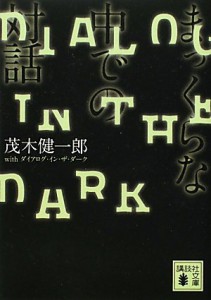
Most of the people who come for counseling have had to let go of something they used to have. A relationship ended, an illness came, a job was lost, a spouse died. What was lost varies, but a great many people suffer because they cannot forget it.
And in that sense of loss, the Dialogue experience is loss itself. You go into complete darkness and the world you could see is entirely gone — the loss of sight.
Almost every visitor, going in for the first time, is afraid of real darkness. Only at first, though. Within about ten minutes, nearly everyone gives up on trying to see — fine, I can’t see, and that’s that. It is a kind of letting the matter drop. And by doing so, the hearing and the sense of smell that had been half closed begin, gradually, to sharpen.
From the moment a person accepts the situation they are in, they can begin to move again.
(My translation from the Japanese.)
Shinsuke Shimura, who runs Dialogue in the Dark in Japan, spoke with us that day, and everything he said carried real feeling. I wanted to come back when I had the time and do the full version. So on April 26, 2015, having finished the trip around the world, I asked some friends along and went back.

As luck would have it, Shimura’s book Yami kara Sekai ga Kawaru (The World Changes from the Dark: The Challenge of Dialogue in the Dark Japan) had just come out. I had decided I would buy his book whenever it appeared, and since there was no Kindle edition at the time, I picked up a copy right after getting back to Japan, on April 15, and finished it quickly.
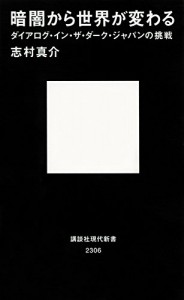
Twenty years of getting Dialogue in the Dark onto its feet. The difficulty of establishing a permanent venue. Setting prices. He writes honestly about what it takes to build something, and I liked that.
How a person changes when sight is gone. What shifts when you go into the dark and, unable to see, start using the other senses. Whether a disability is seen as a disability or as a characteristic. He writes about what the dark makes it possible to learn, and his character comes through.
This time it ran about seventy minutes, from 11:50 in the morning to one o’clock. Five of us, myself included, went in with a blind attendant, letting our eyes adjust as we went. A room that smelled of wood; tatami and grass underfoot; and at the end, a café. Tea and something sweet in the dark, and the conversation among the five of us went somewhere.
What I found strange was that it had nowhere near the impact of the first time, and there was no fear. I thought about why.
The trip had covered twenty-five countries and fifty-five cities. Take away the four countries and six cities where English gets you through — the United States, Britain, Malaysia, the Philippines — and that leaves twenty-one countries and forty-nine cities where the first language is something else.
The signs in most of them carries no English and no Japanese, so sight was not something to rely on. In Europe that meant communicating by ear, in English; in South America, where English does not get you far, it meant the body.
And the Rolfing training, where I learned how much it matters to keep space — ma — between yourself and another person, gave me reason to think about how flexibly communication can be handled.

It was because of all that, I think, that I could go into the dark and communicate through the senses rather than through sight. Which suggests that traveling is not an experience of the eyes but one that calls on everything you have.
There will be other places to go. I want to keep taking them in through more than sight.
Note, September 2026
This piece records, as experience, what happens when sight stops being available.
What came first in the dark was fear. Then, in the simple business of passing a ball and walking hand in hand over uneven ground, hearing and a sense of distance came into use. Calling out, holding on, gauging the space between people. What sight had been doing got taken up by the rest.
Eleven years later I would receive the same thing as theory.
Rolfing looks at three things behind posture: vision, the vestibular sense, and the kinesthetic sense. When vision stops doing its job, the body recruits the other two to cover what is missing. That is what was happening in the dark.
And of those three, vision is the only one that gets learned — as Rita Geirola put it in a Rolf Movement training. How you look is something acquired, and anything acquired can be changed. The dark, then, is a place where the learned one is temporarily taken away.
Session 7: The Neck and Shoulders — Waking the Vestibular Sense
There is something else. The passage quoted in this piece already contains what would become the central subject eleven years later.
Within about ten minutes, nearly everyone gives up on trying to see. And by doing so, the hearing and the sense of smell that had been half closed begin to sharpen.
The senses do not sharpen as a result of effort. They sharpen when effort stops. It belongs neither to the one doing nor to the one being done to.
What happens in a Rolfing session has the same shape. Breathing deepens under the hands. Conditions get right and a muscle starts moving on its own. What the Rolfer does is not to produce change but to hold the space in which change can occur.
The “Neutral” Way of Being—Neither Passive Nor Active: Reflections on The World of the Middle Voice and Rolfing Sessions
In the dark, led by a blind attendant, you give up on seeing. Those seventy minutes were practice for that, I think.
One note on the figures. The twenty-five countries and fifty-five cities in the text are as of April 2015, when this was written. Sri Lanka came afterward, bringing the final count to twenty-six countries and sixty-five cities.