

Introduction
I have been reading the books of Yūji Ikegaya, a professor in the Faculty of Pharmaceutical Sciences at the University of Tokyo, since the days when he was still an assistant there. His latest, Nō wa Yume o Kanaeru Tame ni Aru (in Japanese) — roughly, The Brain Is There So That Dreams Can Come True: “The Phenomenon of Me,” Talking Through the Brain with High-School Students — came out on 28 March 2024. It is an ambitious book that goes at how the brain works while setting it against the artificial intelligence everyone is talking about, and I enjoyed it.


He has given three sets of lectures to high-school students in the past, and they were published as Shinka Shisugita Nō (in Japanese), on how far the brain has evolved, and Tanjun na Nō, Fukuzatsu na Watashi (in Japanese), on the simple brain and the complicated self. This is the third. All three are worth a look if you read Japanese.
There was something in the new book about the bodily movement that learning to see requires, and I want to pass it on here. In the second half I turn to how observation is trained in Rolfing, which seemed to me to resemble it.
What Is Seeing? — What Restored Sight Reveals
When we think about anything, we tend to be bound by past experience and memory. Ikegaya uses the photograph of a road below to make the point.

Anyone with sight reads this as a road running off into the distance, with themselves in the middle of it. But what happens when someone who has been blind looks at it?
People who have been blind and then have sight restored by surgery do not see depth. Standing in the middle of a road running straight ahead for the first time, they are astonished at the fact that distant things look small. Which is to say, they cannot tell it apart from a flat triangle.
What Is Seeing? — A World Reassembled by the Brain
The world is three-dimensional, but the retina, which handles visual information, is two-dimensional. Position on the retina, height, depth and a great deal else arrives there together, and unless all of it is read out, no solid three-dimensional thing can be felt. The eye performs that precise reverse calculation all at once, and reassembles it into what we call seeing.
In other words, from a young age we do a long, patient training in reverse-calculating a solid appearance from what lands on the retina. Only with that behind us does visual depth become possible. Which also means that we mistake the world produced by that calculation for reality, and our cognition carries a bias.
Here Ikegaya describes an interesting experiment. From just after birth, a monkey’s head is held so that it cannot move. Food, water and juice are given, and it is raised that way. It grows up with nothing wrong with its body, but it has never moved. When it reaches adulthood and the restraint is removed and it is let into a room, what happens?
The monkey cannot see. The retina, the lens, the neural activity — none of it is impaired. In the end, it is movement of the body that makes seeing.
What Is Seeing? — It Comes from the Experience of Moving
Take a pen. Bring it close to your face and it looks large; move it away and it looks small. The same pen, and yet what falls on the retina changes size with distance. Reading complicated visual information of that kind cannot be done without the experience of moving hands and feet, of travelling through space.
To have any real sense of depth or solidity, then, one needs the experience of moving through space. Seeing is determined by the memory one has built up through one’s own experience. What comes in through the retina is actively read out against that memory, and only through that process does one see. The link between how I moved and how the appearance shifted is what matters.
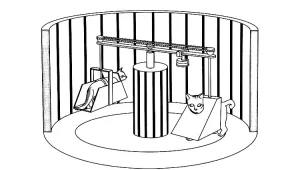
There is a second experiment worth knowing: the kitten carousel. A vertical post has horizontal arms reaching out to either side, with a kitten attached to each. One has its feet on the floor; the other sits in a basket.
As with the monkey, both are raised this way from an early age. The one on the floor can move under its own power; the other cannot. And the result? The kitten that stayed in the basket does not come to see, while the one that walked about sees perfectly well.
What the experiment says is that unless you move about yourself, you cannot see.
As for whether the monkey, once released, might come to see later by moving about on its own — apparently it largely does not. There is a sensitive period: unless visual experience comes during a certain window in development, sight never arrives.
Observation in the Rolfing Training
What Dr Ida Rolf, who founded Rolfing, placed at the centre of the basic training in the hands-on work was the capacity to observe.
From August 2014 to March 2015 I stayed in Munich for the basic Rolfing training. The training itself came to eighty-four days and seven hundred and thirty-one hours.
In a word, the Rolfing training is about how to sharpen the capacity to observe.
Fully half of it goes to the question of how to observe a body.
When Ida Rolf began teaching the basic training, she divided the curriculum into two stages: Auditing, the stage of the observer, of perceiving; and Practitioner, the stage of working with hands.
Auditing is the stage where one is taught how to observe. The weight falls on observing bodies. No hands-on work at all. One watches practitioners, over and over again.
And it continues until the capacity Rolfing asks for — what to observe — has been acquired. The method is called the Saturation Method, saturation in the sense of information reaching a point of saturation.
Information is fed in until the eye becomes an eye that can observe, until an eye for the body has been grown.
The approach lives on in the present Rolfing curriculum, and the amount of time given to observing other practitioners is one of the things that marks the training out.
The Eye Is Grown by Looking, Again and Again
What is interesting is that one day, quite suddenly, the body becomes visible.
It happened to me during the training, without my noticing, without my meaning it.
How does the necessary eye arrive? Let me give one example.
Look at the picture above and all you can observe is an arrangement of shapes. But what if you were asked whether you could find a giraffe in it?
Though not a single line has been added, a giraffe rises out of it. What changed is that you now held the right concept, the right meaning — giraffe — and so you could observe a giraffe.
Coming to observe a body perceptually, in Rolfing, resembles that process. In the practice sessions I run, so that people can taste it for themselves, I ask them to set the textbook aside and go into the session without it.
What grows out of that is a mind willing to accept a way of seeing it did not expect.
Conclusion
This piece has been mainly about seeing as something acquired by moving the body, and then about the observation I was taught in the basic Rolfing training.
In Rolfing we tie seeing to the body in order to bring posture into order, but we do it from the angle of how to make someone aware of a capacity they already have.
Note, September 2026
Reading it back, there are two kinds of seeing in this piece.
What Ikegaya’s experiments show, in the first half, is that without movement sight does not arrive. The monkey raised with its head held still, the kitten carried in the basket — nothing whatever wrong with their eyes, and they cannot see. The experience of having moved oneself is what makes seeing.
The second half is about something else. The moment you hold the concept of a giraffe, a giraffe rises out of an arrangement of shapes with no line added. There it is not movement but the concept one holds that settles what can be seen.
When I wrote this I put the two side by side because they seemed to me to resemble each other. Now I would say they resemble each other without being the same. Coming to see by moving, and coming to see by holding a concept, work by different means.
The second half was first written in February 2015, in “Phase III (6) — Seeing and Perceiving (1): Seeing Begins with a Concept.” The giraffe, Auditing, the Saturation Method — all of it is there first. This piece was a shorter restatement of it.
That piece has a long note of its own, added in August 2026, on where Auditing came from and what became of it: that Ida Rolf had no system for teaching how to see a body, that the gap left by this eventually led to Jeff Maitland’s work, and that in 2025, in the advanced training, it came back as a procedure for observation. Eleven years of one subject moving. Anyone interested should read that one.
What stays with this piece is the first half.
That moving and seeing cannot be pulled apart maps directly onto what Rolfing and Rolf Movement work with. When the way a body moves changes in a session, people sometimes say that things look different afterwards. Their eyesight has not improved. They have begun moving differently, and a different way of seeing has come up with it.
When I wrote this, it was set down as something surprising I had taken from Ikegaya’s book. I now read it as a description of what I do in sessions every day.