Introduction
Since June 2015, I have offered Rolfing sessions. Approaching the fascia brings the posture into order, and the movement of the body improves along with it. This time, I would like to introduce another Rolfing testimonial — a Rolf Movement one.
What Is Rolf Movement?
Ida Rolf, who founded Rolfing, called the fascia the organ that maintains the shape of the body — the Organ of Structure. The shape of the body is the history of the life that person has walked, and all sorts of experience is inscribed in it. In Rolfing’s hands-on work, when enough pressure is applied for the fascia to find a place where it can move, the shape of the body changes. As the shape changes, the movement of the body changes with it.
In the ten Rolfing sessions, improvement in posture and in the movement of the body can be expected, by way of the fascia. There is, in fact, another kind of session. To settle the effect of Rolfing, there are the three-to-five sessions of Rolf Movement, which center on how the body moves.
It is a session that brings bodily movement into the “Rolf” of the founder, Ida Rolf. It has been offered since 2020, suited to people who want to raise their performance through the body — yoga, Pilates, dancers, singers, instrumentalists, breath, and so on. What is interesting is that by drawing on all the muscles and going slowly, carefully, putting things into words, a large change takes place in the body.
What I pay attention to is not having the client memorize a movement, but turning their awareness toward the body. Most people move the body from the head, and tend to react to things quickly. Probably a society that prizes speed, efficiency, and thinking with the head has made it that way.
What happens the other way round — slowly, letting go of the movement you have used until now, going carefully? What comes into view is where, inside your own body, you are tense and hard to move. The habits of movement picked up in the past — old habits — are let go, and a new option appears in the body’s awareness. You could say that, as a result, a new habit of movement takes hold.
Experiencing a Session — Sachiko Aimoto — Improving the Movement of the Pelvis
This time, Sachiko Aimoto, a freelance announcer, tried Rolf Movement centered on the movement of the pelvis. The pelvis has three parts — the ischium, the ilium, and the pubis — and it sits next to the coccyx, at the end of the spine. It may come as a surprise, but moving each of them independently is difficult.
Conversely, when the ischium, the pubis, and the coccyx are treated as three separate things and the movement of each is brought into awareness, then even in sitting the breath reaches the pelvic floor more easily, the range of the shoulders widens, and low-back pain eases. And for someone whose shoulders and chest will not let go, doing an exercise at the end that releases the pelvic floor lengthens the spine, and the holding quietly goes.
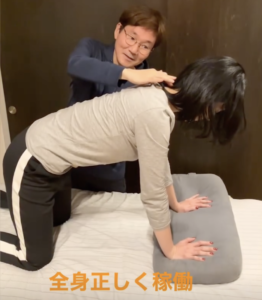
We started by bringing awareness to the movement of the ischium, the coccyx, and the pubis. Lying on her back with one knee up, attending to the sole of the foot, she lowered the knee slowly, keeping the ischium, the coccyx, and the pubis in mind as three things that move independently.
After that, exhaling slowly (letting go through the out-breath), we worked with
1) drawing the two sitting bones toward each other
2) drawing the two iliac bones at the back toward each other
3) lifting the coccyx
each held in awareness.
Then we did the pose called Cat and Cow, as an exercise for feeling the connection between the spine and the pelvis.
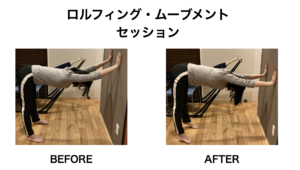
BEFORE is prior to the pelvic work. The range of the pelvis is somewhat stiff and the awareness of the pelvic floor is weak, which affects the back, so the shoulder, elbow, and hand appear to ride upward.
AFTER is once all the pelvic work is done. The range of the pelvis has widened and the awareness of the pelvic floor has grown, which affects the back, so the shoulder, elbow, and hand can be seen running in a straight line with it.
- Nothing was touched at my back or shoulders, and yet they became easier!
- I came to feel the connection through my low back, my shoulders, and my legs!
Those were among the impressions she gave.
Conclusion
This time I have introduced a testimonial, and let it carry most of the piece.