
Introduction
Since June 2015, I have offered Rolfing sessions. Approaching the fascia brings the posture into order, and the movement of the body improves along with it. This time, I would like to introduce a testimonial from a first Rolfing session.
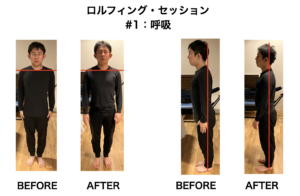
The First Session Works with the Breath
The very first Rolfing session is given over to the breath. As the Japanese expressions for getting along with someone — matching the breath, breathing together — suggest, once a client can bring awareness to their breathing, the relationship with the practitioner becomes easier to build.
That is because only when you can be aware of your own breath can the two of you bring your breathing into step and build a relationship from there.
And for the human body, breathing is the movement that teaches bodily sensation. We breathe more than twenty thousand times a day, so if the muscles are slow anywhere, it reaches the whole body. The other way round, when the breath comes in, the whole body moves more easily and the posture settles more easily too.
I have written about this in more detail in “Session 1: Working with the Breath — Why Rolfing Begins Here,” so do have a look.
What Happens in the Session — The Diaphragm and the Pelvic Floor
Session 1 aims at releasing the fascia involved in breathing, working through the tension in the superficial muscles around the bones of the upper body — the collarbones, the ribs, and around the sternum. In people who do desk work these are rigid with tension, and the pain is strong. When that tension comes out, the neck lengthens, the range of the head and upper body widens, and at the same time the diaphragm becomes something you can feel.
Next, to widen the range between the pelvis and the upper body — the rib cage, to be precise — I work mainly with the muscle that lies between the pelvis and the ribs, the quadratus lumborum, opening the space between the upper body and the pelvis. Once that widens, the pelvic floor begins to move, and it comes to feel as though the breath reaches all the way down to it.
What Changed Between BEFORE and AFTER
In the session with Tasuku Suzuki, a pharmacist, once the diaphragm and the pelvic floor came into balance — and to my own surprise — the neck and upper body lengthened and the posture shifted toward a spine standing straight. The difference between before the session (BEFORE) and after it (AFTER) should be clear in the photograph below.
At the end, Tasuku said that his breathing had become easier and his posture had settled.
Conclusion
This time I have introduced Tasuku’s testimonial, and let it carry most of the piece.