
Introduction
Since June 2015, I have offered Rolfing sessions. Approaching the fascia brings the posture into order, and the movement of the body improves along with it. This time, I would like to introduce another Rolfing testimonial.
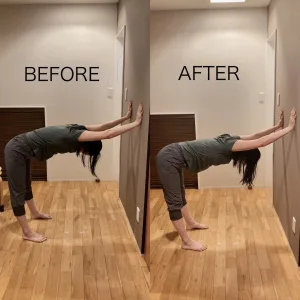
The person who took part this time is Sachiko Aimoto, a freelance announcer. Before she came, she had caught a cold, and as a result the balance between her left and right shoulders had been lost and her breathing had become shallow. Ordinarily a cold tends to adjust the body and bring it into order, but there are cases like this one; when that happens, I put the breath first and look for anything else that may be involved.
A Session for the Stomach and the Breath
Using IMAC, which the Rolfer Hiroki Sato developed, I checked which meridians — the eight extraordinary vessels and the twelve primary meridians — were slow in East Asian terms, and the stomach meridian turned out to be where the trouble was. We began by working with the stomach meridian and with the position of the stomach itself. When I asked Sachiko whether anything was wrong with her stomach, it turned out that the cold had left her digestion poor.
After that, centering on the breath, which is what the first Rolfing session works with, I took an approach that opens the fascia of the breathing muscles — the diaphragm and the intercostals. In the end:
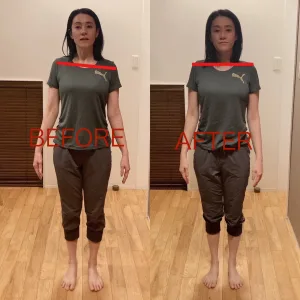
The balance of the shoulders, which from Sachiko’s side had been higher on the right and lower on the left, came level.
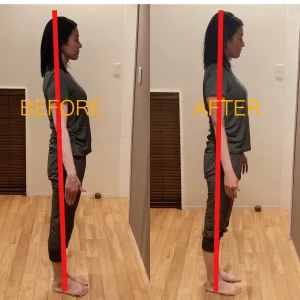
The posture, whose weight had been back on the heels, changed to one where the weight comes forward and both the toes and the heels can be felt.
What the Weight in the Foot Means — Bringing Sight and Hearing into Balance
In fact, once the toes and the heels can be felt, how a person uses sight and hearing also becomes clearer as a bodily sense. Using the eyes tends to bring the weight toward the toes; using the ears tends to bring it back onto the heels.

You can see why by looking at where the eyes and the ears sit in the face. The eyes are at the front; the ears, compared with the eyes, are further back — and the body follows. The other way round,
once you can tell which you are using more, the toes or the heels, you come to use all five senses in balance.
In Sachiko’s case, hearing was strongly in use and sight was weak, which would explain the posture she came in with. In her own words, her work as an announcer means reading copy and listening to what is said around her, so hearing is in use a great deal and sight rarely gets her attention. Peripheral vision and taking in what is around her would improve it, and I suggested as much.
Conclusion
This time I have introduced Sachiko’s testimonial, and let it carry most of the piece.