
Introduction
Since June 2015, I have offered Rolfing sessions. Approaching the fascia brings the posture into order, and the movement of the body improves along with it. This time, I would like to introduce a testimonial from a third Rolfing session.
The Third Session Works with Front-Back Balance — A Shift in How Space Is Read
The first session brought the breath, and the upper body, into order. The second worked with the soles of the feet, the lower body. In the third, those two dimensions — upper and lower — open out further, and the session turns its attention to three: front and back, and space.
That leads to taking the body up again as something three-dimensional, and it brings a large change (for more, see “Session 3: Organizing Front-Back Balance — From a Plane to a Volume“).
People treat the space that opens as they extend their hands and feet as their own — personal space. Why does holding that space matter? Because out in the world, unless you have some grasp of how your brain is moving through space, you cannot respond to what you did not expect: a car or a bus coming at you, someone stepping in close.
Further, once personal space can be held in three dimensions, space can be read more deeply; relationships begin to change, and how much distance to keep — from other people, from the space itself — becomes clear.
The other way round, when that sense is weak, perhaps because you do not know where you stand, or where other people stand,
behavior that sits outside the social also becomes more likely.
Front-Back Balance — Where Do You Work?
To bring the front-back balance into order, the third Rolfing session attends to three places: the shoulders and arms, the spine, and the thighs.
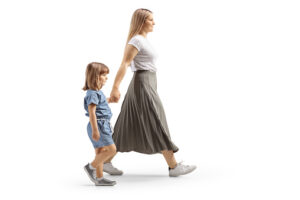
The shoulders and the arms both sit on the side of the body, which is the border of the front-back balance, and they carry an important part in bringing that balance into order.
When you walk, for instance, the arms swing; this is how the body keeps the front-back balance from becoming unsteady mid-stride.
Further, the spine makes its curves — cervical, thoracic, lumbar, and the sacrum — and in many cases those curves have been pulled out of shape by tension in the fascia.
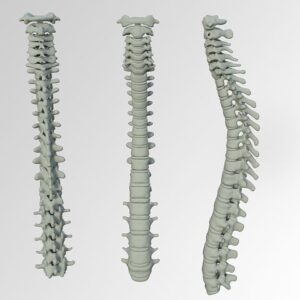
To bring the front-back balance into order is also to bring the curves into order. And that, in turn, eases low-back pain.
What Changed Between BEFORE and AFTER
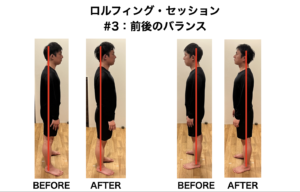
In the session with Tasuku Suzuki, a pharmacist, I worked with the fascia around the shoulders and arms, the spine, and the pelvis, keeping the connection between the upper and lower body in view. Once the front-back balance settled, what had been a slightly rounded back before the session (BEFORE) became, afterwards (AFTER), a spine that lengthened and a chest that was open without being forced — as the photograph below shows.
This time Tasuku said that, compared with the first two sessions, he did not feel as much change; what he did notice was that the sensation in his feet was strong, and that he felt his feet sweating more. My own guess is that, where front-back balance is concerned, his posture was not as far out as it had been up and down.
Afterwards, he shared the impression that it felt as if he had grown taller.
Conclusion
This time I have introduced Tasuku’s testimonial, and let it carry most of the piece.