
Part 1 of Jonathan Martine’s workshop (hereafter Jon) reached its final day.
I have written about this workshop five times so far in this column.
- 1: The Nervous System and Rolfing
2: Pain and Approaching Through the Nerves
3: Teaching and Noticing
4: Coaching and Global Listening
5: Learning a Simpler Approach
The workshop is divided into Part 1 and Part 2, six days each. Today brings Part 1 to a close.

The subject was the nervous system of the upper and lower body. This time there was also a chance to learn how to work with the viscera; Part 1 alone held a great deal, and the material looks like something I can bring into the ten series ahead.
Part 1 ended with work centered on the midline — from the pelvis, around the bladder, through the abdominals, ribs, and clavicle to the region of the neck (trapezius, sternocleidomastoid, hyoid). Although the work was on the midline, it had a good effect on the pelvis and the feet as well, and I could feel the whole body ease.
Eighteen months since I was certified as a Rolfer through the training in Munich. This is the first Rolfing workshop I have taken in Japan, and the first with an American teacher.

In the European training, and in Phase II especially, the instructors took great care that everyone had an equal chance to speak. During practice they came around without your having to call them over, so you could simply concentrate on your own learning.
The training in Japan went through an interpreter, which made the pace slower than usual — and that turned out to suit me, in a different way. Generous time was given to questions and to practice, which was also good.
Jon took his time answering any question put to him. During practice he circulated through the room, and when asked, he explained with a smile and with great clarity how to locate each muscle and nerve, so that whatever had been unclear became clear on the spot.

Because I could learn from the anatomical fundamentals, I could come to class with a clear sense of purpose about what I was attending to. The images he showed on slides, drawn from a range of anatomy textbooks — some quoted from German, French, and English sources — were valuable. Having an interpreter also meant I did not have to go looking up the Japanese terminology, which was excellent.
Thinking back, when I studied in Munich I recorded Phase II and Phase III on a video camera. There was so much material in Phase II that I was frantic just to acquire the techniques, and my head felt close to bursting.
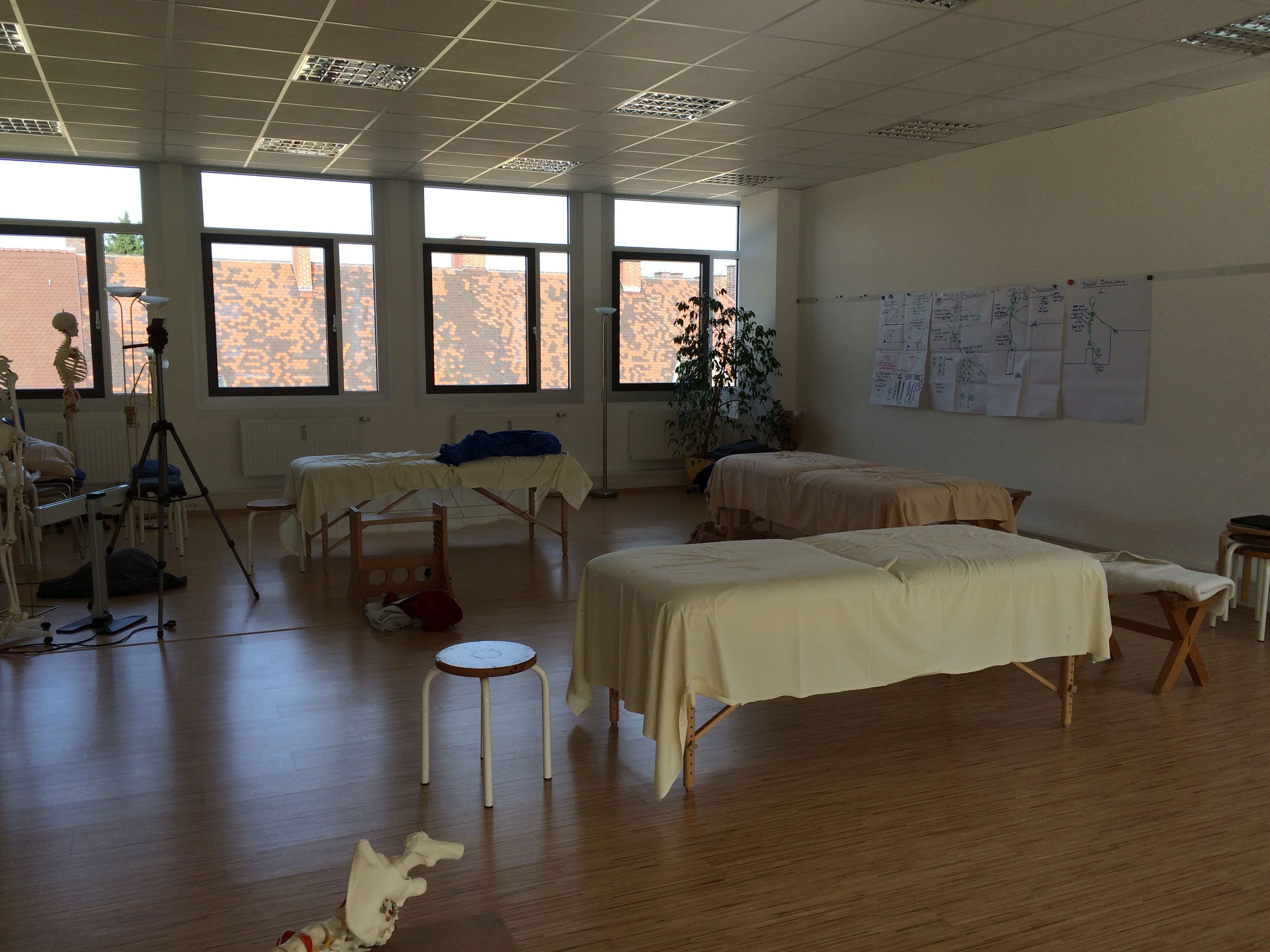
A year on, I think my experience has deepened. My sense is that on top of what the certification training teaches, I have learned that there are several methods.
As I have written here, I have been bringing what I learned into my clients’ sessions, and I am genuinely looking forward to seeing how the ten series unfolds from here.
Part 2 starts tomorrow, with twenty-two participants expected (Part 1 had fifteen). New people to meet, among other things — I intend to enjoy the remaining six days.
Note, August 2026
There are two remarks about recording in this article. When I studied in Munich, I recorded Phase II and Phase III on a video camera; there was so much material that I was frantic just to acquire the techniques, and my head felt close to bursting. And of this workshop, I wrote in another post that someone was recording all of it, which let me concentrate more fully on the class.
The same recordings, with their roles reversed. In Munich it was a record for supplying afterward what I could not take in at the time. Here it becomes a matter of someone else handling the record so that I can be present.
And in fact, I never went back to it.
From then on, at workshops I might record, but going back to review became something I did only under exceptional circumstances. I have never once reviewed the video from the 2025 Advanced Training. Twenty-four days of material.
At the time, I imagine I put it down to having more capacity. Now a different reason is visible.
Technique can be reconstructed from a record. Hand position, direction of pressure, sequence — all of it stays on the video. What cannot be reconstructed is the state I was in while I was there. What I felt and how, where my attention rested, what I was waiting for. None of that is on the recording.
What I learned most from the 2025 training was a way of being as a bodyworker. The three requirements of Neutral, the distinction between Intention and Intentionality, Kind Indifference, Right Action. Each can be written down as words, but none is acquired by rereading words. It was the kind of thing that only passes to you by being present for it.
I stopped reviewing, I think, because the weight of what I was receiving shifted toward what a record cannot hold.
This article also contains a comparison of how one is taught. In the European training the instructors took great care that everyone had an equal chance to speak, and during practice they came around without being called. In Japan the interpreter slowed the pace, and long stretches were given to questions and practice. Both are written up as good.
Writing about the slow pace as an advantage says something about where I stood at that point. In Munich, keeping up with the speed was the problem. Here, slowness became room for understanding. A year has passed and my experience has deepened, as I put it myself.
And within that year and a half, the need to review the recordings had disappeared. Not that I could learn more, but that I had become able to receive it on the spot.