Organizing the Body Through Daily Habits — Part 1 of 3
This is the first of three pieces in the series Organizing the Body Through Daily Habits. The series answers a question I am often asked in Rolfing sessions: what can be done in ordinary daily life? Part 1 takes up the clock inside the body. This series began as seven pieces written over the summer of 2023, brought together into three in 2026. Sleep, water, the timing of meals, salt, sunlight, focus, body fat. I had written them by subject, one at a time — and reading them again, the same material keeps coming back. Cold showers appear four times, dopamine and noradrenaline three times, the circadian clock four times.
In bringing them together, I cut the overlap and used the space to set out where the claims come from and how well they have been tested. Seven pieces became three, so each one runs longer.
The right diet, the right posture
Since June 2015, I have offered Rolfing sessions in the Shibuya, Ebisu, and Daikanyama area of Tokyo.
In sessions, I am often asked about daily habits. With food, the question usually arrives as: what should I be eating?
Before answering, let me take a detour.
Posture tends to get discussed in terms of correct posture, wrong posture, posture that strains the body. But how was “correct” decided? By other people, in fact. Parents, schoolteachers, colleagues and superiors at work, partners. And because it happens without our noticing, many people only become aware of it once they arrive for a session.
The same holds for food. What counts as appropriate gets chosen by the surroundings. Omnivore, macrobiotic, low-carb, paleo, Mediterranean, Japanese, vegetarian. Parents, schoolteachers, an admired instructor, the state, the culture — and “science.”
Unfortunately, it is not possible to run long-term dietary experiments on human beings. And switching away from a way of eating one is invested in is hard, because it is bound up with how one sees oneself.
Eat a balanced diet, we are told. But ask what “balanced” means for an athlete, for a pregnant woman, for a teenager, for a bodybuilder, for someone with diabetes, and the answer stops being one thing.
Food and posture are alike in this. In the end, you find what suits you, in your own way.
With that said, there is something to look at before what you eat. When you eat.
The body has a clock
The 2017 Nobel Prize in Physiology or Medicine went to the discovery of the genes behind the circadian clock.
We have a clock inside us, and digestion and absorption follow its rhythm. When that rhythm breaks down, it turns out to be closely bound up with a range of troubles.
Two things set this clock: light, and food.
Morning light sets the clock in the brain; the first meal sets the clock in the organs. With those two in place, the rest of the day tends to follow. Let me take them in that order.
Morning light
The single most important thing for improving sleep is to get sunlight immediately after waking. Ten to thirty minutes.
Sunlight here means letting light into the eyes, not just onto the skin. You do not need to look directly at the sun. A cloudy day looks like less light than a clear one, but compared with indoor lighting it is still far stronger. Getting it on a cloudy day matters.
In the retina there are cells carrying a photopigment called melanopsin, which receives blue light. They are called intrinsically photosensitive retinal ganglion cells, and their peak sensitivity sits around 480 nanometres, in the blue range. From there, information travels to the suprachiasmatic nucleus, the body’s central clock in the brain. In the end, the message “it is morning” reaches the whole body, and the body wakes.
Sunlight also brings out cortisol and serotonin. Cortisol tends to get discussed in relation to stress, but it matters for waking and for sharpening focus. Serotonin peaks during the day when you have had light, and seventeen hours later becomes the material for melatonin, which brings on sleep.
The sleep scientist Matthew Walker covers this ground in detail in Why We Sleep.
Evening light pushes the clock back
If morning light moves the clock forward, evening light pushes it back.
Avoiding blue light before bed and shifting the lighting toward red matters. Blue light is the signal for waking, so taking it in at night leads the body to mistake the hour and head toward waking.
Let me correct one thing I had written. I used to say that blue light breaks down melatonin. More precisely, it is not a breakdown but a suppression of its production. Evening light, even in small amounts, suppresses melatonin and pushes the clock back.
And the mechanism turns out to be more delicate than I had thought. Once the light stops, melatonin recovers fairly quickly — within about fifteen minutes. Meanwhile, red light at 631 nanometres, and light that flickers on and off, can also reset the clock. Responses have been reported at five to ten lux, with the eyes closed, during sleep.
A study of a hundred participants shows something more involved still. Over the first quarter of a light exposure, the cones drive the suppression of melatonin; over longer durations, melanopsin takes over. What we have been calling simply “blue light” changes hands as the exposure goes on.
More recently, it has been suggested that light between ten at night and four in the morning also affects mood.
Waiting a little for caffeine
Sunlight also reduces adenosine, the other molecule that brings on sleepiness.
Drink coffee or green tea immediately on waking and the clearance of adenosine does not proceed. And by the time the caffeine wears off during the day, adenosine has built up further, and sleepiness arrives. To avoid this, take caffeine an hour and a half to two hours after getting light, once adenosine has cleared somewhat —
This is the approach Andrew Huberman, the neuroscientist at Stanford, has made widely known. Wait ninety to a hundred and twenty minutes after waking.
Here the ground is less firm than it looks.
The reasoning holds together. Cortisol peaks shortly after waking, and caffeine works by blocking adenosine receptors. Why block a molecule that is not there yet?
But I could not find a well-designed randomised controlled trial testing this ninety-minute prescription directly. No human trial shows that delaying morning caffeine improves alertness, prevents an afternoon slump, or changes health outcomes. A plausible hypothesis wearing the costume of a tested protocol, as one account puts it.
Something else, though, is firmly supported: stopping caffeine by early afternoon. Its effects linger for many hours and reliably interfere with sleep.
If you try it and feel better, carry on. If going without the first cup is misery, there is no need.
When to eat
The other thing that sets the clock is food.
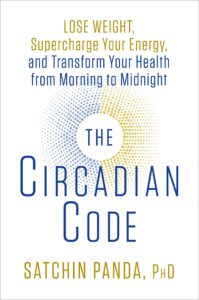
The gut begins its work with the first meal and heads toward rest twelve hours later. Satchin Panda’s The Circadian Code covers this. It does not run around the clock like a convenience store. Eat a mouthful late at night and the gut has to start up again, which affects digestion and sleep considerably.
Hence the approach of finishing all eating within a set window. TRE — time-restricted eating — also called intermittent fasting. You fix the span from the first thing you eat, water aside, to the last, and take no caloric food outside it.
I use an eight-hour window myself, starting between ten and eleven in the morning and finishing by six or seven in the evening. Holding to eight hours every day is hard in some circumstances — an event, dinner with friends. In those cases I allow up to twelve hours, once or twice a week.
One thing I keep to is not eating for the first hour after waking. Even finishing dinner at seven the previous evening, digestion and absorption take at least six hours. The effects of fasting come after that. During sleep, cells are repaired, learning is consolidated, waste is cleared from the brain, body fat is broken down. To extend that, I put off eating by at least an hour after waking.
At the other end, I want caloric food finished two to three hours before bed. After eating I walk for about thirty minutes. Light movement speeds the digestion and absorption of carbohydrate, which brings the fasted state on sooner. Growth hormone, involved in the repair of cells and tissue and in the breakdown of body fat, also comes more readily when eating finishes two to three hours before bed, with blood sugar not having dropped too far. The level declines with age, so this is welcome.
Finally, it is better to keep the eating window at a consistent time. Scatter it and the internal clock develops something like jet lag, taking days to a week to recover.
On TRE
Here too, the standing of the evidence is worth setting out.
An eight-hour window is often said to be the effective one. But in a trial following participants for twelve months, the group doing eight-hour TRE and the group doing calorie restriction alone showed no difference in weight loss. Body fat fell by a similar amount, and the authors concluded that the two regimens had similar success.
The meta-analyses vary as well. An analysis of 16/8 fasting and glucose and lipids found improvements in fasting glucose, insulin resistance, insulin, and HDL cholesterol — with the certainty of the evidence rated low. An analysis of thirteen trials in women with overweight and obesity found a reduction of about 1.9 kilograms in body weight and a fall in fasting insulin, with no significant effect on BMI, fat mass, visceral fat, blood lipids, glucose, or blood pressure.
There is also a criticism from a different angle.
Peter Attia, a physician specialising in longevity medicine, used to advocate fasting strongly, and has changed his position. For two reasons.
One is that sixteen hours without food is not long enough to activate autophagy or to inhibit chronic elevation of mTOR. It is very difficult to measure what is happening at the cellular level, he adds.
The other is protein. Compress eating into a narrow window and you are, as he puts it, virtually guaranteed to miss your protein intake. The scene he describes: the number on the scale goes down while body composition gets worse. Lean mass — muscle — is lost, and body fat stays the same or increases. However much he exercised during the fasting periods, he writes, he could not maintain lean mass.
He now treats time restriction as a tool used deliberately rather than a fixed daily practice. And he offers a rule of thumb for any way of eating: you must eat enough to maintain lean mass and long-term activity patterns.
What I wrote at the start comes back here. There is no single answer to what the right diet is. Attia himself says it should be built around individual metabolism, and designs it patient by patient.
If TRE means anything, it means a way of testing how eating in step with the body’s clock feels — not a rule to be obeyed.
Lowering temperature to sleep
One more thing bears on the clock: body temperature.
We reach our lowest body temperature about two hours before waking, rise from waking through the day, and fall gradually toward bedtime.
A warm shower or bath helps that fall along. It sounds backwards, but warming the body dilates the blood vessels, heat escapes more easily, and temperature comes down as a result.
Here the evidence is clear. A meta-analysis drawing on thirteen of seventeen studies found that bathing or showering at 40 to 42.5 degrees improved subjective sleep quality and sleep efficiency. And done one to two hours before bed, for as little as ten minutes, it significantly shortened the time to fall asleep — by around 36 percent, or about ten minutes earlier on average. Fifteen minutes before bed is too close to produce the same effect.
Room temperature between 18 and 22 degrees matters too. Under the covers, keep the palms, the soles of the feet, and the forehead outside. Heat escapes most readily from these places. With the room somewhat cool, body temperature comes down more easily.
Sleep is what makes posture stick
Why write about sleep in a piece about Rolfing?
Because the thing that makes the effects last — not widely known — is sleep.
Sleep consolidates what you have studied, helps the body learn movement, clears space for memory, regulates appetite appropriately. It also sharpens focus and raises the efficiency of work.
“Helping the body learn movement” matters most here. Posture that changed during a session does not settle on the spot. It settles through sleep.
That is part of why Rolfing sessions are spaced. Taking on a new habit in the body requires time to rest.
Conclusion
This piece has taken up light, food, and temperature, from the point of view of setting the body’s clock.
In the morning, get light into your eyes. Have coffee a while later. Keep eating to a consistent window. At night, dim the lights, warm yourself in the bath, and sleep.
None of this is unusual. But knowing that there is a clock inside the body changes what the same actions mean.
Next time, water and salt.
Organizing the Body Through Daily Habits (Three Parts)
- Part 1: The Body Has a Clock — Light and Food Set the Day (this article)
- Part 2: Water Does Not Stay Without Salt — On Taking Things In
- Part 3: Focus and Fat-Burning Both Start in the Nervous System — Using the Day
Note, September 2026
The pieces behind this one were written between late June and July of 2023. Sleep, sunlight, the timing of meals. I had set them out by subject, listing what could be done in daily life.
At the time, I took each to be a separate matter.
Two years later, on another site, I ended up writing about the frame itself: the four pillars of extending healthspan that the physician Peter Attia sets out in Outlive. (That piece is in Japanese only.)
The four pillars are exercise, sleep, nutrition, and emotional health.
Sleep and the timing of meals, which this piece takes up, are two of them. What I had laid out as subjects found their position inside a frame only afterward.
What I find interesting in Attia’s account is the separation of strategy from tactics. Being able to climb stairs unaided at eighty. Keeping the fitness to hike with a grandchild. You set the long-term goal first, and work backward to the daily means. Without a strategy, tactics scatter and lose their effect.
Everything in this piece belongs to the tactics side. Get light in the morning, wait for caffeine, keep eating to a window, bathe before bed. All of it is means, not end.
The TRE question touched on above I have also taken up from another angle — the autophagy and mTOR that Attia has in mind when he says sixteen hours is not long enough. (That piece, too, is in Japanese only.)
When a cell senses that fuel is short, an enzyme called AMPK switches on. The mTOR pathway, which drives growth, is suppressed, and autophagy — the breaking down and reuse of aged proteins and damaged structures — gets going. Fasting, calorie restriction, and exercise all connect to this same pathway.
Fixing a window for eating is also a way of giving the cells a stretch of time in which fuel is short. Whether sixteen hours is enough is exactly what is being argued over.
What to do on the side of the body, and how the mechanism works. This piece is about the first; the second is kept elsewhere.