
Introduction
My name is Hidefumi Otsuka, and I offer Rolfing® sessions based in Shibuya.
Through working with many different bodies on a daily basis, I support a state in which thinking, feeling, and bodily sensation (hara / tanden) naturally come together into a unified decision.
In everyday life, we may think about posture or how we use our bodies. However, we rarely ask the question:
Why did humans evolve to stand upright?
Yet, when we observe the body deeply, we begin to notice something.
The human body is not merely a collection of muscles and bones.
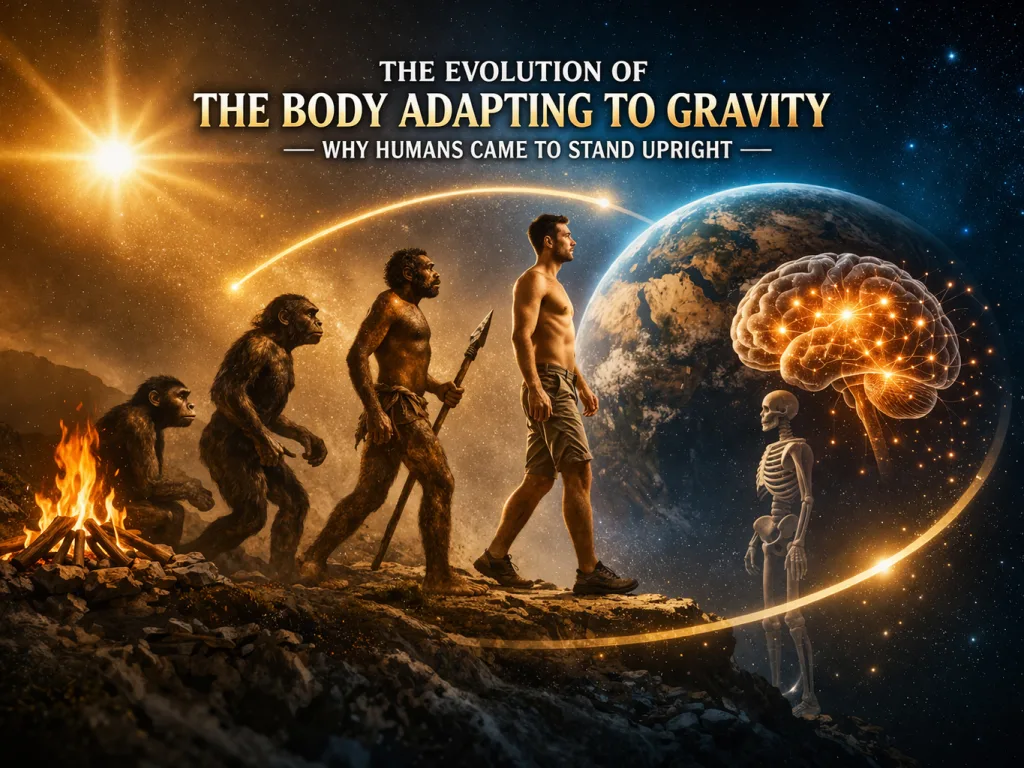
Within it are three layers:
- Brain (thought)
- Mind (emotion)
- Bodily sensation (hara / tanden)
These three layers are integrated within gravity, and through that integration, the human being comes into existence.
This structure, in fact, has been shaped over the long history of human evolution.
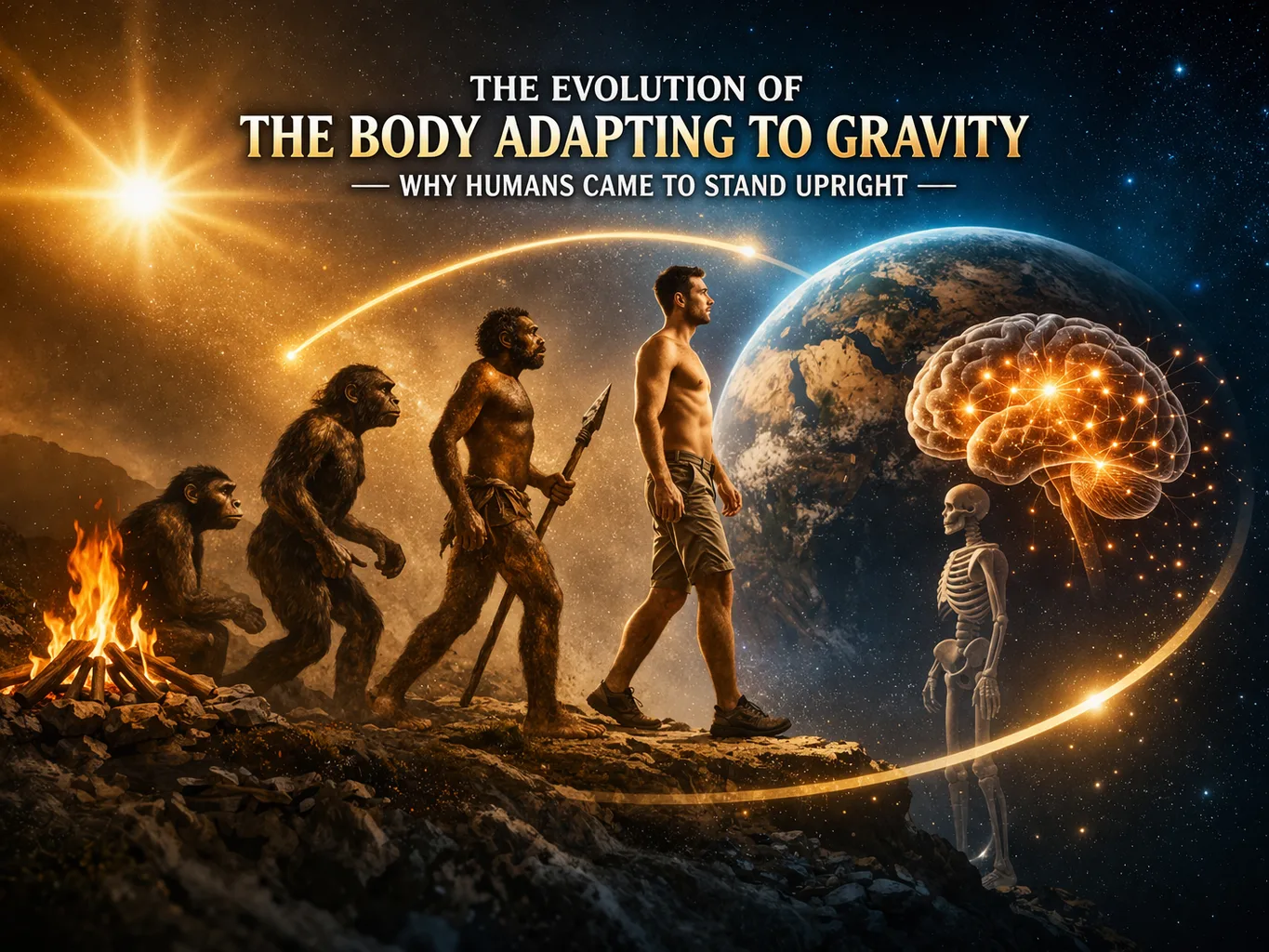
Today, I would like to explore why the body came to be designed to stand, through the following flow:
- Transition from arboreal to terrestrial life
- Emergence of bipedalism
- Appearance of Homo erectus
- Use of fire
- Expansion of the brain
- Changes in the gut
- Gravity and tonic function
The Human Body Was Originally a “Tree-Dwelling Body”
Human ancestors were originally primates living in trees.
They grasped branches, hung, and climbed—moving through space in three dimensions.
In such a body, the following were essential:
- Mobility of the shoulders
- Grasping ability of the hands
- Flexibility of the hip joints
However, several million years ago, environmental changes led our ancestors to gradually expand their habitat from forests to the savanna.
In other words, a major transition occurred—from arboreal life to terrestrial life.
This change was not merely a shift in locomotion.
It was a shift in the relationship with gravity.
In trees, the body is supported by branches.
On the ground, however, the body is constantly exposed to gravity.
From this point on, the human body began a long dialogue with gravity.
Bipedalism as a “New Relationship with Gravity”
Humans are the only primates that walk on two legs.
Compared to quadrupedal animals, bipedalism is:
- Unstable
- Prone to falling
- Difficult to balance
And yet, humans adopted this mode of movement.
Common explanations include:
- The ability to see farther
- Freeing the hands
- Efficiency in long-distance travel
- Better thermoregulation
However, from the perspective of body structure, something even more important is at play:
The organization of the body in relation to gravity.
When humans stand, they appear still, but in reality, they are constantly making subtle adjustments.
The body continuously balances:
- Feet
- Pelvis
- Spine
- Head
In other words, standing is not resisting gravity—it is continuously adapting within it.
Homo Erectus and the Emergence of the “Walking Body”
Around 1.9 million years ago, Homo erectus appeared.
This species had:
- Long legs
- A body structure similar to modern humans
- A body adapted for long-distance walking
In other words, the walking body was established.
Homo erectus spread out of Africa into Eurasia.
This was not only an evolution of the body, but also an expansion of the relationship with the world.
When the body changes, the world changes.
Around this time, the human brain also began to expand gradually.
The Use of Fire Changed the Body
One of the major turning points in human evolution was the use of fire.
With fire:
- Food could be heated
- Digestion became easier
- Energy efficiency increased
This is a crucial point.
Until then, humans digested food entirely within the body.
But with fire, part of the digestive process began to occur outside the body.
This shift had the potential to transform the very structure of the body.
Brain Expansion and Changes in the Gut
The modern human brain has a volume of approximately 1400cc.
However, the brain is an extremely energy-demanding organ.
Although it makes up only about 2% of body weight, it consumes around 20% of total energy.
To support this enormous energy demand, the body’s overall energy allocation is thought to have changed.
One hypothesis is the Expensive Tissue Hypothesis.
According to this idea:
- As the brain grew larger
- The burden on the digestive system decreased
In other words, there may have been a trade-off.
This means that not only the brain evolved.
The entire body was reorganized to support the brain.
Gravity Divided the Roles of Muscles — The Tonic Function Hypothesis
At this point, the relationship between gravity and muscles becomes important.
In our bodies, there are:
- Muscles that fatigue easily (phasic muscles)
- Muscles that can work for long periods without fatigue (tonic muscles)
This is not simply a difference in strength.
There is a division of roles:
- Muscles that generate movement
- Muscles that support posture
In Rolfing and movement education, Tonic Function refers to the foundation of postural support.
It is a function that emerges through the coordination of:
- Deep muscles
- Fascia
- Nervous system
It can be understood as a system that integrates the body within gravity.
If we try to support the body only with superficial muscles, fatigue occurs quickly.
However, when tonic function is active, the body can stand with minimal effort.
The Three-Layer Structure: Brain, Mind, and Bodily Sensation
Let us return to the three layers:
- Brain
- Mind
- Bodily sensation
Human existence arises from the overlap of these three layers.
1. Brain (Thought)
The brain is responsible for:
- Planning
- Memory
- Decision-making
Through evolution, the expansion of the brain enabled humans to create complex societies and cultures.
2. Mind (Emotion)
The mind creates:
- Emotions
- Empathy
- Relationships
Humans are not merely intellectual beings—they are emotional beings.
3. Bodily Sensation (Hara / Tanden)
The most ancient layer is bodily sensation.
This includes:
- Balance
- Center of gravity
- Sense of gravity
- Interoception (internal bodily sensation)
In other words, it is the layer directly connected to gravity.
The Body Is Integrated Within Gravity
In modern society, emphasis is often placed on:
- Thought (brain)
- Emotion (mind)
However, the body possesses a more fundamental intelligence.
That is, the sense of gravity.
We are constantly in relationship with gravity through:
- Standing
- Walking
- Breathing
Rolfing is not only a technique for organizing the body—it is also a process of reorganizing our relationship with gravity.
When the body comes into harmony with gravity:
- Thinking becomes quiet
- Emotions stabilize
- Bodily sensation returns to the center
In other words, brain, mind, and bodily sensation become integrated.
Conclusion: To Stand Is to Cooperate with Gravity
Humans:
- Descended from trees
- Walked on the الأرض
- Used fire
- Expanded the brain
- Evolved
At the center of all of this was the relationship with gravity.
To stand is not to resist gravity.
It is to cooperate with it.
And when this cooperation emerges:
- Brain (thought)
- Mind (emotion)
- Bodily sensation (hara)
naturally integrate.
What Rolfing aims for is not simply better posture.
It may be the recovery of the integrated body within gravity— a body that humanity acquired through evolution.