
Reading Eleven Years of Articles
In preparation for a major revision of this Rolfing website, scheduled to go live at the end of August 2026, I am now revisiting articles from eleven years ago.
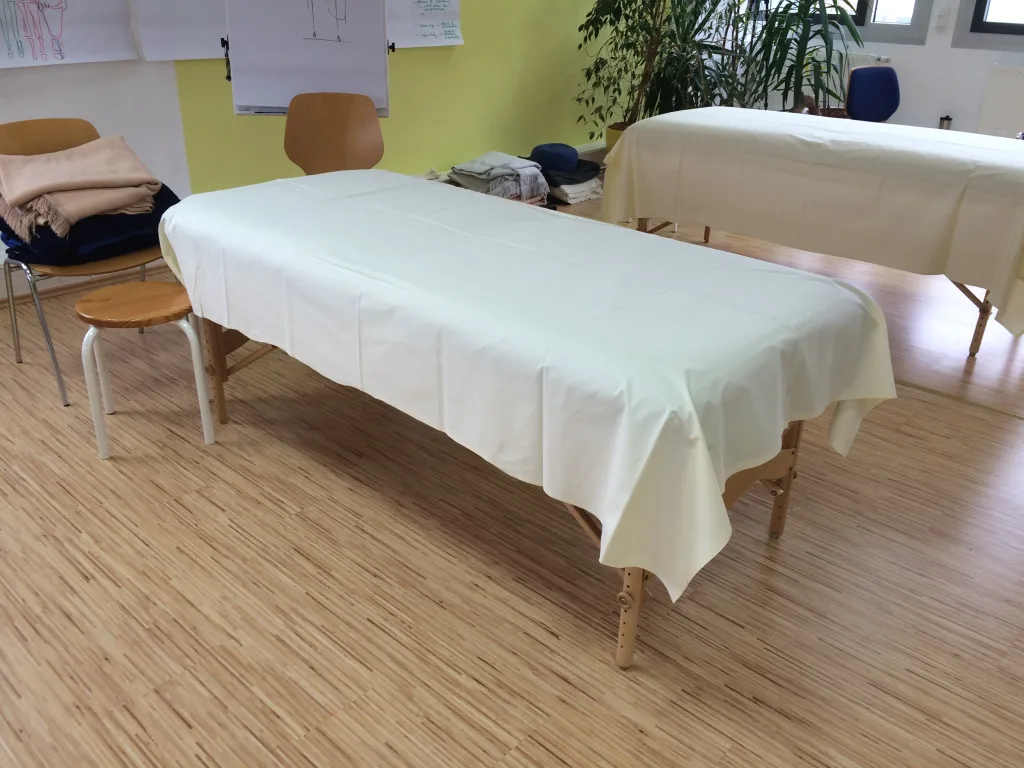
From August 2014 to March 2015, I took the Rolfing Basic Training in Munich, Germany. Phase I, Phase II, Phase III. Throughout that period, I kept a journal on this blog and on Facebook almost daily. What was said in class, what my hands could not yet reach, what happened in sessions with clients. No textbook as such was handed out in that training, so I wrote with the sense that I was making a textbook for myself.
I am now opening those posts one at a time. Correcting typographical errors, aligning terminology, adding notes on what has become clear when seen from 2026, and then translating each into English. The count has already passed one hundred.
What was that training, as an education?
The Three Cores of Education
At the center of education there are three things: mind, body, and knowledge.
How to be. How to move. What to know.
None of the three should be missing.
Yet looking back over Japanese schooling from elementary school through graduate school, the weight falls heavily on the side of knowledge. What can be measured by examination is concentrated in that one domain. What cannot be measured falls outside the scope of evaluation, and in time falls out of the curriculum as well.
During my years of research in graduate school, one premise had soaked into my body: what deserves trust is what can be quantified, and what cannot be quantified — anything sensory — does not. Occasions to question that premise itself were almost never given.
The Three Were Present in Japan’s Older Forms of Education
For the second half of 2026, I have taken medieval Japanese Buddhism as my annual reading theme. Reading Saichō’s collected works in order from the first volume, reaching toward the writings of Kūkai, I plan to travel to Shikoku before long.
The more I read, the more clearly one thing appears: the older forms of education in Japan held all three cores.
The course of study Saichō established on Mount Hiei rests on two practices, shikan-gō and shana-gō — sitting and observing, and carrying out the forms with the body. To these is added the reading of the sutras. Twelve years, without descending the mountain.
It is not designed as a place for acquiring knowledge but as a span of time for forming a person.
The terakoya schools that lasted until the end of the Edo period were the same. Sodoku means reading aloud. Tenarai means holding the brush and writing. Both are forms of learning that pass through the body, and the ability to read and write grows out of that repetition.
Tea, calligraphy, and incense share the same structure. There is temae, the bodily order of the procedure; there is the interval, ma, that runs between host and guest; and there are the layers of knowledge surrounding the utensils, the scripts, and the woods.
I attended Urasenke practice for three years, and what takes place in the practice room is not the memorizing of a procedure but the receiving of something through it. A gathering in the Shino-ryū style of incense works in the same way: the fragrance is not smelled but listened to. Without standing on the side of perception, that world does not open at all.
The Rolfing Basic Training Covered All Three
Looking back at the training of eleven years ago, all three were present in the curriculum.

That was the most interesting thing about those six months.
Mind. This is the domain of how a Rolfer holds himself.
What Jörg Ahrend-Löns repeated in Phase III was not precision of technique. At the stage of body reading, the information becomes too much, confusion sets in, and the Rolfer loses himself. A client suddenly reports pain, tasks multiply, panic follows.
The way out is to take a deep breath, settle down, and bring the body to the ground. The journal of the time records it as bringing the body to Neutral.
From Giovanni Felicioni, the instructor in Phase II, I learned about the interval. At the midterm interview, the strength named for me was giving space to the client — Hold the space.
What that instructor, a former stage actor, embodied was not a technique but a quality of being present.
Body. There is the procedure of the Ten Series, and the order of Sleeve, Core, and Integration. But the bodily side does not stop there.
In Phase III, each student takes on two clients and goes through six sessions in a single session day. Two instructor demonstrations, two of one’s own clients, two observed. Across ten rounds, that comes to sixty sessions seen. The hands move in twenty of them; the remaining forty are observation.
This structure has a source.
When Ida Rolf began teaching, the curriculum was divided into two stages: Auditing, the stage of observing, and Practitioner, the stage of hands-on work. In the Auditing stage, no hands-on work was done at all — only continued observation.
This way of supplying information until the eye for the body has been formed is called the Saturation Method.
Knowledge. The Tonic Function hypothesis, Polyvagal Theory, anatomy, Somatic Experiencing, phenomenology (Merleau-Ponty). The density of theory is high.
In Hubert Godard’s hypothesis, four elements are named as bearing on the working of the muscles that support posture: the structure of the body, the coordination of movement, the perception of the world, and the making of meaning.
Working on structure reaches the other three.
What Was Most Interesting Was the History of Painting
And the most unexpected, the most interesting, was the class on the history of painting.
The history of Western painting can be read as a record of how those who paint have perceived the world, and of how that perception changed.
From there, Giovanni moved on to the seeing of the body. The handling of the background in a painting connects to the way the linkage of the joints is seen in the body, and from there to the sensation of the soles of the feet. There was also a session on how the head and the face are seen.
Why was this so interesting?
At the time I could not say clearly. Now I can.
It was an education for training perception.
Among the materials in Phase III there is an image made only of assembled shapes. It looks like nothing but a pattern. Yet the moment the words “there is a giraffe in this” are spoken, without a single line being added, the giraffe rises into view.
What changed is not the image but the arrival of the right concept on this side of it.
Becoming able to observe a body follows the same course.

Around the time of my university entrance examinations, on my father’s recommendation, I read Peter Drucker’s The New Realities, whose closing chapter is titled “From Analysis to Perception.”
A physical phenomenon can be understood as the sum of its parts; a biological phenomenon has no parts, and everything is whole. Information itself is analytical, but meaning is a perceptual recognition.
When I read it around 1990, the sense of it escaped me.
Being shown the giraffe in a Munich classroom, it landed twenty-five years later.
There is almost no chance to receive an education in art in the general curriculum of a university. Yet that is precisely where mind, body, and knowledge work at the same time.
What Became Clear Eleven Years Later
In 2025, I took the Advanced Training in Tokyo. Under Ray McCall and Hiroyoshi Tahata, I was certified as an Advanced Rolfer.
What surprised me in rereading these early posts is that the journals of 2014 and 2015 already contain the original form of what would be taught in 2025.
Only, it has no name.
“Strangely enough,” “I cannot explain it well” — the phenomenon alone is recorded.
The phenomenon comes first, and the name comes afterward.
The work of revisiting and annotating more than a hundred articles from eleven years ago is also the work of retracing that order.
What I could not name at the time can be named now. And that some things become invisible the moment they receive a name is something I want to set down at the same time.
The road from the Basic Training to certification has been gathered into a single summary article. For anyone interested, I hope it will be read alongside this one.