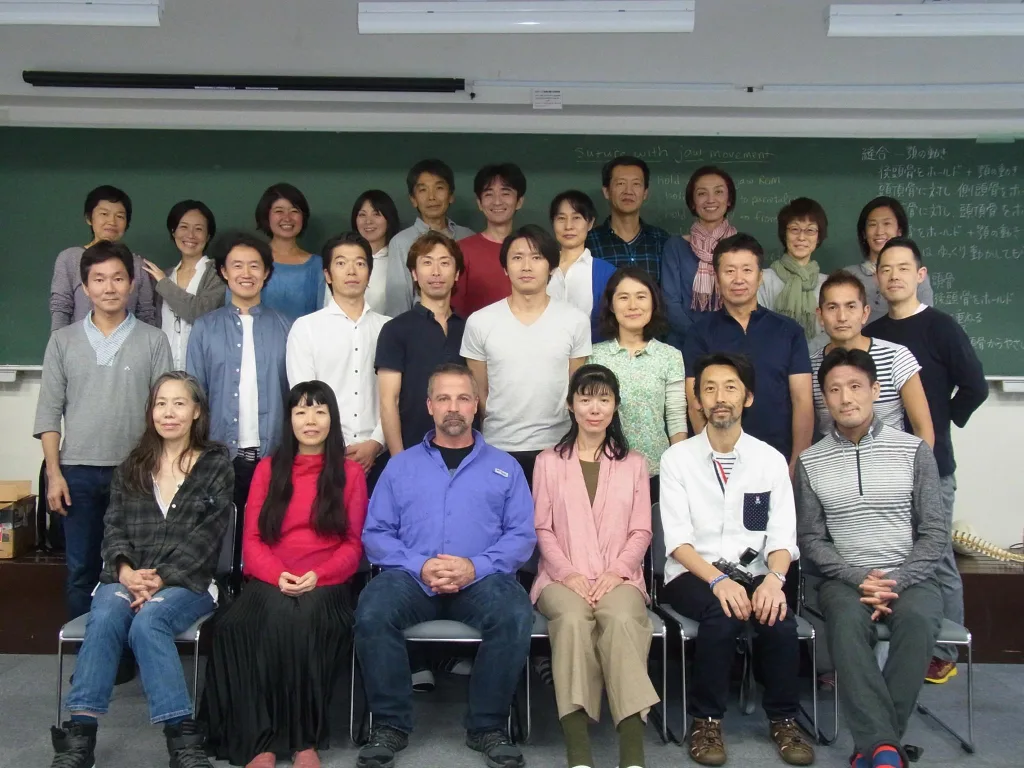
On Thursday, October 13, 2016, Jonathan Martine’s workshop on neural manipulation (hereafter Jon) came to a close.
I have written about this workshop seven times.
- 1: The Nervous System and Rolfing
2: Pain and Approaching Through the Nerves
3: Teaching and Noticing
4: Coaching and Global Listening
5: Learning a Simpler Approach
6: Scenes from the Training
7: Danger and Safety, and Redrawing the Map
The content was rich, but the work went deep enough that by the twelfth day I was fairly worn out physically. Even so, thanks to the twenty-two participants and to the excellent organization by the staff of the Japan Rolfing Association, I was able to give my attention to what there was to learn, and I am grateful for it.

A year of practicing the basic techniques I learned in Munich has given me a working framework for which part of the body to address in each of the ten sessions.
With that foundation in place, I think I was able to come to this workshop asking how to bring the material into the ten series.
Over the twelve days I gave close to twenty sessions. With people carrying pain, approaching the nerves through the surface layer of the skin (for the principle, see “Danger and Safety, and Redrawing the Map“) released the body to a certain degree without any work on the muscles at all.

In particular, weaving the neural approach into the psoas in session five, the sacrum, piriformis, and gluteals in session six, and the neck and shoulder girdle in session seven, has a noticeably greater effect.

As I continue with the ten series, I want to work with what I have learned here alongside the techniques from the certification training.
The thing Jon said during the workshop that stayed with me most was his answer to a question about who is doing the work.
Those who learned Rolfing in earlier days tended to offer sessions on the assumption that the practitioner held all the knowledge and could predict the changes. The work was something the Rolfer did.
Now, the practitioner is someone who offers awareness and assistance, nothing more — someone who helps the client change. The work is the client’s. Holding that understanding is what matters.
In Jon’s own words:
I am offering the possibility to have the client change the body and brain.
What the client believes is the key to a successful session, he said, and for that reason everything rests on whether they can feel safe while your hands are working. I have the sense that this workshop gave me something like a guideline for choosing among SourcePoint Therapy, Rolfing, IMAC, and the neural approach.
In November comes Sharon Wheeler’s Bone Work — Sharon having learned directly from Ida Rolf. It looks to be a dense five days, and I want to take it in fully before heading to the Supervision Workshop in Munich in December.
Note, August 2026
What stayed with me most across those twelve days, as recorded here, was not a technique. It was Jon’s answer to the question of who is doing the work.
Those who learned Rolfing in earlier days offered sessions on the assumption that the practitioner held all the knowledge and could predict the changes. The work was the Rolfer’s. Not so now: the practitioner offers awareness and assistance, and the work belongs to the client. That understanding is what matters, I was told.
The subject of the sentence has moved.
Two months later I would hear the same movement from Sharon Wheeler, as testimony from someone who studied with Ida directly. Sharon had learned the technique but feared she might overdo it and harm her clients; Ida told her that if you do the work, each part of the body knows for itself where its home is, so there is nothing to worry about.
The practitioner does not bring in the correct answer. Judgment is left with the body. Ida in the 1970s and Jon in 2016 are saying the same thing.
And nine years later, in the 2025 Advanced Training, it was handed over as a way of using the hands. Shape the Hand: rather than trying to do something with your hand, you let the client’s body shape it for you. Neutral was explained as placing yourself between the force that would make something happen and the waiting for it to happen. Kind Indifference: not caught up in the other person’s experience, and watching over it with deep interest all the same.
From hearing it as an idea to receiving it as a way of using the body took nine years.
Here what I wrote at the start of this series comes into play. Jon was Ray McCall’s student. That what I received from Ray in 2025 and what I received from Jon in 2016 point the same direction is no coincidence. I received it from the student before receiving it from the teacher.
At the time, though, I did not recognize it as a lineage. This article says the workshop gave me something like a guideline for choosing among SourcePoint Therapy, Rolfing, IMAC, and the neural approach. I took it as a matter of choosing a method.
What had actually been handed over was the premise underneath the choosing: who is doing this. Which method to use is the practitioner’s decision. But the one producing the change is the client. The two do not conflict.
At the end of this article, Sharon Wheeler’s Bone Work in November and the Supervision Workshop in Munich in December are waiting. In fact it went on well beyond that — Gael Rosewood the following March, the Rolf Movement training from July. The studying I chose for myself after certification starts here.
That what I received on the last of those twelve days was an account of what a practitioner is not doing seems, in retrospect, the right way for it to have begun.