
Introduction
Since June 2015, I have offered Rolfing sessions. Approaching the fascia brings the posture into order, and the movement of the body improves along with it. This time, I would like to introduce a testimonial from a fourth Rolfing session.
From the Sleeve Sessions (1–3) to the Core Sessions (4–7)
Because bodily sensation can be sharpened while the body is brought into order, the troubles people come with — stiff shoulders, low-back pain — tend to ease as well.
The first Rolfing session works with the breath. The second works with the soles of the feet. The third works with front-back balance. As bodily sensation sharpens in this way, what does each session reach in the mind?
1) As the upper body settles, the breath deepens. On the side of the mind: by way of the autonomic nervous system, things quieten.
2) As the soles of the feet settle in the lower body, sight and hearing come into balance. On the side of the mind: the field of view widens, and it becomes an opening for thinking more widely.
3) Front-back balance lets bodily sensation be held in three dimensions. On the side of the mind: how much distance to keep between yourself and others, in building relationships.
In this way the body comes to be held three-dimensionally — with the sphere below, it means attending to the middle of it. And then the next step becomes possible: working with the medial line.

Sessions 1 to 3 work with the superficial muscles, on the outside of the body. Superficial muscles can be seen with the eye, which makes them easier to work with. The sessions for the medial line, by contrast, work with the deep muscles, on the inside.
Why does the medial line, the work in the depth, matter? Because it brings you to “Where am I taking my life? What is it for?” — and that reaches how a person lives, and what they feel, in a large way.
Broadly: the fourth session works with the lower body; the fifth with the front of the trunk and the lower body; the sixth with the back of the trunk and the lower body, each bringing the medial line into order; and the seventh, at the shoulders and neck, finishes the axis of the whole body.
The Fourth Session — Where Do You Work?
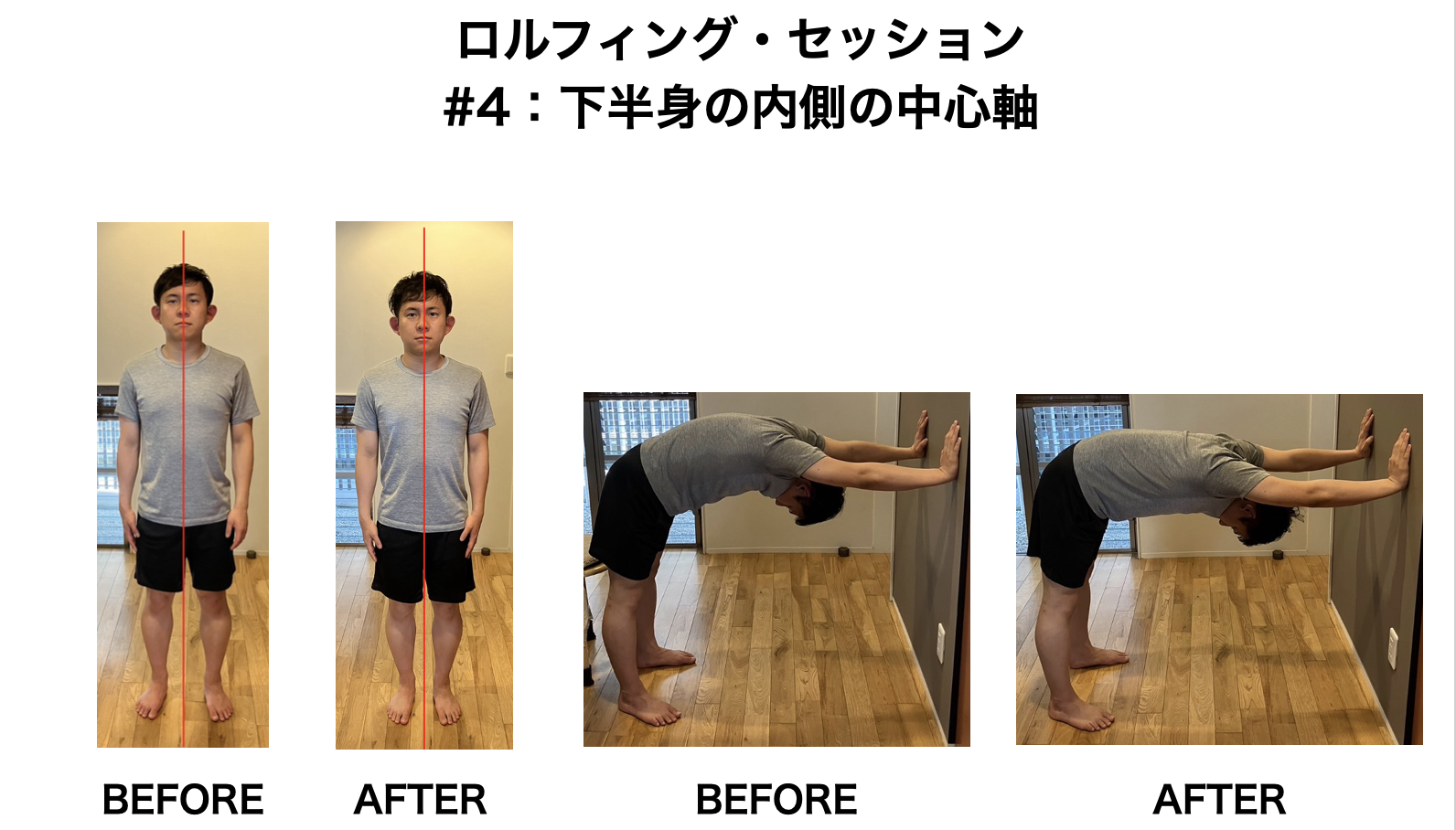
To support the medial line of the upper body, three places in the lower body need to come into order: the pelvic floor, the adductors, and the arch of the foot. The session therefore centers on these three (see the figure below).

What Changed Between BEFORE and AFTER
In the session with Tasuku Suzuki, a pharmacist, I worked with the fascia up the inside of the leg, from the toes to the sitting bones at the pelvic floor, keeping the connection between the upper and lower body in view. Specifically: the arch of the foot, the adductors, and the muscles of the pelvic floor. When these settle, low-back pain eases, and backbends in yoga deepen in particular, so it becomes a foundation for the work that follows.
In the photograph on the left: before the session (BEFORE), the inside of the lower body was working only weakly — the adductors — so the legs sat somewhat apart; after the session (AFTER), the sense of the adductors working has grown stronger, and the width between the legs has narrowed.
In the photograph on the right, we were looking at how far he could lengthen the spine using the hands and the feet. Compared with BEFORE, in AFTER the spine lengthens further, as I think can be seen.
And indeed, Tasuku shared that there was a sense of the spine lengthening.
Conclusion
This time again I have introduced Tasuku’s testimonial.