Saturday, November 7, 2020. An early flight from Haneda to Itami, and on to Osaka.

A short overnight trip to Kitahama in Osaka, where Hiroki Sato — everyone calls him Hiro — the Rolfer who runs TEN ~the space for your Life & Body~, is based.

The seminar this time is IMAC (Integrative Movement Assessment & Conditioning).
IMAC is a method Hiro developed himself, and there is more about it on the IMAC site he recently opened. If you are interested, have a look at “ABOUT IMAC.”
In the basic Rolfing training (“Becoming a Certified Rolfer in Europe — The Certification Training of the European Rolfing Association”), the emphasis falls on cultivating bodily sensation. The reasoning is that once your own bodily sense is developed, you can understand what is changing in another person’s body.
And in fact, for the first year or two after opening my practice, reproducing the methods and the technique did sharpen that sense.
At the same time, accumulating sessions made it clear that knowledge — anatomy included — for assessing change in the body was also needed. Unless bodily sensation can be expressed in the language of scientific knowledge (anatomy, physiology, biochemistry), it becomes difficult to explain anything to a client.
Within that, what is interesting about the IMAC Hiro developed is that it assesses the range of motion of joints and muscles, and looks at the state of the viscera, the nerves, the meridians, and the muscles from the perspective of East Asian Medicine.
As I wrote in “IMAC (4) — The Viscera and the Muscles: How Does Muscular Function Affect the Organs?”, taking IMAC into my sessions from 2018 made it easier to assess before and after in Rolfing work.
IMAC is divided into Basic Courses and Advanced Courses, and I have already completed the basic ones.
This time I took the Spine and Viscera course, one of the three advanced classes — Spine and Viscera, Head and Neck, and Integration.

Six of us learned methods of working with the viscera and the area around the thoracic and lumbar spine and the sacrum. With a small group, Hiro’s talk wandered a good deal, in the best sense, and it was enjoyable.
Showing anatomical diagrams, he introduced the positions of the thoracic and lumbar vertebrae and the sacrum, and explained clearly that with the viscera, what matters is the phase: is it superficial, or deep? How are the organs held within the abdominal and thoracic cavities? How do the organs meet one another?
What was most interesting was embryology.
Hiro explained that there are two approaches to looking at embryology: a chemical one (cell biology, molecular biology) and a physical one (biokinetic, biodynamic).
The first works out how the genes — the blueprint of the human being — build the body. Rather than seeing the body as a whole, it treats each organ as a machine part and explains how each part is made, using the proteins the genes produce.
Having spent a long time in Western medicine, I find this account more familiar, and there are many books on it.
Jamie Davies – How the Human Body Creates Itself, for instance, explains chemically and clearly how the body changes from a fertilized egg, through the fetus, to a single individual.
It takes the human body in three stages:
- The large framework is built.
- The details are made.
- Finishing and maintenance.
In the first, the explanation begins from how cells multiply from the fertilized egg, and outlines how the gastrula, then the neural tube, then the somites are formed. Scientific detail is kept to a minimum at each stage, and the analogies help.

The second covers how the heart and the other organs are made through communication between cells and through cell migration, and how the reproductive organs and the limbs are formed. I particularly enjoyed the account of how neural crest cells migrate from the neural tube to make various kinds of cells.
The third takes up cell death, the formation of the brain, the mechanisms that determine bone and body size, the immune system, and includes an account of how the body is maintained after birth.
Reading this alongside Shohei Yamashina’s Karā Zukai Jintai Tanjō — a color-illustrated Japanese book on how the body is made — deepens the understanding.
That book describes what Western medicine currently knows, but does not address East Asian Medicine, or how things relate to one another when the body is seen as a whole.
From the perspective of East Asian Medicine, Daniel Keown’s The Spark in the Machine is interesting for its account of East Asian Medicine seen from Western medicine.

The book describes the force that gathers cells together as qi. It notes that acupoints are most densely distributed in the organizer regions that play a central role in early embryonic development, and that the meridians are channels running along fascia that connect these points. What flows in the channels is described in terms of electricity, morphogens, hormones.
What matters in understanding the meridians, it says, is the organs. Each organ in Chinese medicine has its own character, and those characters are determined by which hormones they use.
The physical view — the second approach — is in fact a minority position in present-day medicine. Since I began offering Rolfing sessions, I have come to think there may be something to it.
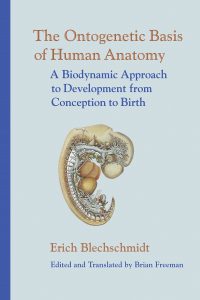
In the Spine and Viscera course, Hiro introduced the account of the German anatomist Erich Blechschmidt: The Ontogenetic Basis of Human Anatomy: A Biodynamic Approach to Development from Conception to Birth.
Much of Blechschmidt’s writing is in German, and only a limited amount has been translated into English. The trouble is that the English vocabulary of anatomy and embryology is difficult, and even someone who spent a long time in academia finds the book hard going.
For a fertilized egg to become a single individual, the view holds, it is essential to understand the environment in which the fetus is placed; as the body grows, the brain, heart, liver, kidneys, stomach, small intestine, and large intestine each settle into the place they are to occupy.

Embryologically, after fertilization the body divides into three germ layers — endoderm, mesoderm, ectoderm. From the endoderm come the digestive and respiratory systems; from the mesoderm the skeletal, muscular, circulatory, and urogenital systems; from the ectoderm the skin, the nervous system, and the sensory organs.
Blood vessels come from the mesoderm; they supply nutrition and form early. What is interesting is that the ectoderm builds the body outward, so force works in the direction of expansion. The endoderm, staying inside, has little space and moves slowly.
So the ectoderm takes most of the nutrition from the mesoderm, and what will become the brain and skin is built.
Organs form from the endoderm, but they move within a narrow space, so the positions of the stomach, pancreas, and spleen are determined around the liver, the largest organ among them.

This view sees the organs in relation to one another rather than as machine parts — an entirely different premise for looking at the body, which is what makes it interesting.
Learning a way of seeing different from what I had, I think my field of view widened.
This time, two things deepened through learning the techniques:
- The environment within the body determines where the organs sit.
- The organs are constantly moving, and the movement has direction.
And once you can understand the idea that this leads to health, I felt the work itself would deepen.

今回、幸運だったのは、Go To トラベルで、飛行機・宿泊の手配で、新幹線の往復よりも安価(宿泊込で22,000円)で、かつGo To のクーポンが5,000円分使えたことだ。
次回のIMACの「頭頸部編」(2020年11月28日〜29日)に参加する際も、その恩恵を受ける予定なので、セミナー内容を含め、楽しみにしていたい。
コロナ禍で参加者が少数だったにもかかわらず、IMACの脊柱・内臓編を開催していただいたヒロさん、参加者の皆さんに今回も多大なサポートをいただいた。改めて感謝申し上げたい。
I was fortunate that the Go To Travel campaign made flight and accommodation cheaper than a return trip by shinkansen (22,000 yen including the stay), and that 5,000 yen in Go To coupons could be used.
I expect the same for the Head and Neck course (November 28–29, 2020), so I am looking forward to it, content included.
Despite the small number of participants under the pandemic, Hiro held the Spine and Viscera course, and I received a great deal of support from him and from the other participants. My thanks to them all.
Related Articles
- IMAC (1) — The Introductory Course: Assessing the Body Through Range of Motion and Anatomy
- IMAC (2) — The Upper Limb: In What Order Do You Take Range of Motion, Test, and Work with Fascia?
- IMAC (3) — The Lower Limb: Not Loosening What Is Tight, but Finding Where Information Is Not Reaching
- IMAC (4) — The Viscera and the Muscles: How Does Muscular Function Affect the Organs?
- IMAC (5) — EROM: Learning How to Assess Range of Motion from the Ground Up
- IMAC (6) — The Lower Limb: Where Anatomy Meets the Meridians, and What Range of Motion Reveals
- IMAC (7) — The Upper Limb: Range of Motion and the Meridians — Reading the Organs and the Autonomic Nervous System
Note, September 2026
In this course I was taught that there are two approaches to embryology.
The chemical one. It works out how the genes build the body. It treats each organ as a machine part and explains it with the proteins the genes produce.
The physical one. The environment within the body determines where the organs sit. The ectoderm works outward; the endoderm, in its narrow space, moves slowly. The ectoderm takes most of the nutrition from the mesoderm. The stomach, pancreas, and spleen find their places around the liver. Organs are seen not as parts but in relation.
Of the first, the article says that having spent a long time in Western medicine, I find this account more familiar.
That is true. Nine years of medical research at graduate school, eleven years in a pharmaceutical company. The language that explains the body through genes and proteins was something I had spent twenty years acquiring.
And then it says: the physical view is a minority position in present-day medicine, and since I began offering Rolfing sessions I have come to think there may be something to it.
Knowing it was the minority position, and saying there may be something to it.
I do not think I was carried along. Nor did I switch without knowing where each view stood. Knowing where both sat, and setting them against what my hands had been touching, I judged that this one explained more.
A way of seeing I had spent twenty years acquiring, looked at from outside. Not discarded. As the article says, it is still the more familiar of the two. Only that it had stopped being the only one.
In the anatomy week of Phase I, Konrad Obermeier gave me a conditional agreement rather than an unqualified one: more anatomy and more hands-on experience were needed. The anatomy I was short of, back then, was the anatomy asked for in that room. I had been admitted on the strength of a doctorate, on the grounds that it gave me the ground for anatomy and physiology. What the classroom asked for was something else.
Six years later, in this course, the shape of that gap becomes visible. What I held was the language of chemical embryology. What the classroom wanted was the language that sees how a body was built, in relation.
Konrad himself studied visceral manipulation directly under Jean-Pierre Barral, and teaches Blechschmidt’s embryology. The Blechschmidt Hiro introduced in this course had also been taught in Munich. The same name had reached me twice, six years apart, from two different places.
The knowledge from my former work did not get in the way. It worked as something to measure against. Because I knew the familiar side, I could see what the minority side was doing differently.