
Introduction
Twice now I have written about fascia. The first time, that it is alive and connected. The second, that the same tissue senses. Seen from outside, a continuum; felt from within, a projection of sensation that mirrors the self.
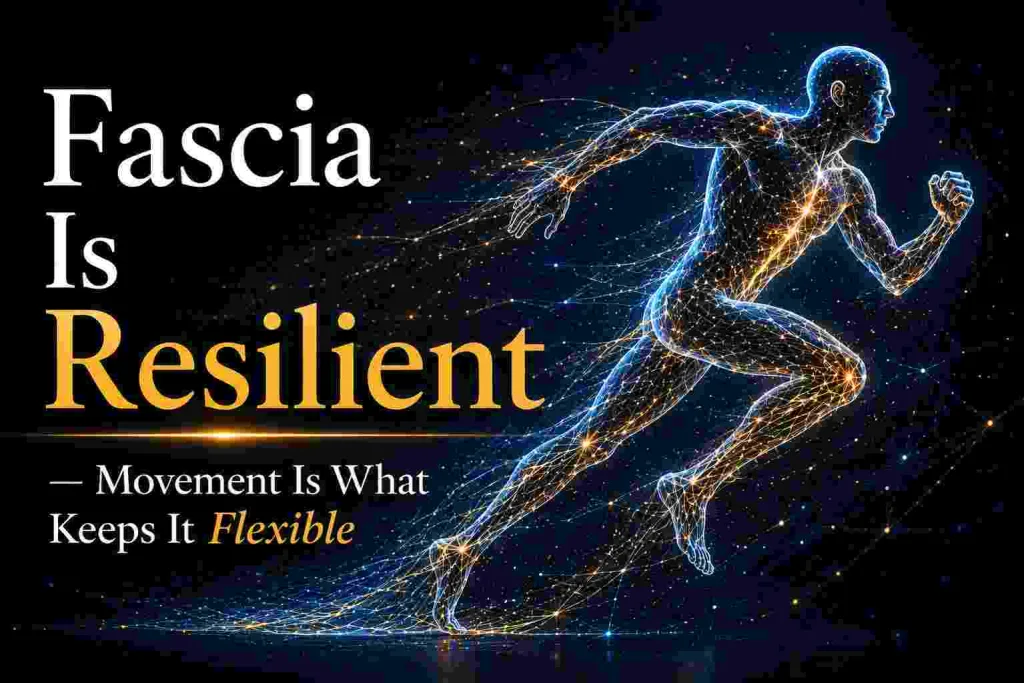
This time I want to take up one more face of it: fascia as a tissue that moves, and that is kept alive by movement. It is not something to be avoided when thinking about sport, or when feeling the body change with age.
The Kangaroo’s Leap — Force Stored in Fascia
How does a kangaroo jump so far on such thin legs?
The secret is not muscular power alone. The Achilles tendon and the fascia store force and send it back, like a bungee cord or a rubber band — the work of elastic recoil. With each landing the tissue lengthens and takes on energy; with the next leap it releases it. The animal is not jumping by muscle alone. An elastic spring is helping.
Humans use the same mechanism in walking and running. With every step, tendon and fascia lengthen and shorten, storing force and returning it. Fascia does not merely hold the body up. It is also a flexible spring that stores energy and gives it back.
👉 Related article: “Upright Bipedal Walking — Energy-Efficient, but with a Risk of Falling“
From Elastic Stocking to Stiff Rope
This elasticity, though, is not maintained on its own.
According to Robert Schleip — a Rolfer, and a leading figure in fascia research — fascia left unmoved shifts from something like an elastic stocking toward something like a brittle, stiff rope. Unused fascia in the lower back grows thin and is easily strained by even a small load. In chronic low-back pain it is not unusual to find layers of fascia adhering to one another, having lost the glide they should have. What goes unmoved lets go of its flexibility: use it or lose it.
Then there is the question of time. Muscle can be trained in a matter of weeks, but restoring the elasticity of fascia takes far longer. Schleip suggests something on the order of three months of consistent practice. Remodeling collagen is slow work. It does not change quickly — but kept up, it is a tissue that answers in kind.
Wringing Out a Sponge — Water, and Flow
As earlier pieces touched on, most of fascia is water held within it.
Move it, lengthen it, press on it, and each time the old water is pushed out, as from a sponge being wrung. Release the pressure, and fresh fluid seeps in from the plasma. Moving in many directions, with rhythm, is what brings about this exchange. Stay still, by contrast, and the water stagnates; metabolic waste and substances involved in inflammation accumulate, and the tissue grows brittle.
Recalling the interstitium from the first piece — that fluid network running through the whole body — something comes into view. To move is also to lend a hand to that flow. What keeps fascia alive may not be a quiet structure, but the constant turnover of water.
One Continuous Line — Movement Travels the Whole Body
That fascia is continuous throughout the body is what I described in the first piece. From soft fascia to tendon, periosteum, and bone, the supporting tissues are joined as a single web.
Thomas Myers mapped this continuity as a map of movement, in the idea he calls Anatomy Trains. Muscle and fascia run through the body as continuous “lines.” So force or tension applied at one point does not stay there; it travels along the line and carries far. Work on the sole of the foot (the plantar fascia), it is said, can reach tension in the back or the head, far away.
Movement is not a local affair. It travels the continuous web like a wave. Here again, the Body as an Operating System returns quietly — the view of the body not as an assemblage of parts but as one system that moves as a whole.
Being Honest About What Cannot Be Asserted
Here too, I want to draw a line.
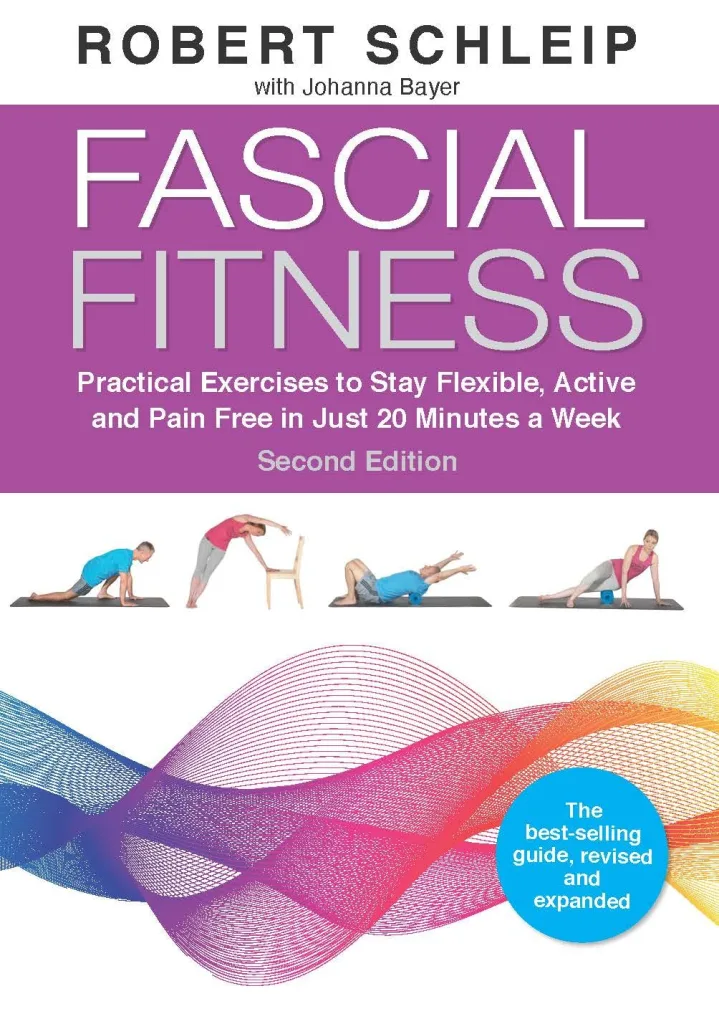
Much of what I have described about elasticity and hydration rests on the idea of “Fascial Fitness” proposed by Schleip and colleagues. It is an appealing framework, but one still in the course of being tested. The figure of three months is only a rough guide.
And this is not a story about “Rolfing making one younger” or “preventing a particular illness.” All that can be said is that a way of seeing has grown up — one in which fascia appears to keep its flexibility and its moisture through movement. I hope it can be received not as a promise of results, but as a relationship between tissue and movement. The line between what is known and what is not yet known is one I want to draw with care.
Conclusion
Alive, sensing, and moving. These are the three faces of fascia I have looked at across three pieces.
All of them converge on a single way of seeing: the body is not an assembly of separate parts, but one living system in continuous communication with itself, sensing and moving. What Rolfing lends a hand to is the elasticity of that continuum.
And the most immediate way of working with it may not be any special technique. Moving daily, in many directions, with spring. Hanging, twisting, and bouncing, the way a child does. Each of these keeps this tissue alive.
I would be glad if this piece offered even a small occasion to feel one’s own body, once again, as a moving continuum.