Sunday, February 4, 2018. The workshop finished its final day. Saying goodbye to the participants, I took the train out to Munich International Airport, and via Charles de Gaulle in Paris arrived at Haneda at eight the following evening.

Homework has been set for before Part 3, in groups of three: sharing a case study on Rolf Movement. I am looking forward to exchanging emails and Skype calls between Sweden and Russia.

Twenty-one days into the Rolf Movement training, various things have come into view. The content is practical.
I gave three Rolf Movement sessions each to a client and to a fellow student. Unlike the Rolfing ten series, the session has to be built around each client’s particularity, which asks you to take a risk and bring in a different approach (for details, see “Confusion in a Good Sense, and on Tonic Function” and “What Comes into View Through Intuition and Body Reading“).

That said, I do want to know what framework the Rolf Movement teachers are thinking within.
On the eighth day, France Hatt-Arnold (hereafter France), the Swiss Rolf Movement instructor, set out her thinking.
Territorial Body and Body of Action. The regions of the body, and the movement of the body. The first is what Rolfing has always worked with; the second is the territory of Rolf Movement. Dividing them this way, she says, makes a Rolf Movement session easier to build.
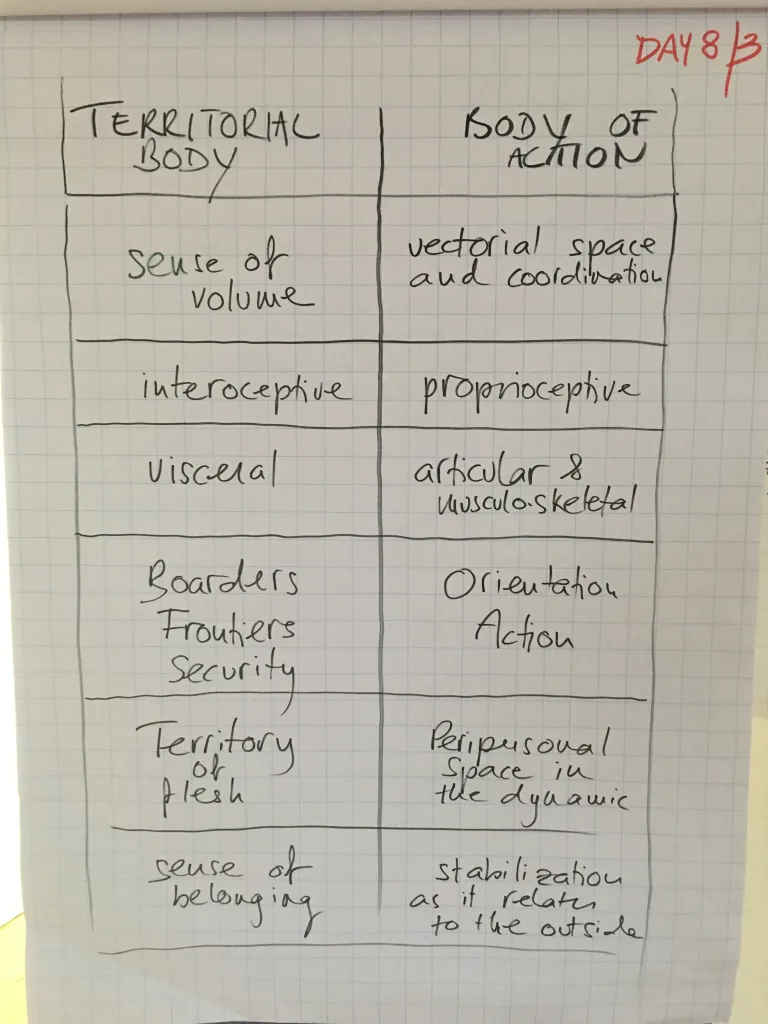
Six points were discussed.
- For the viscera in front of the spine, bring in articular movement — making space within the body — and musculo-skeletal movement.
- For someone who cannot sense within their own body — interoceptive, in her term — bring in movement that gives access to the proprioceptive: perception governed by information from the limbs and elsewhere, the sense of where the body is (for details, see “Psychological and Perceptual Change — The Body Map“).
- To feel space and depth within the body — volume, in the language of the training — bring in vectorial space, which lets the two directions be felt in relation to space, along with coordination-type movement for the body to work together. The space between the spine and the sternum, say, or between the back and front of the head (on bidirectionality, see “The Five Principles“).
- Where the border with the client, the frontier, or security is what is called for, bring orientation — bidirectionality — into the movement.
- For the other regions of the body, the territory of flesh, bring in movement in relation to peripersonal space, the space around the body.
- And in approaching the sense that the body belongs to you — sense of belonging — the surrounding environment is involved, so bring in movement that allows safety and reassurance.

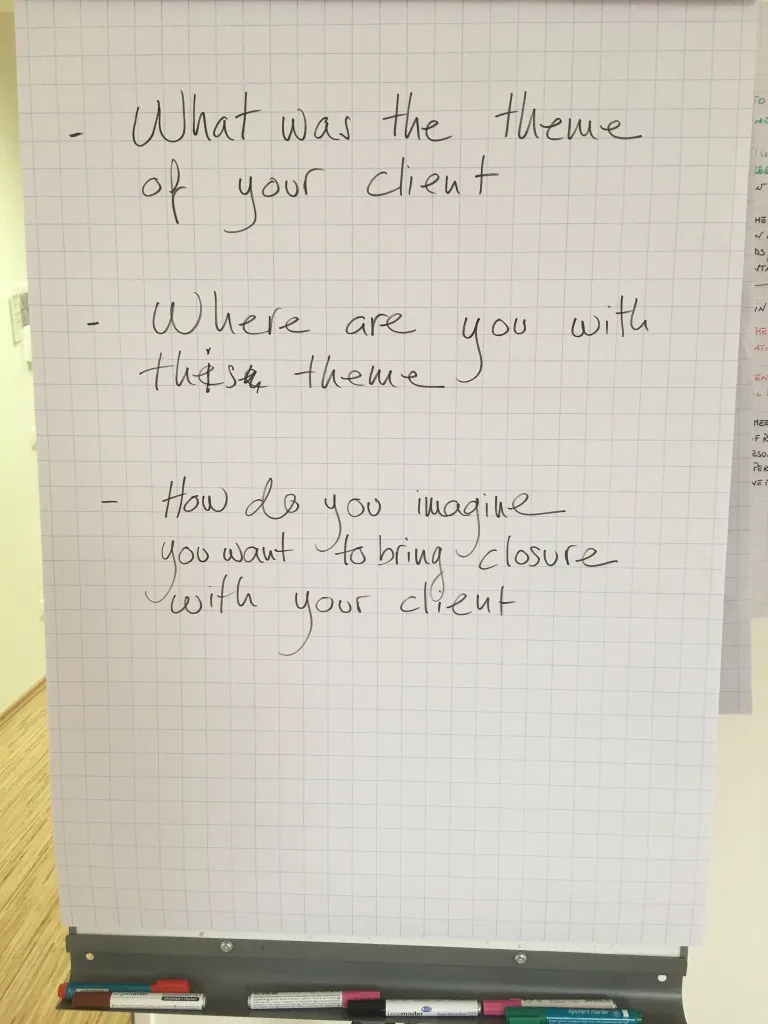
Before the third session began, these questions were put to us.
- What was the theme of your client across the three sessions?
- Where are you with these themes?
- How do you imagine you want to bring closure with your client?
Through those questions, how to build it came into view. France explained it well from Territorial Body and Body of Action.

Rolf Movement carries the influence of Hubert Godard’s Tonic Function, but it also matters that the three information-gathering systems — visual, vestibular, and kinesthetic — work in balance. I want to take that up next time (see “Organizing the Balance of the Three Information-Gathering Systems“).
Note, August 2026
What I wanted at the time is written here.
I do want to know what framework the Rolf Movement teachers are thinking within.
Twenty-one days in. No procedure handed over, only questions, and people telling each other they were confused in a good sense. On top of that, I wanted to know what the teaching side was holding.
And on the eighth day, France showed the framework.
Territorial Body and Body of Action. The regions of the body, and its movement. Divide them and a session becomes easier to build.
Then six correspondences. Viscera: articular and musculo-skeletal. Someone who cannot feel their own interior: proprioceptive. Space and depth: vectorial space and coordination. Border and safety: orientation. Other regions: peripersonal space. The sense that the body is one’s own: movement that allows reassurance.
A classification.
Nine years later I received something of the same shape: the Taxonomy. Structural and segmental, biomechanical, functional, psychobiological, energetic. A framework for choosing, from the side of the system, which vantage to work from.
The two are alike, and the axis of division differs.
The Taxonomy divides by which layer of the body you look through. Structure, function, nervous system, field. A classification of the observer’s vantage.
France’s six divide by what the other person needs. Is the interior unfelt? Is space lacking? Is safety required? A classification of the client’s state.
And each need has its corresponding kind of movement. You are not choosing a vantage; you are matching a means to a need.
Neither is better. But Rolf Movement’s version is closer in form to a prescription.
This was, after all, a course that did not hand over procedures. The one thing resembling a correspondence table came out on that eighth day.
And it came out because it was asked for. I do want to know, says the record.
Eleven years on, I would say that I needed a framework at that stage. To become able to bear the absence of a procedure, you need some other footing. Questions alone were not yet enough.
That footing comes off later. What I learned most in the 2025 Advanced Training was neither the five principles nor the Taxonomy but a way of being. You hold the classifications and keep them from coming to the front during a session.
There is a stage that needs the classification, and a stage that can hold it without using it.
There is one more thing recorded here: the questions about closing the three-session series.
What was the theme across the three. Where are you with it. How do you bring it to a close.
Closure appears here.
Nine years later I would receive it as a principle — CLOSURE, one of the five, giving a process an appropriate ending. Sharon Wheeler had said something adjacent: that rather than producing change at once, moving back and forth between regions lets the client take the change in.
You design the ending. Three sessions, ten sessions, a single hour — the same question stands.
France’s three questions were its first form.