
In looking at posture, Rolfing holds that three elements are involved: the visual system, the vestibular system, and the kinesthetic system. Balance is understood to be in order only when all three are present. Among them, what matters in Session 7 is the vestibular sense. The theme is how to recover the vestibular sense the body originally holds.

Let me take them one at a time.

The visual system takes in information through the eyes, and the eyes are said to carry some eighty percent of a person’s external information. When the eyes are overused — desk work involving a computer, for instance — the body attempts to balance them against the other two senses. But if those other two have not developed, posture collapses again no matter how much one means to correct it. Rolfing therefore looks to organize the other two.

The kinesthetic sense concerns whether the external sensory organs — the hands, the feet, the head and face — receive external information fully and carry it to the interior of the body. Rolfing expresses this with the words palpatory and haptic.
Palpatory derives from palpation. It is the work of touching a living body to confirm where the muscles and bones lie, familiar from studying anatomy. Haptic, on the other hand, derives from the Greek haptō, to touch or to grasp by touch. What matters is bringing the hands and feet into a state where they receive information as they touch — and the body is not necessarily arranged that way.

With the foot, there are three plantar arches. Building the foundation of those arches and creating space between the lower leg and the foot — the subject of Session 2 (see “Session 2: Organizing the Feet“) — lets the lower body receive the ground fully, and the freedom of the upper body increases.
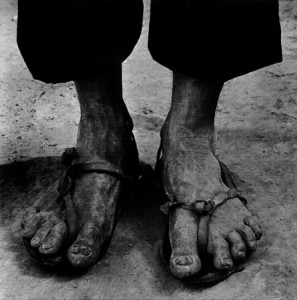
To describe a foot in a palpatory, haptic state: it might be thought of as a state of adhering to the ground like a gecko, or as receiving information as though the foot had eyes on it.

With the face and head, rather than a state of being crushed by gravity, the head hangs as if suspended from the sky — the sky hook — and the body is organized against gravity in two directions, Palintonicity, as described in “Basic Concepts — Bidirectionality (Palintonicity).” The two directions mean the lower body meeting the ground and the upper body rising freely upward. The head then moves freely as well, which makes information from outside easier to obtain.

The vestibular sense is the sense of equilibrium. What feels gravity is the inner ear, deep within the ear. The organs of equilibrium there work together with the cranial nervous system, sensing the direction the body faces, its tilt, and its movement. Through this the body works to recover its balance.
A clear example of the sense of equilibrium is seasickness. It occurs because the waves of the sea take away the sense of equilibrium. The ear is part of the face and head. In Session 7, approaching the vestibular sense of the face and head is a way of calling that sense back into the interior of the body.
For this, the fascia of the related sites inside the mouth and nose is released. These include the jaw and the muscles around it, the muscles around the nose, and the muscles of the tongue.
Having touched briefly on the effects concerning the face and head, the account of Session 7 itself will show how it was experienced in the body.
Note, August 2026
The three information-gathering systems named here — visual, vestibular, and kinesthetic — would go on appearing.
2018: Confirming it in the body
From January into February 2018 came Part II of the Rolf Movement training. There, these three were addressed directly as the three information-gathering systems (see “Organizing the Balance of the Three Information-Gathering Systems“).
Rita Geirola’s observation was striking. Human beings learn to see through education and experience. The vestibular and kinesthetic senses, by contrast, are already present. Because it is acquired through learning, vision is the easiest of the three to bring to awareness, and correspondingly the likeliest to dominate. That is an account, from the side of how the senses come about, of what this piece describes as the eyes carrying eighty percent of external information.
And when the sense of the eyes runs too strong, the work of the vestibular sense and the feeling of gravity grow harder to register. Since the eyes connect to the back of the head, overusing them ties into stiffness in the neck and shoulders.
There was an exercise that confirmed this directly: how the body changes when observing a person with both eyes, then with one. In my own case, if the field of the left eye is 100 and spherical, the right came out at 60, tilted slightly toward the rear. Closing the left eye and using only the right produced a sense of congestion in the chest.
A partner then made a sound at the outer right side of the head to activate the vestibular sense, and the field of the right eye widened while the congestion in the chest cleared. Organizing the sensation of the feet steadied the vision further still.
A slight change in vision bears heavily on how the body organizes itself. What this piece states — that balance is in order only when all three elements are present — had been confirmed in my own body four years later.
2025: Toward the framework of the one who sees
In the 2025 Advanced Training, these three senses occupied a different position.
What Jeff Maitland emphasized above all was training the capacity to see. “Not mere visual inspection, but listening to the body with the whole of the sensory apparatus.” He recommended gathering information through the Somatic Sensorium — the full mobilization of bodily sensation.
Ray McCall put it this way as well: “‘Seeing with your own eyes’ invites misunderstanding. Receiving with the whole body is what observation is” (see “Principles and Observational Skills in Rolfing — Jeff Maitland’s Approach“).
The framework has shifted here. The three elements taken up in this piece served to assess the client’s posture. Eleven years on, they concern how the practitioner observes. A framework belonging to the one who is seen had moved to the one who sees.
The point about eighty-percent dependence on vision was written at the time as a general observation. In 2025 it functions as a caution addressed to the practitioner.
The eye of the foot
This piece contains the following line:
“Receiving information as though the foot had eyes on it.”
In the 2025 Advanced Training, the name of the exercise Ray McCall reportedly introduces every time was the Eye of the Foot. One assumes there is an eye in the sole of the foot, and observes what changes in the body and in the surrounding space as it opens and closes (see “Space Is Not “Nothing” — It Is “Something”: A Perceptual Shift Beginning with the “Eye of the Foot”“).
What was written in 2014 as a figure of speech returned eleven years later as the name of a technique.
And the 2018 experiment sits between them: the record that organizing the sensation of the feet steadied the vision. The connection between the eye of the foot and vision was not a figure of speech but an actual relation.