When thinking about Reiki as something that originated in Japan, history matters. The seminar, too, began with history.
Its formal name is Usui Reiki Ryōhō for improving mind and body. It was developed in 1922 by Mikao Usui as a healing technique using the hands, and is known as a method aimed at improving both mind and body.

According to the book we were given, Usui was born in 1865 in the village of Taniai in Gifu Prefecture, and as a young man traveled several times to Europe, America, and China. He also worked in a range of occupations — civil servant, company employee, businessman, newspaper reporter, secretary to a politician.
The most interesting of these is his time as secretary to Shinpei Gotō. Gotō began as a physician, held important posts in the colonial administration of Taiwan and Manchuria, and was central to the grand design and reconstruction of Tokyo after the Great Kantō Earthquake.
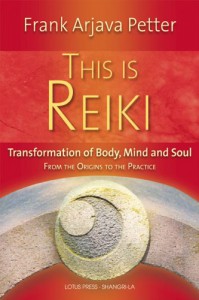
According to “This is Reiki” by Frank Arjava Petter, who lived in Japan, it was perhaps because of Gotō’s influence in political circles that Usui gained access to senior figures including those in the army and navy, and was able to travel abroad.
After accumulating knowledge across history, biography, medicine, the new religions of the period, Christianity, Buddhism, psychology, and divination, along with his own life experience, Usui reached a conclusion: that the ultimate purpose of life is to attain anjin ryūmei — a settled peace of mind.
So he entered Zen practice for three years, but did not attain awakening. When he consulted his teacher, the answer was: then try dying. He went into seclusion on Mount Kurama in Kyoto and began a fast. In the third week he felt a violent shock, as though lightning had struck the center of his brain, and lost consciousness.
When he woke as dawn was breaking, filled with a sense of clarity in mind and body, he understood that the energy he had felt in that shock had passed through him, achieving resonance and unity within the body, and that he had arrived at the awakening he had sought.
Rejoicing in this, he stumbled on a stone while coming down the mountain and tore off a toenail. When he placed his hand on it, the pain left, the bleeding stopped, and it healed immediately. Trying it on his own family produced the same effect, and he came to want to extend the benefit of this to the wider world.

Through study and refinement, he stripped away religious content as far as possible and organized the method simply. A month later he founded the Usui Reiki Ryōhō Gakkai in Aoyama, Tokyo, beside Tōgō Shrine.
Through his connection with Gotō, he gained the support of the ruling class by way of the army and navy. And the following year, with the Great Kantō Earthquake of 1923, it spread rapidly. By the time Usui died four years later, there were said to be two thousand practitioners and forty branches across Japan.
The Usui Reiki Ryōhō Gakkai still exists today, but the turning point came after the Second World War. The allopathic policy driven by Rockefeller and the American Medical Association in the United States was brought to Japan through the occupation authorities. With the exception of some folk practices, anything not scientific was headed for prohibition.
For reference, according to Petter’s book, there were a million Reiki practitioners in Japan before the war. As a result, Reiki effectively disappeared until it was reimported in 1987 in the form of Western Reiki.

That Reiki became known worldwide owes a great deal to Hawayo Takata, a Japanese American living in Hawaii. In 1935, before the war, suffering from conditions of the heart, stomach, lungs, and gallbladder and told she had little time left, Takata traveled to Japan for treatment. She was to undergo major surgery at a hospital, but is said to have heard an inner voice telling her the surgery was unnecessary.
She asked her physician whether there was any way to recover without surgery. She was told it might take time, but if she accepted that, an introduction could be made — to Chūjirō Hayashi, who had founded the Hayashi Reiki Kenkyūkai. Hayashi was one of Usui’s students, a naval captain, and a physician. After eight months of Reiki treatment, Takata is said to have made a remarkable recovery.
That is what the book we were given records. According to Takami Kamata, though, the episode of the inner voice is not factual. Two people in Hawaii — a Japanese teacher and a missionary — had given Takata Reiki treatment and set her on the path to recovery, so she had already experienced its effects. When she first traveled to Japan, she had already resolved to become a Reiki practitioner under Hayashi.
For reference, Hayashi’s clinic in Shinanomachi had about eight tables, with sixteen Reiki practitioners at work.

Moved by Reiki, Takata invited Hayashi to Hawaii in 1933 and learned the technique. Forty years later, in 1978, she began teaching, and trained twenty-two teachers.
According to the materials we were given, some three million people practice Reiki today. The international Reiki organizations now include the Reiki Alliance, headed by Takata’s granddaughter Phyllis Furumoto, and the Radiance Technique Association, headed by Barbara Ray.
That is a brief account of how it came down to us. In the next column I would like to look at the difference between Western Reiki and Japanese Reiki, and at what Reiki actually is.
Note, August 2026
What this piece traces is a technique disappearing at home, going abroad, changing form, and coming back.
It was born in Japan in the Taishō era, and before the war there were said to be a million practitioners. Postwar policy effectively erased it. By way of Hawaii it spread through Europe and America, and in 1987 it was reimported.
Other things took the same route
Zen did. After the persecution of Buddhism in the Meiji era, Buddhism redefined itself, in order to survive, as a rational and non-dogmatic science of mind. A self-image formed in response to Western criticism became, as it stood, the export. D. T. Suzuki wrote it in English, Alan Watts popularized it, America took it up in the 1950s, and it came back having reorganized how Japanese people themselves understood Zen.
Yoga followed a similar route. So did Eugen Herrigel’s Zen in the Art of Archery, and so did the process by which the rock garden at Ryōan-ji became world-famous.
Reiki is one of these. With one difference: Zen and yoga survived at home, in altered form. Reiki was cut off.
What comes back is not what left
In the next column I will write that Western Reiki contains elements added later — the idea of protecting people from negative energy, and the framework of chakras. The original had been modified.
This too is common to the pattern. What the West receives has been shaped into something the West can receive. And the shaped version is what returns to the country of origin.
The circulation turned up what had not circulated
What is interesting is that the Jikiden Reiki I studied stands outside that circulation.
Western Reiki was reimported in 1987, and Reiki began to be reconsidered in Japan. That prompted a search for its roots. And so it emerged, in 1999, that the Usui Reiki Ryōhō Gakkai — thought to have been destroyed by the occupation — had survived, and that Chiyoko Yamaguchi, who had learned directly from Chūjirō Hayashi at the age of seventeen in 1938, had been practicing continuously for sixty-five years.
Because the reimported version spread, a line that had never disappeared was found. The circulation turned up what had not circulated.
And the person who taught it to me was a Rolfer living in Frankfurt. I received a Japanese technique in Tokyo, from a Japanese person living in Germany.
Correcting the handout on the spot
One small but significant moment is recorded here.
The book we were given said that Hawayo Takata, just before major surgery, heard an inner voice telling her the surgery was unnecessary. Kamata said this was not factual. Takata had received Reiki in Hawaii and already knew its effects, and traveled to Japan intending from the outset to train under Hayashi.
The teacher was dismantling, in the moment, a dramatic anecdote printed in the material. And in the direction of the plainer fact.
The version that travels well survives; the plain fact drops away. That is what happens inside a circulation. This correction ran against it.