
Introduction
Since June 2015, I have offered Rolfing sessions. Approaching the fascia brings the posture into order, and the movement of the body improves along with it. This time, I would like to introduce a testimonial from a seventh Rolfing session.
Working with the Deep Muscles — What Settles?
Sessions 4 to 7 of Rolfing bring the medial line into order. Why the work in the depth matters is that it brings you to “Where am I taking my life? What is it for?” — and that reaches how a person lives, and what they feel, in a large way.
Sessions 4 to 7 proceed in the following order.

Session 4: the lower body (the adductors through to the pelvic floor)
Session 5: the front of the spine in the upper body (the psoas, the viscera, the diaphragm)
Session 6: the back of the spine in the upper body (the lower leg, the gluteals, the sacrum, the spine)
Session 7: the shoulders and the whole neck
Drawn out, it looks like this.

Three Senses — Sight, the Inner Ear, and the Muscles, in Posture
Three things bear on each other when you look at posture: the visual system, the vestibular system — the inner ear — and
the kinesthetic system, the sense of the muscles.

Rolfing takes it that balance is there only when all three are.
The second session wakes the kinesthetic sense; the seventh wakes the vestibular one. As those two come awake, they reach sight as well, and the posture settles.
The vestibular sense is what balance depends on. It sits deep in the ear, out of sight, and is hard to get hold of. Can it be woken at all? That is one of the themes of the seventh session.
The Neck, at the Center of Session 7 — What Posture and Breath Rest On
The seventh session moves in this order: the hands, the arms, around the shoulders, the spine of the upper body, the face, the head.
To put it another way: sessions 4 to 6 brought the medial line up as far as the chest, so the seventh works with the sense of setting the neck on top of that. The head sits at the summit of the body, so in a way the seventh session is where awareness of the medial line comes back.
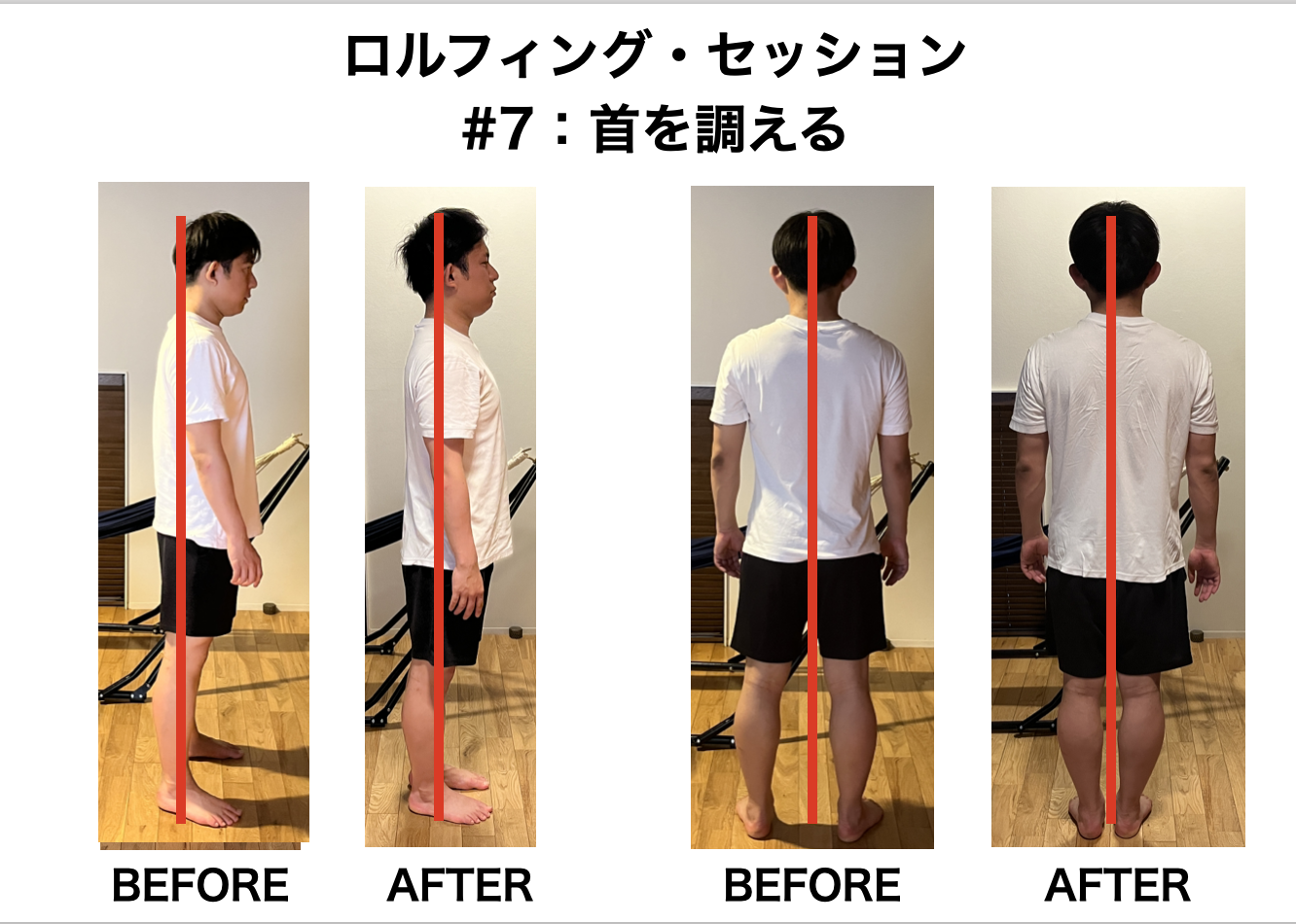
Session 7 — BEFORE and AFTER
With Tasuku Suzuki, a pharmacist, I worked with the fascia mainly at the hands, the neck, and the shoulders. Something I had noticed in the sixth session: he has a habit of carrying the head forward. It shows up readily when sight is dominant, and as the neck settles, the head comes to rest where it belongs.
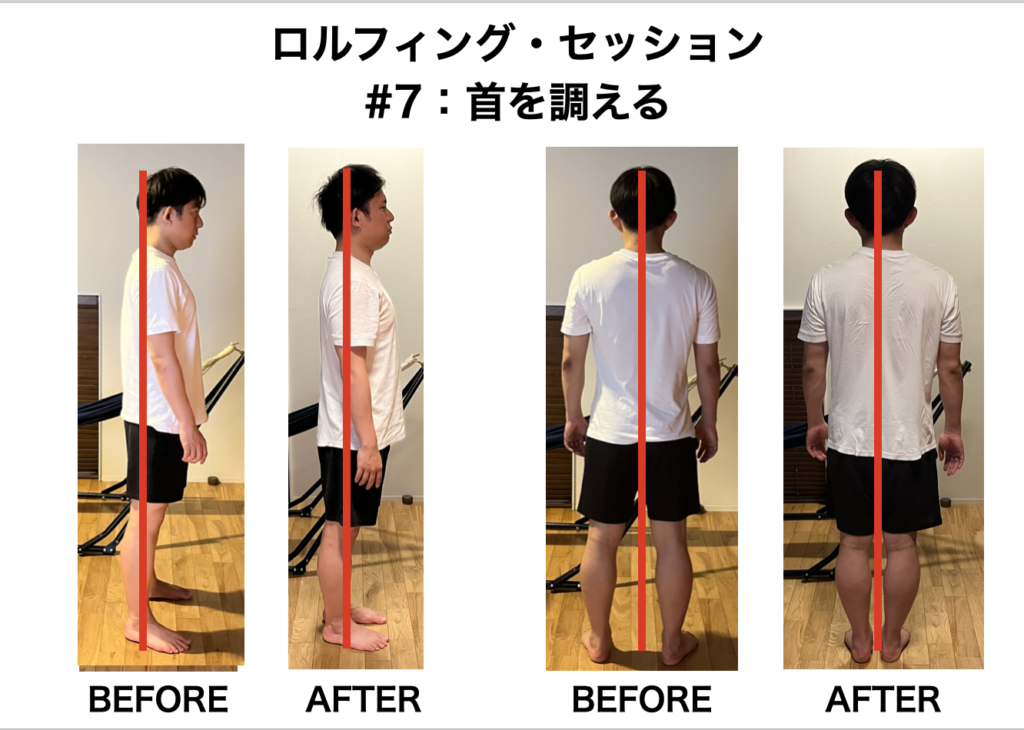
Comparing before the session (BEFORE) and after it (AFTER), it is plain enough. The neck has come to rest, held by the support of the lower body, with the effort gone out of it.
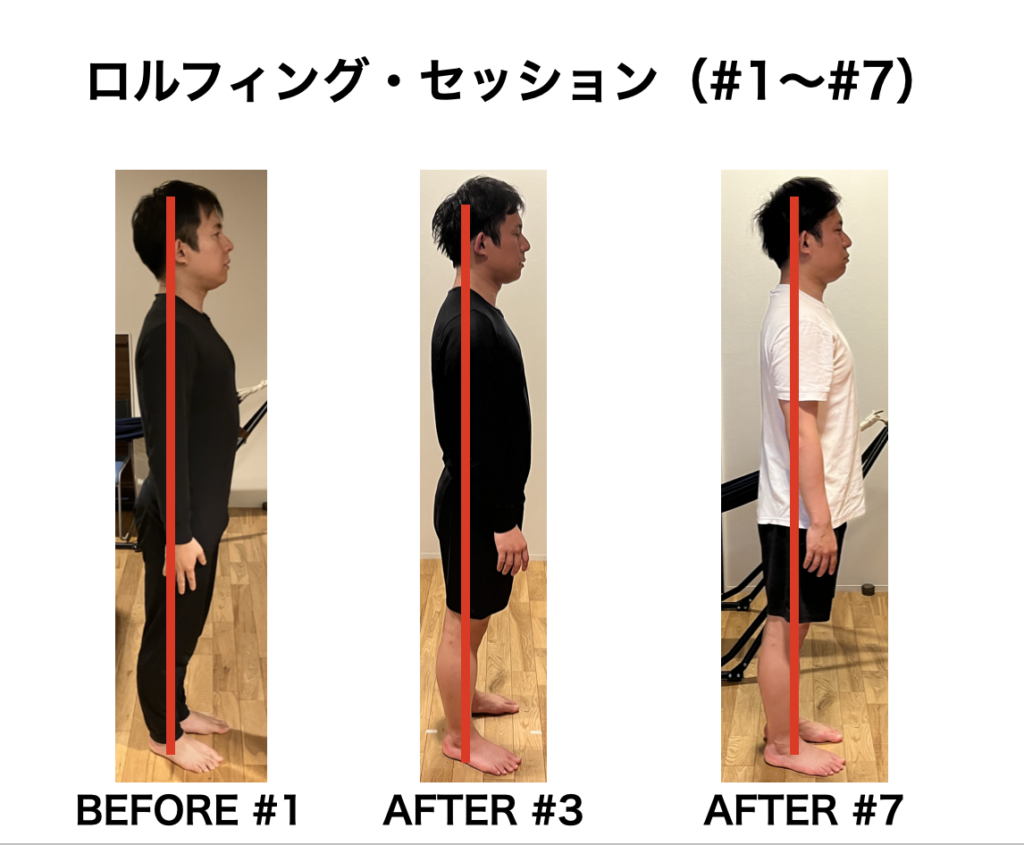
What Changed Across Sessions 1 to 7
Finally, I would like to show the photographs of the change across sessions 1 to 7. Before the first session, the posture was chest out and back straightened, rather like standing to attention. By the third the chest had let go; and as the medial line came into order through sessions 5 to 7, the chest let go further and the neck came to rest where it belongs.
Conclusion
This time I have shared the experience of a seventh Rolfing session.