Between December 2016 and February 2017, inquiries have been coming in from Japanese people who want to study Rolfing, and the occasions to explain the Munich training have been increasing little by little.
On the European training, please see below:
- Why I Chose to Study in Munich: The Application Process and the Costs
- What Comes into View When You Study Alongside People Whose First Language Is Not English
- On the ERA Mentoring Sessions and the Supervision Workshop Ahead
- Becoming a Certified Rolfer in Europe — The Certification Training of the European Rolfing Association
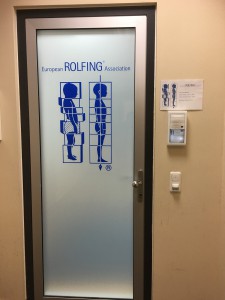
From what I hear, there are two Japanese participants in Phase I and two in Phase II of the Munich training, as of February 2017.
None of the European teachers has English as a first language; it is a foreign language for them. Because of that, unlike in the United States where English is handled as a matter of course, the pace of speaking is very slow.
Educated in Europe, in Germany, I found the respect for other opinions and the willingness to listen that come with Europe’s many cultural backgrounds. And I came to feel that Japan and Europe are closer than one might think.
Out of that experience I have come to think the training is better taken in Germany, so the steady increase in Japanese participants seems a good thing to me.
One of them, Maiko Kuwahara — now working as Maiko Matsuda, and referred to here as Maiko — was due to begin Phase III on February 20, 2017. She came to the session room in February 2017, and we were able to exchange Rolfing sessions twice.
Maiko had worked as a systems engineer, and through her encounter with Rolfing came to want to study it. She has written about that and about the training in Germany on her blog (“Started Studying Rolfing in 2016 — A Daily Record (only in Japanese)“), which is worth a look.
There was a clear purpose: to check body reading — how the body is seen in Rolfing — and bodily sensation. I explained how I understand it.
Sharon Wheeler told me that Ida Rolf, who founded Rolfing, could not teach body reading (on what Sharon said, see “Bone Work – Sharon Wheeler (5) — The Final Day: What Sharon Said (2)“). I have asked various teachers about it myself, and never got a clear answer either. Given that, what I passed on was to keep it to noticing what catches your attention, rather than looking analytically and deeply into a client’s body.

Now, about the exchange.
For the first session, since she was having trouble sensing change in her body, we worked mainly with the neck and sacrum work that always comes at the end of a session. I told her to put her feet on the ground, settle her own posture, and take time releasing the hands, the neck, the spine — then wait. She said she began to feel the body releasing, starting from the hands.
The second session was a review of Session 6. Working the sacrum and sit bones, approaching the buttocks, connecting the lower and upper body from behind — it is often called the hardest session in Rolfing. It took practicing it in Phase III before I understood what to do, so I understood the feeling well when Maiko asked to review that in particular. We went through it focusing on how to approach a body without using the hands — using the elbow, the back of the hand, the palm — in ways that do not put strain on you.

In the end I think both sessions cleared up her questions. Phase III is largely review of what was learned in Phase II. Practice it, and the material is such that you come to see how a session is put together.
I also told Maiko that certification as a Rolfer is not that difficult, and that how you find clients matters far more. As I had told her when we met in December 2016, I advised her to prepare a website with her contact details on it (or Facebook), and a place from which she can put things out — a blog (on that meeting, see “The Rolfer Hidefumi Otsuka (2) – only in Japanese“).
In April 2017 a new Rolfer will appear in Saitama. Being a Rolfer is genuinely enjoyable work, so I hope Maiko will enjoy the training.
Note, September 2026
There were two things I passed on to Maiko in this piece.
One was how to do body reading: keep it to noticing what catches your attention, rather than looking analytically and deeply. This followed from Sharon Wheeler’s remark that Ida Rolf herself could not teach body reading.
The other was that certification is not that difficult, and that finding clients matters far more.
Nine years on, that second view has not changed.
If anything it has hardened. Through the pandemic and after it, finding clients has become harder. Getting certified as a Rolfer and continuing as one are two different things. The path to certification is laid out as an institution; what comes after it has no procedure.
This piece is also a record of exchanging sessions.
At the time, I was the one teaching, and she was on her way to Phase III. Nine years on, it is an exchange between equals.
Three of us now exchange sessions regularly: Maiko, Kumi Umamoto, and myself. Maiko works in Saitama, Kumi in Shimokitazawa.
Kumi spent a period offering Rolfing in Germany, and is close to Takami Kamata in Frankfurt. I continue to exchange with Takami as well (see “Receiving a Session from Another Rolfer — Frankfurt, December 2016“).
One trained in Munich, one worked in Germany. What I wrote here — that the training is better taken in Germany — has stayed with me nine years later in the form of the people I exchange sessions with.
A session is something you give alone, but someone has to receive as well. Exchanging with others in the same work is one way of arranging that.