
Introduction
Since June 2015, I have offered Rolfing sessions. Approaching the fascia brings the posture into order, and the movement of the body improves along with it.
When someone is not feeling well, when a cold will not clear, when the heaviness will not lift, I bring one kind of energy work — Source Point Therapy — into the session.
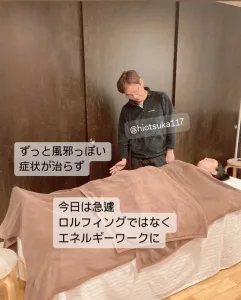
Sachiko Aimoto, the freelance announcer who took part, had had cold-like symptoms that would not clear for some time, and it was on her mind, so we did a session using Source Point Therapy instead of what had been planned. I would like to share what came of it.
What Is Source Point Therapy?
Source Point Therapy is work that engages the flow of energy, supporting the body as it moves toward its own state. One of its features is the use of points, around the body and within it. Through those points, the practitioner does not send energy; rather, the person’s own points begin to work, energy fills, and the body changes.
Each point supports the whole — not only the physical body but the feelings and the mind as well — as it moves toward a sound state. It is very much a whole-body approach, and the change is easy to feel physically.
In Sachiko’s case, I felt that the field she needs for her own health had been disturbed by energy from outside, so to bring that field into order I used a technique called Drawing Out.
Tension from the Throat to the Chest
A Drawing Out session finishes in about forty minutes altogether. What I noticed in Sachiko’s case was the tension I felt from the throat to the chest. I could feel that the muscles there had been holding, without release, for some time.
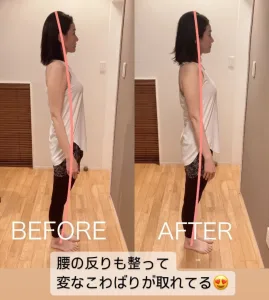
Sachiko works with her voice, so there is probably a fear that if the throat gives out, the work goes with it. Perhaps because of that, the throat had been held at the ready, and afterwards I felt that the body may have taken that shape in order to let the throat rest. With Source Point Therapy, between BEFORE and AFTER, as the throat let go, the sense of the spine lengthening came back — and I also said that care afterwards would matter.
In the end, I said that treating the throat kindly — as an ally, acknowledging that it is there — tends to let the body move toward what is easier, and with that the session came to a close.
Her impression the next day: “The curve of my low back has settled, and the odd stiffness has gone.”
Conclusion
This time I have introduced Sachiko’s testimonial, and let it carry most of the piece.