“I received Rolfing and my body changed. I want to become a Rolfer myself.” “I want to make bodywork my profession — but how does one actually study Rolfing?” For those who hold questions like these, this article lays out the full picture of the path to Rolfer certification.
What you’ll learn from this article: the differences among the organizations that certify Rolfers (DIRI, ERA, ABR), the content and length of Basic Training, the conditions for continuing education, and the path to Advanced Rolfer certification — all from the perspective of a Rolfer who trained with the ERA and earned Advanced certification.
A note before starting: the system changes. I trained between 2014 and 2016, when the ERA course ran in three stages called Phase I, II, and III. It has since been reorganized into Levels 1 to 3. This article describes the current system, and marks clearly where I am talking about the course as it was when I took it.
The Certifying Bodies
There are three main international bodies that certify the Rolfing credential.
DIRI (Dr. Ida Rolf Institute) is based in Colorado and is the direct lineage of the association Ida Rolf founded. Its training runs in three phases — Phase I, II, and III — totaling 731 hours across 28 weeks, held at the campus in Lafayette, Colorado. A three-week break falls between each phase, and the faculty-to-student ratio is limited to one to ten.
The program is accredited by the Commission on Massage Therapy Accreditation (COMTA), and graduating from the accredited program requires attending all three phases at the Lafayette campus. For those already licensed or trained in massage, chiropractic, or osteopathy, there is an accelerated route that grants credit for prior study.
The Japan Rolfing Association (rolfing.or.jp) also partners with the DIRI to hold training within Japan from time to time.
ERA (European Rolfing Association / Dr. Ida Rolf Institute Europe) is based in Munich, Germany. Its training runs in three stages — Level 1, Level 2, and Level 3 — and is offered in Munich as well as in Amsterdam, Stockholm, and Bologna. This is where I trained. No prior bodywork experience is needed to begin at Level 1.
ABR (Associação Brasileira de Rolfing) is the Brazilian association, active primarily in South America. Its training is sometimes held in Japan as well.
All three certifications are internationally recognized, and there is no practical difference in the sessions one can offer clients. The differences lie in location, language, structure, and the finer points of approach, so the choice comes down to your own circumstances. The ERA spreads 85 days across Levels and lets you choose between an intensive and a modular format; the DIRI runs 28 continuous weeks at its own campus. Which of those fits your life is the more useful question.
Where you certify does not determine where you can work. I certified with the ERA and practice in Japan. Membership follows the region where you practice — in my case, the Japan Rolfing Association. Which body you train with and where you eventually work are separate questions.
Maintaining certification means paying annual dues to the association you belong to. ERA membership is 120 euros for the first two years and 495 euros from the third year onward. In the United States, DIRI dues run around 600 dollars a year, a figure discussed periodically in the profession’s own journal (The Business of Rolfing SI). In Japan, full membership in the Japan Rolfing Association is 30,000 yen a year — the figure I paid from 2015 through 2025. Worth knowing as a fixed annual cost after certification.
→ ERA — How to Become a Rolfer
→ DIRI — Become a Certified Rolfer
→ Japan Rolfing Association — Education (Japanese)
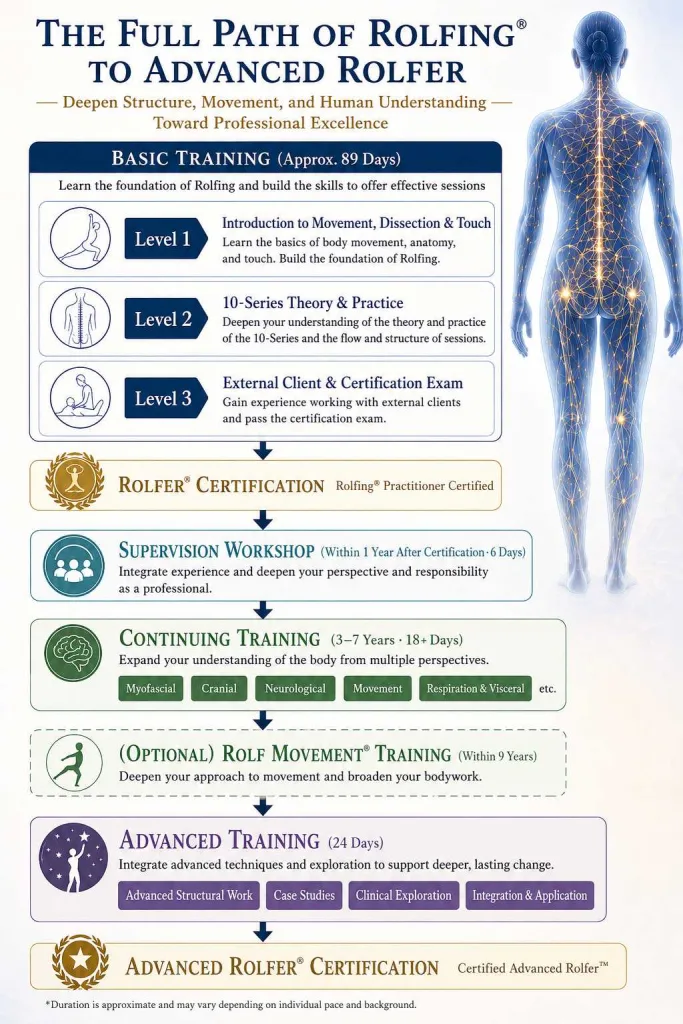
Step 1 — Basic Training (85 Days)
The Three Levels
Basic Training is where you acquire anatomy, palpation, fascial theory, and the theory and practice of the Ten Series. At the ERA it runs across three Levels, 85 days in total.
Level 1 (Myofascial Foundation) is 27 days: nine three-day workshops, three each across the three pillars of Movement, Anatomy, and Touch. It is open to those with no bodywork experience, and the first three courses (Movement 1, Anatomy 1, Touch 1) can be taken on their own to see whether Rolfing suits you. Completing all nine leads to the Myofascial Foundation certificate and admission to Level 2. Receiving one to three sessions of the Ten Series beforehand is recommended.
Before that, there is Meet ROLFING, a one-and-a-half-day introductory workshop. No experience is required, and it is not a compulsory part of the training. It covers the history of Rolfing, connective tissue and gravity, structural body analysis, the basics of touch, and a demonstration session. Suited to anyone who wants a first taste.
Level 2 (Structural Fascial Bodywork) is 34 days. This is where the theory and practice of the Ten Series are learned, working on fellow students, with a first outside client toward the end of the course. Ethics and practice building are included.
Level 3 (Rolfing Structural Integration) is 34 days, giving a complete Ten Series to an outside client under the supervision of instructors. There are midterm and final interviews, and a certification workshop at the end leads to certification as a Rolfer.
Two Formats
The ERA offers an intensive format and a modular format, and you can switch between them at each Level. Level 2 runs as two four-week blocks in the intensive format, or across about ten months in the modular one. Level 3 runs eight weeks intensive, or ten to twelve months modular. The choice depends on whether you are studying alongside work or setting aside a block of time.
The Course as I Took It
I took the old system — Phase I to III — which came to 84 days.
Phase I (Foundations) was 15 days, Phase II (Embodiment) 33 days, and Phase III (Clinical Application of Rolfing Theory) 30 days, plus a six-day Supervision Workshop a year after certification. That workshop was compulsory then; today it is one of the continuing education courses (Deepening the 10 Sessions, four days).
The entry point is what changed most. Phase I involved a review of documents: a Ten Series from a Certified Rolfer, five movement sessions, a university degree, a qualification or experience in hands-on work, and an Admission Paper of five to eight thousand words. Only those who met all of it entered the room. Level 1 today has no such requirements.
There was also a separate course at the time called Spectrum: thirteen days covering movement, anatomy, and touch, recommended before the main training but not required. This, rather than Phase I, is what corresponds to today’s Level 1. What was once an optional preparatory course has become the compulsory entrance. The gate moved from a document review before entry to the completion of Level 1.
For what is learned at each stage and who teaches it, I have written a separate article.
How I Met the Application Requirements
The one requirement I did not meet at the application stage was hands-on work. I held no qualification in massage or shiatsu.
So I set out my experience in detail: a 200-hour Yoga Alliance teacher training; more than fifty hours of hands-on work with over thirty students; guiding students physically through poses using anatomical knowledge; and a doctorate giving me a grounding in anatomy and physiology. The Education Committee reviewed it and admitted my application for Phase I.
I also used the opportunity to take a Thai massage qualification. It was there to satisfy a requirement, but it became the first bodywork skill I acquired.
The requirements look fixed on paper; in practice, what mattered was what I could actually do. If you have prior bodywork experience or related qualifications, it is often worth asking. What gets read in your favor, though, is then actually looked at. In my case, I received a conditional assessment in the anatomy week of Phase I.
What the Training Teaches
Beyond the structure and function of anatomy and fascia, what matters most are body reading and touch — reading what structural patterns a client’s body holds and what it needs, and working appropriately with the fascia. Cultivating both at once is the substance of Basic Training.
More important still is learning, in the body, a Rolfer’s way of being. Not doing technique, but responding to what the client’s body needs. That theme runs through the whole training.
Mentoring Sessions
The training also includes assignments outside the classroom: mentoring sessions, in which students visit an Advanced Rolfer at their practice for individual instruction. The ERA requires five such sessions before certification.
I completed mine with four different Advanced Rolfers.
- Keith Graham (London): twice, in 2014 and 2016.
- Alan Richardson (London): 2014.
- Kathrin Grobelnik (Leipzig): 2016.
- Hubert Godard (Paris): 2016. Receiving mentoring directly from Godard — the Rolfer and dancer who built the theoretical foundations of Rolf Movement — changed how I see the body and movement.
What deepens the learning is not simply picking up technique, but encountering the perspectives and the presence of different Rolfers. Each of them worked entirely differently. How different the same Rolfing could look was my honest impression.
Looking back over my study of Rolfing, I have learned from 24 teachers: nine in Basic Training, seven in Rolf Movement Training, five in continuing education, two in Advanced Training, and four through mentoring.
Three of them taught me in more than one course, so that figure is the count with duplicates removed. Who teaches you shapes the depth of the training considerably. As for choosing a Rolfer or a training teacher, the best route is to talk to a Rolfer practicing where you want to work.
Step 2 — Continuing Education
Certification is followed by ongoing study. At least eighteen credits of continuing education are required before the Advanced Training. One day of attendance counts as one credit.
At the ERA those eighteen credits have a structure: ten credits of Intermediate (manual work), five of Movement, and three of elective credit. A movement workshop is built in as a requirement.
The content is varied — fascia, the cranium, the nervous system, movement — with workshops led by specialists held around the world.
The main continuing education I took after Basic certification:
- Neural Fascial Mobilization (Jonathan Martine): a twelve-day intensive on the mobility of the neural fascia. Tokyo.
- Bone Work (Sharon Wheeler): a five-day workshop on a direct approach to working with bone. Tokyo.
- Structural Integration for the Cranium (Sharon Wheeler): a four-day workshop on a structural approach to the cranium. Seattle.
- Trauma Workshop (Lael Keen): a one-day workshop exploring the relationship between the body and trauma. Tokyo.
- Dimensions of Integration (Gael Rosewood): a four-day movement-based workshop exploring the depth of integration. Tokyo.
- Peter Schwind Workshop (ERA): a three-day workshop in Munich with Peter Schwind, an ERA faculty member and a leading authority on fascia and structural integration, known for his work on Fascial and Membrane Technique.
Continuing education broadens both the range and the depth of a practice.
Which courses fill those eighteen credits, however, is not specified. This is the one stage on a Rolfer’s path where the content of your learning is your own to choose. I have written separately about the framework, the five taxonomies, and the leanings of teachers and regions — and about what I actually look at when the options are in front of me.
- Continuing Education After Rolfing Certification — The 18-Credit Framework and a Map of the Teachers
- How to Choose Continuing Education — Four Things I Look At Before Signing Up
- Becoming a Certified Rolfer in Europe — The Certification Training of the European Rolfing Association
- List of Certifications and Training (as of July 11, 2025)
Step 3 — Rolf Movement Training (Optional)
Offering Rolf Movement is not possible with Basic certification alone; it requires completing the separate Rolf Movement Practitioner training. In the ERA’s pathway it sits as its own course, after Level 3 and before Level 4.
The training runs in three Parts across 30 days. It covers, in practice, the frameworks Hubert Godard systematized — Tonic Function and pre-movement among them. Where Rolfing works on the body through the practitioner’s hands, this works through the client’s own movement.
I completed Parts 1 to 3 in Munich between July 2017 and December 2019 and became an ERA-certified Rolf Movement Practitioner. By the ERA’s own figures, about a quarter of Rolfers hold this certification.
With Rolf Movement, the structural and movement approaches come together, considerably expanding the range of what can be done in a session.
- What Is Rolf Movement? — Bodywork That Explores the Quality of Movement
- On the Path to Becoming a European Rolf Movement Practitioner — The Road to Certification
Step 4 — Advanced Training
Requirements
At the ERA, the Advanced Training requires three to seven years of practice after certification and at least eighteen days of continuing education. For those who complete the Rolf Movement certification, that period extends to nine years.
My own path went through the ERA for the basic training and Rolf Movement, but for the Advanced Training I took the one organized by the Japan Rolfing Association, in 2025, ten years after certification. It was taught by Ray McCall from the United States and Hiroyoshi Tahata from Japan.
The Content
The Advanced Training is 24 days: Phase 1 (12 days) and Phase 2 (12 days). Through sessions with outside clients and among students, three things are learned in the body: working non-formulaically, seeing, and being.
It is 24 days not of being taught technique, but of rebuilding one’s capacity to observe and to respond.
“This is not mere visual inspection. It is listening to the body with the whole sensory apparatus.” — Jeff Maitland, Rolfer and philosopher
What It Gives
Sessions change after Advanced certification. Clients say things like: I don’t know what you did, but something changed. It feels completely different from before. Those are signs of the non-formulaic approach and of being showing up in the session.
For how an Advanced Rolfer’s session differs from a Basic one, seen from the client’s side, I have written a separate Gateway article.
- Why Are Advanced Rolfer Sessions “Profound”? — Three Differences, Ten Years After Rolfer Certification
- Journey to Becoming an Advanced Rolfer — A Summary of the Road to Certification
The Full Picture
The course days come to 85 for Basic, 30 for Rolf Movement, and 24 for Advanced. Days are not the same as elapsed time, though. Level 2 and Level 3 each run across about ten months, so Basic certification takes roughly three years. Three more years of practice are needed before the Advanced Training, making six years or so the shortest route.
Rolfing asks for more than technique. It asks for an accumulation of body, experience, and presence.
If You Are Considering Becoming a Rolfer
First, receive Rolfing sessions. Knowing both sides — receiving and giving — is what clarifies why you want to train. The ERA also recommends one to three sessions of the Ten Series before starting Level 1.
For those who want to know what Rolfing is and what changes for the people who receive it, these are the way in.
→ What Is Rolfing’s Ten-Series? — Three Phases in Which the Body Changes, and the Flow of Each Session
→ Testimonials of Those Who Received Rolfing — Classified by Symptom and Purpose
→ What Is Rolf Movement? — Bodywork That Explores the Quality of Movement
→ Yoga × Rolfing Gateway ── Why Is There a “Layer That Cannot Be Reached” Even After Continuing Yoga
Among bodywork modalities, Rolfing asks for an unusually long and deep course of study. It calls for the resolve to keep learning over years, and a real interest in the body.
If you are in Japan, the Japan Rolfing Association’s (JRA) directory is a good place to find a certified Rolfer.
If you are in Europe, you can look for practitioners through the European Rolfing Association (ERA), which also provides information about Rolfing training in Europe.
If you are in the United States, the Dr. Ida Rolf Institute (DIRI) is the main place to look for information about training and certified Rolfers.
- ERA – Find a Rolfer® near you
- DIRI – Find a Certified Rolfer® Near You
- JRA – Certified Rolfer Directory (in Japanese only)
Wherever you are, speaking directly with a practicing Rolfer is probably the most useful first step. Training websites can tell you the formal requirements, but practitioners can often tell you what the training is actually like.
I received Rolfing as a client from December 2013, finished the Ten Series in 2014, and decided then that this was what I wanted to study. Eleven years later I received Advanced certification. It is a long road, and the accumulation of one step at a time becomes the depth of the practice.
- Becoming a Certified Rolfer in Europe — The Certification Training of the European Rolfing Association
- On the Path to Becoming a European Rolf Movement Practitioner — The Road to Certification
- Journey to Becoming an Advanced Rolfer — A Summary of the Road to Certification
Questions about becoming a Rolfer, choosing a training, or continuing education are welcome.
Related Articles on the Rolfing Training
- Becoming a Certified Rolfer in Europe — The Certification Training of the European Rolfing Association
- Continuing Education After Rolfing Certification — The 18-Credit Framework and a Map of the Teachers
- How to Choose Continuing Education — Four Things I Look At Before Signing Up
- On the Path to Becoming a European Rolf Movement Practitioner — The Road to Certification
- Journey to Becoming an Advanced Rolfer — A Summary of the Road to Certification
Hidefumi Otsuka (Ph.D.) | Certified Advanced Rolfer™ / Rolf Movement Practitioner
Completed a doctoral program at the Graduate School of Medicine, the University of Tokyo. After a career in the pharmaceutical industry, has offered Rolfing® sessions in Shibuya since 2015. Has practiced and taught Ashtanga Vinyasa Yoga since 2006. Works under the theme of “the integration of thought, emotion, and body.”