Introduction
Since June 2015, I have offered Rolfing sessions. Approaching the fascia brings the posture into order, and the movement of the body improves along with it. This time, after a while, I would like to introduce a Rolfing testimonial — a Rolf Movement one.
What Is Rolf Movement?
Ida Rolf, who founded Rolfing, called the fascia the organ that maintains the shape of the body — the Organ of Structure. The shape of the body is the history of the life that person has walked, and all sorts of experience is inscribed in it. In Rolfing’s hands-on work, when enough pressure is applied for the fascia to find a place where it can move, the shape of the body changes. As the shape changes, the movement of the body changes with it.
In the ten Rolfing sessions, improvement in posture and in the movement of the body can be expected, by way of the fascia. There is, in fact, another kind of session. To settle the effect of Rolfing, there are the three-to-five sessions of Rolf Movement, which center on how the body moves.
It is a session that brings bodily movement into the “Rolf” of the founder, Ida Rolf. It has been offered since 2020, suited to people who want to raise their performance through the body — yoga, Pilates, dancers, singers, instrumentalists, breath, and so on. What is interesting is that by drawing on all the muscles and going slowly, carefully, putting things into words, a large change takes place in the body.

What I pay attention to is not having the client memorize a movement, but turning their awareness toward the body. Most people move the body from the head, and tend to react to things quickly. Probably a society that prizes speed, efficiency, and thinking with the head has made it that way.
What happens the other way round — slowly, letting go of the movement you have used until now, going carefully? What comes into view is where, inside your own body, you are tense and hard to move. The habits of movement picked up in the past — old habits — are let go, and a new option appears in the body’s awareness. You could say that, as a result, a new habit of movement takes hold.
Experiencing a Session — Sachiko Aimoto — Improving the Movement of the Upper Body
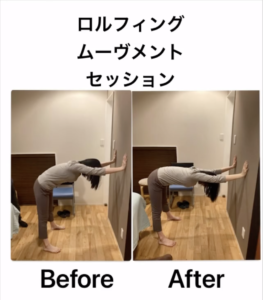
This time, Sachiko Aimoto, a freelance announcer, tried Rolf Movement centered on the upper body. Both hands press against the wall while the hips push back (in yoga terms, the Downward Dog pose). When the muscles of the hands, elbows, shoulders, spine, pelvis, and hips have let go, the body lengthens in a straight line, as in the After below.
In this session: among the hands, elbows, scapulae, spine, trunk, and pelvis, where is the restriction? She recognized it first in the Before posture above (the right side lengthens less easily), and then we began. In the movement of extending the arm, the elbow, shoulder, and neck tighten readily. What happens if each is moved separately?
Anyone can do the movement, but the point is to go slowly and carefully, putting each noticing into words as the session proceeds. Movement like this tires the brain and the body, so we took breaks now and then, raised the arm, and checked what had changed. The session took about an hour.
- From immediately after it ended, the neck pain and stiff shoulders decreased dramatically.
- Even during the Movement session, the range of motion changed.
- The movements of yoga and Pilates became much clearer.
- Doing the Movement work before singing, the voice resonates differently.
- The abdominal muscles let go, and yet the waist drew in.
- The bust sat higher, and the neck and shoulders felt clearer.
- Thinking became clear.
And so on.
Conclusion
This time I have introduced a testimonial, and let it carry most of the piece.