Introduction
Since 2015, this practice has worked to align posture through Rolfing sessions that approach the body by way of the fascia.
The posture that Rolfing emphasizes rests on three elements: walking, standing, and sitting. This article unpacks how these foundations of posture relate to the “body map” within the brain.
What Is a Body Map? — The Key to Maintaining Posture and Recognizing the Self
Why is it that, even with the eyes closed, a person can touch their own nose and know exactly where their limbs are? It is because a “body map” exists within the brain, constantly registering what is located where.
This map extends beyond the physical body as well. The space within reach of an outstretched finger is called “peripersonal space,” and the brain treats this region, too, as part of the self. A skilled rider feeling at one with the horse, or a person handling a smartphone or a tool as though it were an extension of the body — these are made possible by the flexible, expandable nature of the body map.
Without this map, neither grasping the surrounding world nor establishing the “self-recognition” that defines individual character would be possible. Understanding the body map is a key to understanding how the physical body and the intangible mind intertwine to create an emotionally rich “self.”
Two Aspects of the Body Map: Body Schema and Body Image
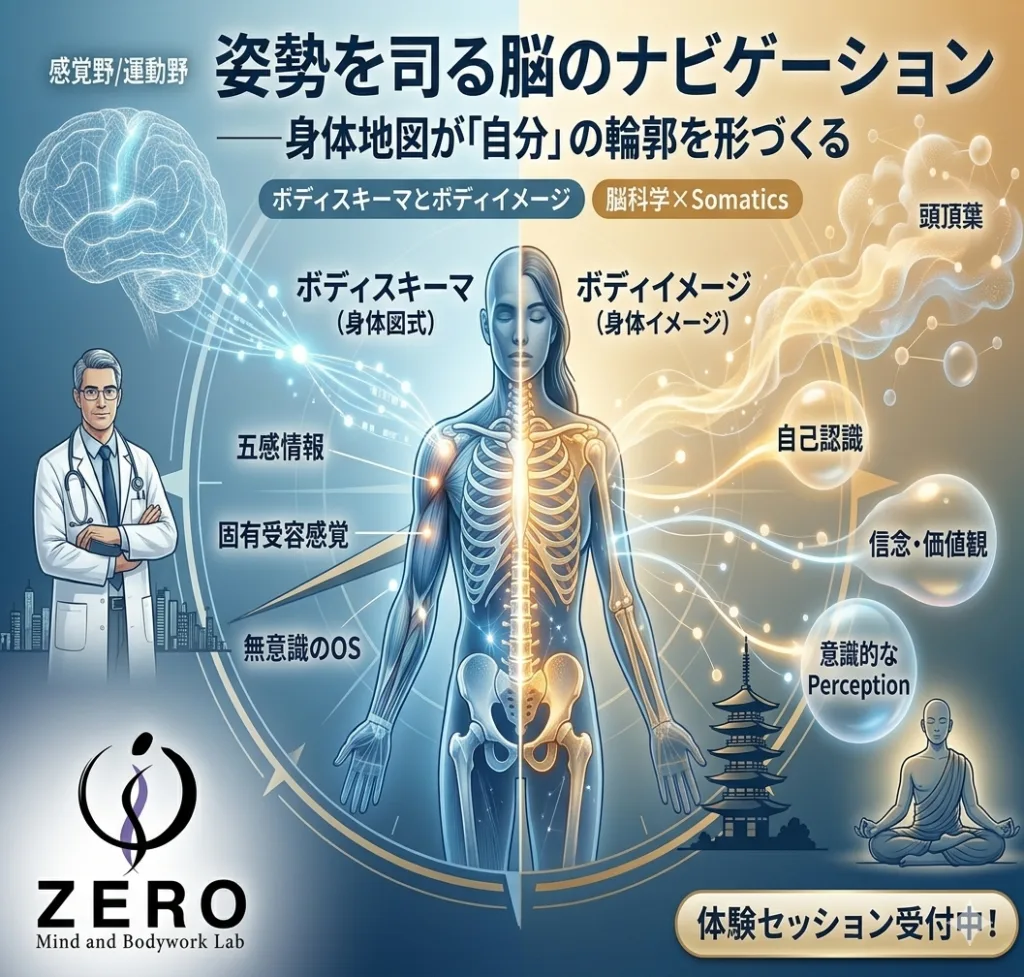
In The Body Has a Mind of Its Own by Sandra Blakeslee, the body map is introduced as two distinct kinds: the “body schema” and the “body image.”
Body Schema — A framework of thought that the brain constructs unconsciously. Built from experience, it cultivates a way of seeing the world that transcends the subjective and the objective, and from it each person’s individuality arises.
Body Image — A map formed by conscious perception and by personal expectations and assumptions. Feeling “fat” despite being thin is the work of this image. Strongly psychological and perceptual, it is deeply tied to one’s worldview (perception).
Body Schema: The OS Within the Body
The body schema is assembled automatically from information drawn from the five senses, proprioception, vestibular sensation, and more. The neuroscientist Wilder Penfield once represented the correspondence between regions of the brain and parts of the body with a figure known as the “homunculus” — the little person.
The occipital lobe governing vision, the parietal lobe handling spatial awareness, the frontal lobe overseeing morality and self-control, and other regions work in concert, ceaselessly updating their information. This function, known as the body schema, is in effect the operating system of a computer. The term comes out of neurology: Henry Head and Gordon Holmes used it in 1911. The philosopher Merleau-Ponty took a concept that already existed and brought it over into phenomenology.
Body Image: The Source of Beliefs and Values
The body image concerns the “self-image” and the beliefs that shape how a person regards and expresses themselves. Unlike the body schema, which is stored in specific locations, the body image is scattered throughout the brain and responds to predictions about, and expectations of, the external environment.
This concept, proposed by the neurologist Paul Schilder, is individuality itself, accumulated across a lifetime. Influenced by family and culture, each person interprets it and forms a distinct set of values. The conviction that “this is the kind of person I am,” set during adolescence, is difficult to change once it takes shape, and can become a source of the gap between the body’s actual state and its image.
What Can Rolfing Do?
Rolfing does not manipulate the intangible body image directly; instead, it turns its attention to the tangible “body schema.”
By approaching the fascia that connects the whole body, Rolfing works directly on the five senses and proprioception, changing the quality of the information sent to the brain. As the body comes into alignment and a felt sense of mind-body unity develops, there arrives a moment of realizing that the conviction “this is how I am” (the body image) was nothing more than an illusion. In other words, Rolfing is a method that, by updating the body schema, rewrites the body image as a result.
Summary
This article has explored posture and the body map.
- Body schema: the unconscious map the brain assembles automatically by gathering information.
- Body image: the conscious map formed by environment, culture, and subjectivity.
Both together shape how the world is seen. Rewriting the operating system that is the body map can make the way a person lives feel lighter. It is a hope that this glimpse of Rolfing’s possibilities proves useful in some way.
Conclusion: Bringing the “Internal OS” Up to Date
When posture collapses, the cause may not be a simple lack of muscular strength — it may be that the “body map” (the body schema) within the brain has grown outdated.
A Rolfing session is a process of sending fresh information to the brain through the fascia and redrawing this map vividly. Once the map is updated to its current state, the body no longer needs to “try hard” to hold posture; without conscious effort, it settles into the easiest, most functional place.
To become free of the “assumptions” (the body image) that once bound the self, and to engage with the world anew through a fresh body map — that lightness is something worth experiencing firsthand, in one’s own body.
Steps to Update the Body Map and Meet a New Self
At the studio in Shibuya, sessions are offered that tune the network of brain and body and update “self-recognition” from its very foundations.
Rewriting the Map in the Brain: The Trial Session
Where the body is, and how far it extends — a trial session is a chance to feel the moment when the “resolution of sensation” rises: the surprise of an approach to the fascia reaching the brain, and posture coming into order of its own accord. How the way the world appears (perception) shifts after a session is something best confirmed in person.
▶ Details and inquiries about the trial session here
Finally: When the Body Changes, the Relationship with the World Changes
The body map is the navigation system that connects a person to the world. When this map becomes clear, hesitation dissolves, and action turns more direct and natural. This goes beyond mere improvement of posture; it is a journey that updates the way a person lives.
In the quiet of the studio, it would be a sincere pleasure to help begin drawing that new map.