Over two blog posts I have touched briefly on how Reiki spread to the West and on its history in Japan (see “The Background, and How the West Took It Up” and “How It Came Down to Us“). This time I want to write about Jikiden Reiki and the line it comes from.

Last time I described how Western Reiki spread worldwide through Hawayo Takata, the Japanese American in Hawaii who learned from Chūjirō Hayashi, while Reiki in Japan was reduced, after the Second World War, to a state close to extinction.
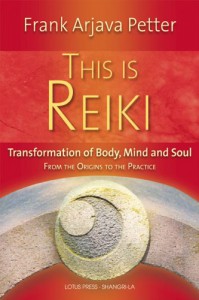
Reiki began to be reconsidered in Japan in 1987. One of the Reiki organizations abroad, the Radiance Technique Association, started holding seminars there, and the practice returned as a reimport. In 1993, Frank Arjava Petter, then living in Japan, began producing Japanese teachers of Western Reiki — people qualified to teach it (see “This is Reiki“). Today there are said to be twenty thousand practitioners of Western Reiki in Japan.
Western Reiki reached countries around the world by way of the United States, but it is also said to have been modified from the original. The idea of protecting people from negative energy, and the framework of chakras, are said to have been added later.
As it spread in Japan, an interest in its roots followed. It became known that the Usui Reiki Ryōhō Gakkai — thought to have been destroyed by the occupation — had survived, and that Chiyoko Yamaguchi, who had received instruction directly from Chūjirō Hayashi, was still alive. She had learned Reiki in 1938 at the age of seventeen and had been practicing for sixty-five years.
That discovery in 1999 gave rise to a movement to transmit Hayashi’s own teaching, and the Jikiden Reiki Kenkyūkai, where I studied, was established. The name Jikiden carries the meaning of Reiki transmitted directly from Chūjirō Hayashi, and the aim is to pass on the teaching as it was. The current head of the association is Tadao Yamaguchi, Chiyoko Yamaguchi’s son.
Studying Jikiden Reiki, you can see the influence of Shintō and Buddhism in Japan, but what it holds most important is kotodama. Looking up kotodama in the Daijirin dictionary: a mysterious power believed in ancient Japan to reside in words, held to bring about the result the spoken word describes.
My own interest in kotodama came from a book by Ihaleakalá Hew Len on Ho’oponopono.
Ho’oponopono, which originates in Hawaii, understands the various problems that arise in the world as the replaying of information in the subconscious — memories of the past. Carrying troubles, illness, or debt is a matter of past memory, and can be resolved by correcting the information in one’s own subconscious.
The method is extremely simple: simply repeating four phrases —
- I’m sorry
- Please forgive me
- Thank you
- I love you
— clears those memories.
The light from the divine, which had been obstructed by past memory, then reaches you directly.

Hew Len worked for five years, from 1983 to 1987, in a special ward at Hawaii State Hospital. It housed inmate patients charged with crimes including murder, assault, and theft, and considered to be in states of derangement; it was known as a frightening place to work.
Hew Len himself practiced Ho’oponopono, cleaning the information daily by reciting the phrases. As a result, the assaults that had occurred three or four times a day on average declined within two or three months of his arrival. Results accumulated, and over months and years seriously ill patients were discharged.

Why is this possible? Because all problems are understood to occur within oneself; there is no problem occurring outside oneself.
What corresponds to the phrases of Ho’oponopono, in Jikiden Reiki, is the gokai — the five precepts. Usui introduced them after observing that people he had treated with Reiki would return again after a while, concluding that a person does not truly recover unless the mind changes. The precepts are recited three times.
Just for today: do not be angry, do not worry, be grateful, work diligently, be kind to others.
What resembles Hew Len’s Ho’oponopono is the idea that reciting these words orders the space, and negative energy no longer enters. The difference lies in the negative constructions — do not be angry, do not worry.

Conventional Western psychology holds that the subconscious cannot recognize negation. When the brain hears do not worry, it gives priority to the word before the negation — to worry itself.
Why Jikiden Reiki uses negative constructions is unclear. What is certain is that it works. I would like to look into that puzzle someday.
So Reiki yields a good deal when approached through kotodama. Next time, saying a little more about the relationship between kotodama and Reiki, I want to introduce reiju, and the influence on tarot and on Rolfing.
Note, August 2026
This piece ends leaving one question open.
The five precepts include negative constructions: do not be angry, do not worry. Conventional Western psychology holds that the subconscious cannot recognize negation — hear do not worry and worry takes priority. Yet Jikiden Reiki uses the negative form deliberately. The reason is unclear, I wrote, but it certainly works. I would like to look into it someday.
Eleven years on, material has gathered around that question.
Precepts are negative to begin with
The term gokai — five precepts — is itself Buddhist. Buddhist precepts are almost all given in the negative: do not kill, do not steal, do not speak falsely. Usui had spent three years in Zen practice. Borrowing the form is unsurprising.
But perhaps what was borrowed is not only the form.
Reading medieval Japanese Buddhism this year, something struck me at Saichō. What Saichō sought was an independent Mahāyāna ordination platform. The full precepts until then formed a system of enumerated rules, and whether you were keeping them could be measured from outside. What Saichō adopted, the bodhisattva precepts, are different in character. You take the vow on yourself, and when you break it you return to it each time. The word for it — receiving the precepts — says as much: not something commanded, but something taken on.
This is where the phrase placed before the precepts does its work: just for today. Not never be angry. Just today. It is built to be taken on again each day.
Read as rules, or read as a vow
With that distinction, the question loosens a little.
Read as rules, the negative form is a list of prohibitions. Whether you are keeping them is what matters, and breaking one is a failure. The problem psychology points to arises with this reading: telling someone not to worry makes them picture worrying.
Read as a vow, the negative form indicates what is to be let go of. To let something go you first have to know what it is. You cannot release what does not come to mind. Telling someone who has never known anger not to be angry will not reach them.
Ways of being are also stated in the negative
The same structure turned up ten years later somewhere else.
Setting out what I received in the 2025 Advanced Training makes it visible. When Ray McCall named the practitioner’s distance Kind Indifference, the explanation was: do not get caught up in the client’s experience. The osteopath Jim Jealous’s line runs the same way: observe, but do not become part of the story. The first of Maitland’s three stages for training observation is to let go of self-centered intention.
SPT was no different. The practitioner does not send energy. The practitioner does not apply force in order to make things better. Yielding, as a word, names something one does not do.
And none of these is something you achieve and finish with. Neutral and Kind Indifference are not acquired once; you return to them each session. They have the shape of a vow.
Still not an answer
This is something that struck me while reading, not something I have looked into. Why the five precepts are negative remains unclear.
But the question looks different than it did eleven years ago. Then I saw it as a contradiction: the negative form should not work, and yet it does. Now there is another view alongside it — that how the negative form works depends on whether you read it as a rule or as a vow.
No answer has arrived. The question has only moved to a different place.