On October 8, 2020, the third day of Module 3 in the Source Point Therapy (SPT) training came to a close.

I wrote about the first day separately (see “The First Day: Not Intervening, What Meditation and SPT Share, and the Relation to Shamanism“). Module 3 is being taught by the two founders, Bob Schrei and Donna Thomson.
Hiroki Sato (hereafter Hiro), who runs TEN — the space for your Life & Body, is a Rolfer and also a certified athletic trainer, with a deep grounding in anatomy. In Modules 1 and 2 he conveyed the depth of SPT fully.
What is good about learning from the two founders is that the understanding deepens at the root — how they built SPT into a system. And because they speak English slowly, and because Hiro brings his own deep understanding of and affection for SPT, my grasp of SPT’s thinking has deepened in both Japanese and English. These have been three full days.

I hope SPT deepens further over the remaining three.
The first three days were given to deepening the Blueprint — the information needed for a human being to take human form.

SPT carries out energy work on the basis of two ideas. One is the points: places for connecting the information of the Blueprint into the body. The Diamond Point, the Golden Rectangle Point, the Navel Point, the Entry Point, and others. The other is the scan: looking for where in the body the Blueprint’s information is not being reflected. Any obstruction to the energy is understood to show up in the body in some form.

As Hiro’s site puts it,
- You balance your physical state by accessing points around your body.
- First, use your hands to locate the spots that want to be addressed.
- Feel for where the energy is blocked, and work to restore its flow.
- Check whether the blockage has cleared, and then move on to find the next spot.
It is fascinating how the body naturally realigns itself simply by repeating this process.
Module 3 integrates the methods taught in Modules 1 and 2 and deepens the understanding of them. Trying Modules 1 and 2 with a range of clients over five years, I think my own understanding has deepened. What has been good this time is that Hiro gives feedback on the work from time to time. His feedback has room in it, and I feel my understanding of the work deepening.

Now, in deepening our understanding of the Blueprint, we took up LEVEL.
According to Donna Thomson, a LEVEL is one of the various elements that contribute to a symptom appearing on the outside of the body. To approach such an element, you access the frequency it holds.
There are five LEVELs: trauma, karma, emotion, ancestors, and belief systems. Module 3 takes up three of them — trauma, karma, and emotion.

What Modules 1 and 2 dealt with covers most cases at the general level. In fact, the general level is the deepest of all. When that does not suffice, you approach another dimension.
With LEVELs such as trauma, karma, and emotion, intent alone lets you tune not only to the physical level but to the mental and energetic levels. It feels like tuning a radio or a television to a channel.

On top of that, unlike psychotherapy, you can approach the root without hearing the account of someone carrying trauma.

Bob Schrei introduced a book by Robert C. Scaer, who is well versed in Somatic Experiencing: Trauma Spectrum: Hidden Wounds And Human Resiliency.
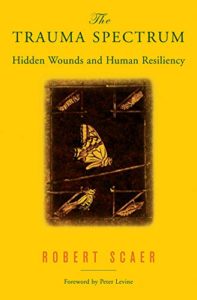
The book states three things as important in resolving trauma: a sense of psychological safety felt within a container, a ritual element, and down-regulation of the limbic system — a relaxed state close to sleep. SPT, we were told, handles all three.
What was interesting — unexpected, or perhaps obvious — is that the place you tune from is the Navel Point, at the navel.
Come to think of it, the navel is the center of vital energy. Through the practice sessions I could feel that it is a fitting place from which to tune to each LEVEL.
To tune, what matters most is how you handle intent. Hiro emphasized this too when we moved into practice.

In the demonstrations and in the paired practice, we worked through the details. Where is the primary blockage obstructing the flow of the Blueprint’s information? At the Navel Point, how do you access the trauma LEVEL? At the trauma level, where is the primary blockage obstructing the flow?
After the morning online session with the two of them, we moved to practice in the afternoon. Tuning to the trauma LEVEL gave the impression that the field shifted all at once.

Module 3 also covers Drawing Out, energy work for removing negative energy that has entered from outside. I have a client in mind for whom this method might lead to healing in the body, so I want to try it when I get back.

There are twelve participants, a small and capable group, and Hiro has taken various measures to provide a psychologically safe space, which helps.
Over the remaining three days, I want to approach the training enjoying whatever deepening of SPT is possible.
Note, August 2026
The subject of this piece is how trauma is handled within energy work.
SPT’s position is clear. Unlike psychotherapy, you can approach the root without hearing the account of someone carrying trauma. Intent alone lets you tune from the physical level to the mental and energetic levels, like tuning a radio or a television to a channel.
No confronting it head-on. No re-experiencing. That was SPT’s stance.
I had been learning the same subject from another lineage
The basic Rolfing training also deals with trauma and the body. What I learned in Phase II was Peter Levine’s Somatic Experiencing and Stephen Porges’s polyvagal theory. The former works with the response that remains in the body. The latter works with how the autonomic nervous system answers safety and threat.
The understanding that it remains in the body rather than in the event is shared. Where they part is what comes next. Somatic Experiencing follows bodily sensation, little by little. SPT does not follow; it tunes.
What is interesting is that Robert C. Scaer, the author of the book Bob Schrei introduced that day, is precisely someone well versed in Somatic Experiencing. Follow a single book out from the SPT side and you arrive at the same lineage I had studied on the Rolfing side.
Two things entered through separate doors, connecting at the same place.
The condition of a safe field
Three things were cited from that book as important in resolving trauma: a sense of psychological safety felt within a container, a ritual element, and down-regulation of the limbic system. SPT handles all three.
The first of them comes back ten years later.
In the 2025 Advanced Training, what Ray McCall offered as the answer to Where do you start? was that the practitioner holds a perceptual state in which safety and reassurance can be felt. Whether the field is safe is treated not as a quality of the person receiving but as something the practitioner makes (see “Journey to Becoming an Advanced Rolfer — A Summary of the Road to Certification“).
And this piece says the same thing once more, in its closing paragraph: there are twelve participants, a small and capable group, and Hiro has taken various measures to provide a psychologically safe space, which helps.
The condition a session needs turns out to be the same condition the room teaching it needs. At the time I wrote those two as separate things — the handling of trauma as content learned, the atmosphere of the classroom as an impression.
Read now, one and the same thing appears in two places.