Introduction
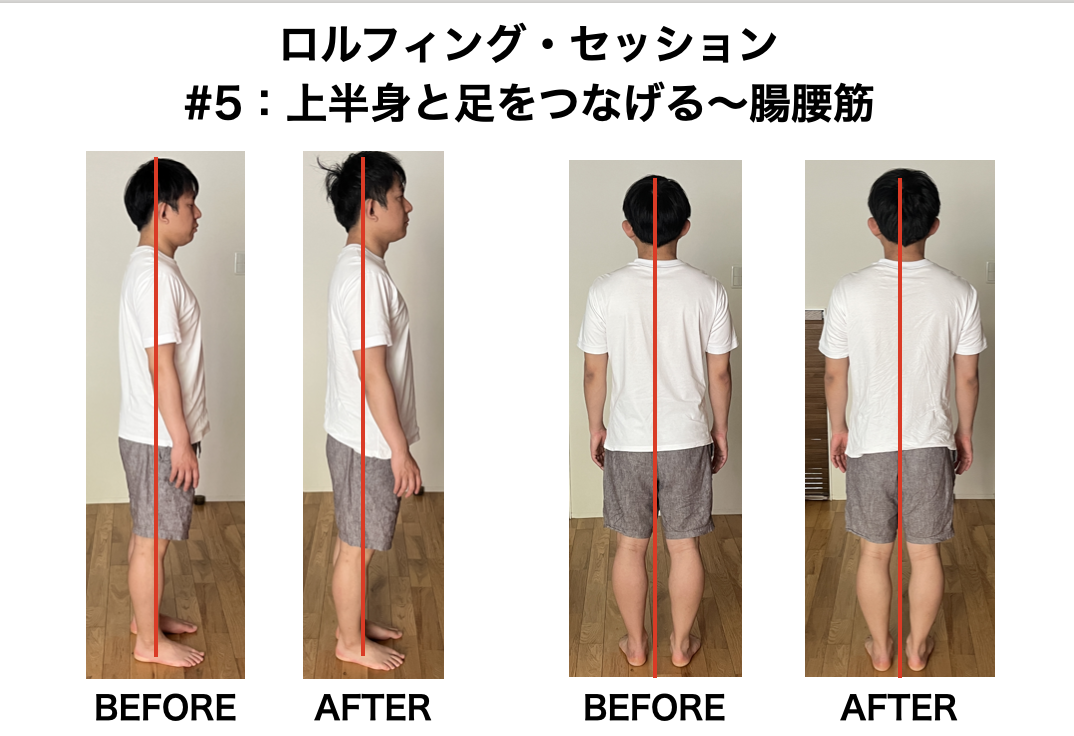
Since June 2015, I have offered Rolfing sessions. Approaching the fascia brings the posture into order, and the movement of the body improves along with it. This time, I would like to introduce a testimonial from a fifth Rolfing session.
Working with the Deep Muscles — What Settles?
Sessions 1 to 3 work with the superficial muscles, on the outside of the body; sessions 4 to 7, which bring the medial line into order, work with the deep muscles, on the inside.
Why the work in the depth matters is that it brings you to “Where am I taking my life? What is it for?” — and that reaches how a person lives, and what they feel, in a large way.
Sessions 4 to 7 proceed in the following order.

Session 4: the lower body (the adductors through to the pelvic floor)
Session 5: the front of the spine in the upper body (the psoas, the viscera, the diaphragm)
Session 6: the back of the spine in the upper body (the lower leg, the gluteals, the sacrum, the spine)
Session 7: the shoulders and the whole neck
Drawn out, it looks like this.

Session 5 — The Psoas and the Viscera
Where the fourth session raised awareness of the adductors and the pelvic floor, the fifth passes by way of those and works mainly on the front of the body, bringing the upper body into order.
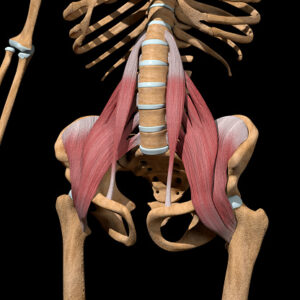
The iliopsoas — the psoas major and the iliacus, sometimes with the psoas minor included — is the only muscle that joins the lower body to the upper. As the anatomical figure above shows, it attaches to the front of the spine. Running from the front of the lumbar spine, past the pelvis, down to the leg at the lesser trochanter of the femur, it also matters a great deal for holding posture.
As the Japanese name says — the muscle of the intestines and the low back — the iliopsoas is closely tied to the gut. The place in the intestine where stool most readily gets held up, for instance, is the sigmoid colon, at the last bend before the rectum. The sigmoid colon sits just inside the psoas. When the psoas hardens, it can bring on constipation.
Its relationship with the other organs is interesting too, not only the gut. Ordinarily, the intestines, kidneys, liver, spleen, pancreas, bladder, stomach, and reproductive organs all move with the breath, and that movement is said to be part of health. When the diaphragm moves, the liver and the stomach move in the directions of the arrows below.
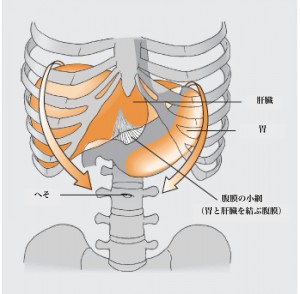
The organs sit around the psoas, and together with the diaphragm the psoas gives them something like a massage. The result is conditions in which the organs can move more easily. I have written about this in more detail in “Session 5: The Psoas and the Viscera — The Front of the Spine,” so do have a look if it interests you.
What Changed Between BEFORE and AFTER
Tasuku Suzuki, a pharmacist, does strength training for the upper body on a regular basis. Strength training tends to firm up the trunk. So I worked with the fascia while keeping in view the muscles around the trunk and the movement around the organs.
Specifically: the fascia under the ribs, at the fingers, the elbows, around the shoulders, and at the abdominals — the rectus abdominis and the transversus abdominis. When the abdominals are hard, the organs move less well, the breath is shallow, the spine does not lengthen, and the pelvis rounds back into a posterior tilt. Release the abdominals, and the deep muscle beneath them, the psoas, begins to move — and the pelvis, the spine, and the position of the organs adjust of their own accord.
In the photograph on the left: before the session (BEFORE), the pelvis sits in a slight posterior tilt, so the spine is somewhat rounded; after the session (AFTER), the pelvis is at a neutral position and the spine has lengthened. I take it the psoas did the work. In the photograph on the right, the medial line is more in view: with the adductors in mind, the width between the legs has narrowed, and he appears to be standing straight.
Tasuku said that his back had lengthened and that he felt easier.
Conclusion
This time again I have introduced Tasuku’s testimonial.