
Introduction
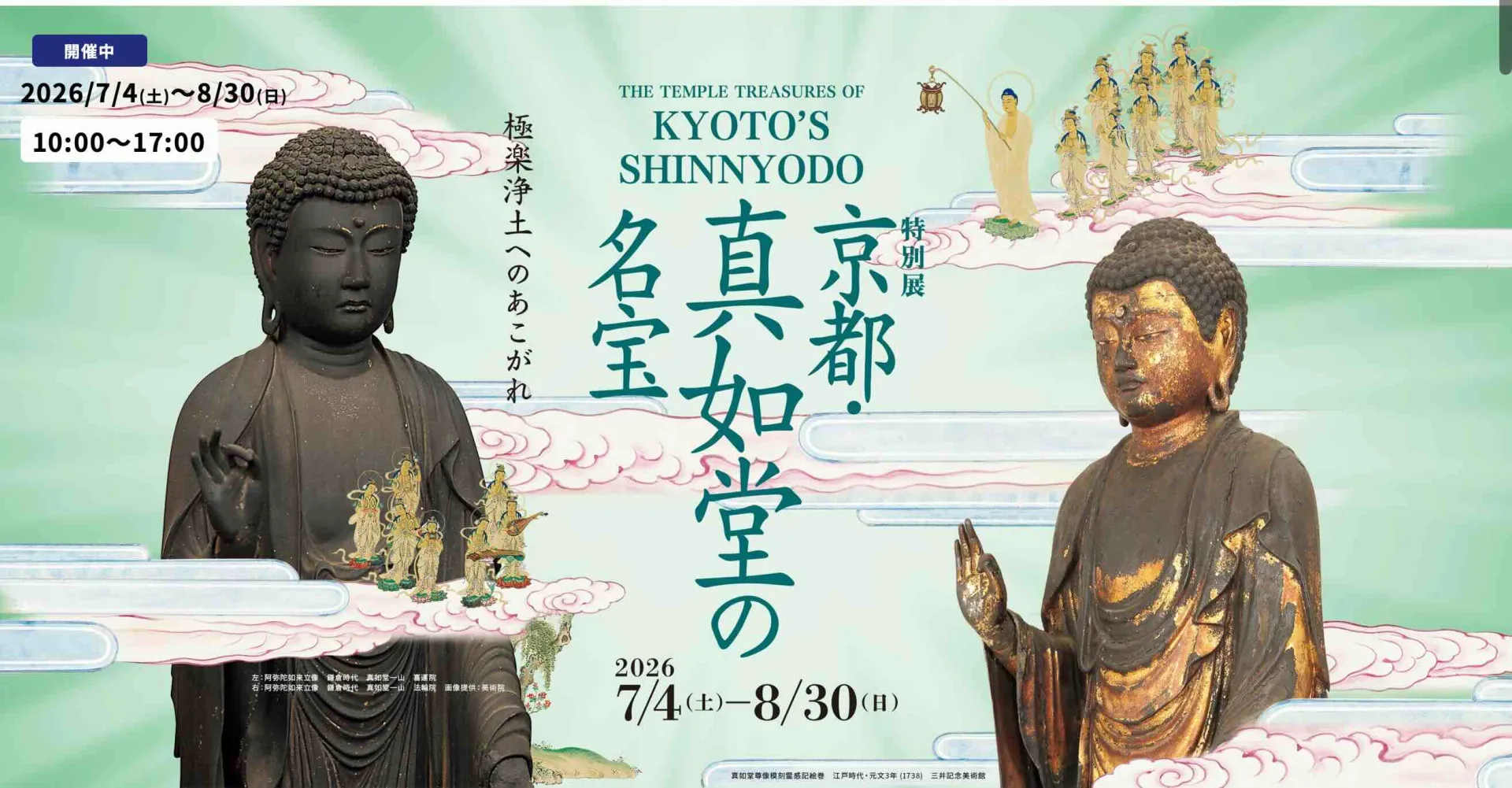
On Tuesday, August 4, 2026, I was able to see the special exhibition “Treasures of Shinnyo-dō, Kyoto” at the Mitsui Memorial Museum in Nihonbashi, Tokyo. It ran from July 4 to August 30, 2026.
I have already written about visiting “Kūkai and the Treasures of Shingon Buddhism” at the Heiseikan of the Tokyo National Museum in Ueno, on July 23, 2026. That exhibition followed the lineage of Shingon. This one is Tendai, the school founded by Saichō.
At the beginning of the Heian period (794–1185), Japanese Buddhism divided into two large currents. Kūkai (774–835) founded Shingon, the esoteric school; Saichō (767–822) founded Tendai on Mount Hiei. This summer I saw both. Less two separate exhibitions than one experience of seeing them against each other.
Shinnyo-dō is a Tendai temple in Sakyō-ku, Kyoto; its formal name is Shinshō Gokuraku-ji, “the temple of the true and correct paradise.” Many temples call themselves Gokuraku-ji, “paradise temple.” The name here carries the meaning that this is the genuine sacred ground of paradise.
Ennin, Known as Jikaku Daishi
Before coming to Shinnyo-dō itself, I want to set down who Ennin was.
Ennin (794–864), posthumously titled Jikaku Daishi, was a disciple of Saichō. He climbed Mount Hiei at fifteen and later became the third head abbot of the Tendai school. Saichō’s own stay in Tang China was short — eight months — and he could not learn esoteric practice in full. It was Ennin who crossed to China to fill that gap, staying nine years.
In other words, this was also an occasion to see how the Tendai that Saichō opened developed through Ennin. And Ennin built the Jōgyō-dō, the Hall of Constant Practice, on Mount Hiei. This exhibition is a story that begins from that hall.
An Amida That Came Down from the Hall of Constant Practice
In 984, following a dream, the monk Kaisan moved the Amida Nyorai — the Buddha Amitābha — that had been the principal image of the Jōgyō-dō at Enryaku-ji on Mount Hiei, down to a retired empress’s villa in the capital. This is the origin of Shinnyo-dō.
The Jōgyō-dō was the hall Ennin built on Mount Hiei after returning from China with the practice of nenbutsu — the chanting of Amida’s name. It was the place for a practice in which one walks continuously around the image of Amida for ninety days while chanting. So the principal image of Shinnyo-dō is a statue that was placed there to be walked around for ninety days.
The temple that came down from the mountain became a place of nenbutsu practice. The place and the practitioners changed, and the content changed with them. Unceasing nenbutsu is a practice of continuous chanting; walking is not among its requirements.
According to the exhibition catalogue, Hōnen — the founder of the Pure Land school — sent a disciple, in 1207, the sacred name he had received from the Shinnyo-dō Amida, as a keepsake. At the third memorial for Hōnen, his follower Shōkaku held seven days of communal nenbutsu in the main hall. In the scene depicted in the Illustrated Life of Hōnen, among the people listening to the preaching, many are women.
Thinking about this, it can be set out as follows.
- What Kūkai brought back was not a doctrine but procedures, implements, and a use of the body
- What Ennin brought back was also a use of the body — chanting while walking
The point is this: on Kūkai’s side there were objects, ritual implements and mandalas; on Ennin’s side there were only legs and a voice. What Kūkai brought back was a procedure for using objects; what Ennin brought back was a practice complete within the body alone.
What is interesting is that, of what Ennin brought back, what Hōnen selected was the chanting alone.
A Statue Made to Be Circled
The principal image, a standing wooden Amida Nyorai, is said to have been carved by Ennin himself and transmitted from Mount Hiei. It is known as the Nodding Amida, and it is a hidden image, opened to view one day a year.
Copying an Image No One Can See
A hidden image cannot be seen. So people have gone on copying this one.
According to the catalogue, replica carvings of the Shinnyo-dō image were made; from the Kamakura period (1185–1333) onward it was copied in painting as well; and in the early modern period woodblocks were cut. The standing Amida of Dainen-ji shown in the exhibition, dated 1243, is one of those replicas, and several others were on display.
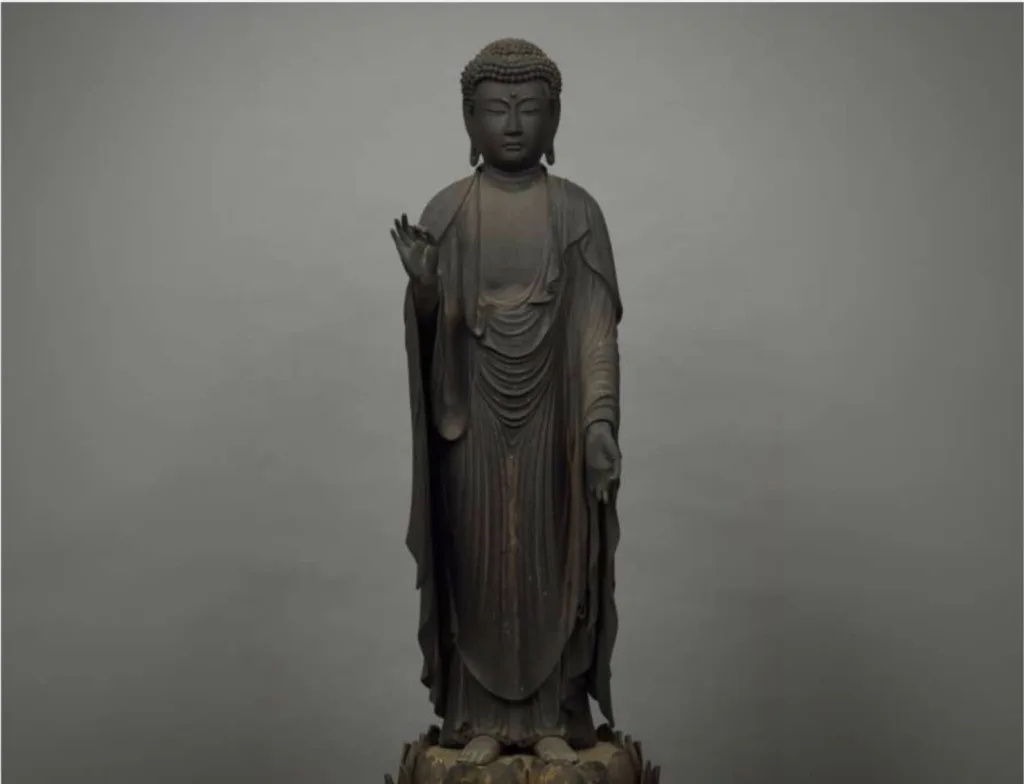
And painted copies have an advantage, the catalogue notes. Through them one can glimpse the pedestal, the halo, the attributes held, and the mudrā — in the case of the Shinnyo-dō image, the unusual gesture of the left hand.
A record of trying, somehow, to see what cannot be seen has accumulated there.
An image inside its shrine cabinet can be venerated only from the front. And in truth, in the exhibition room one could not walk around it either. There too it was from the front. I came to know the back after returning home, on opening the catalogue. Plates taken from four directions — front, side, back, head — are laid out there.
Photography, too, belongs to this line. There were replica carvings, then paintings, then woodblocks, and now plates. The attempt to see what cannot be seen had continued, changing form.
Made as a Solid
Standing in front of it, the first thing I thought was that it is made as a solid. It is not an image made to be seen from the front.
At that point it was only an impression. What supported it was the catalogue. The standing Amida by Inren, dated 1253, and a standing Jizō of the late Heian period both have plates of their backs. The folds of the robes are carved through to the back, and the fall of the sleeves is completed on the rear side.
And it is full, rounded. The late tenth to early eleventh century falls in a transitional period, from the heavy manner of the early Heian to the calmer so-called wayō, the “Japanese style.” According to the catalogue, it was also the era of Kōshō, held to be the predecessor of the great sculptor Jōchō.
Behind this shift lay the taste of the aristocracy of the capital. In this period Tendai was attempting to move from Mount Hiei into the city of Kyoto. Like Rokuharamitsu-ji, Rokkaku-dō, and Kōdō, Shinnyo-dō was part of that effort. Coming down from the mountain also meant fitting the taste of the capital.
Here something came into view. The move toward wayō may be better suited to being seen from all around. Sharp drapery changes according to how light falls, and works best seen from the front. A rounded surface holds at the same density from any direction.
Thinking of a practice of walking around it for ninety days, that is reasonable. Unless it is an image for which no single face is the correct one, ninety days will not hold.
What I noticed at the Kūkai exhibition was that esoteric sculpture is conceived as a solid from the start. What I could confirm this time is that this is not limited to esoteric Buddhism. It was the same in a Tendai standing Amida.
Two Walking Buddhas in the Inner Sanctuary
In the inner sanctuary of the main hall, besides Amida, there is a standing Jizō Bosatsu — the bodhisattva Kṣitigarbha.
There is a reason for this pairing. Amida comes to meet the dying. Jizō appears in all six realms of rebirth, going after those the welcome did not reach in time, to save them even after death. The two divide the first and second halves of salvation between them.
The principal image of Shinnyo-dō is an Amida that chose to save women. In medieval Japan the rebirth of women in the Pure Land was held to carry conditions, and that anxiety shaped the character of this temple. Jizō stands on the same ground — faith belonging to those who would otherwise be left out.
The Staff Was Added Later
What was interesting was that several Jizō were shown.
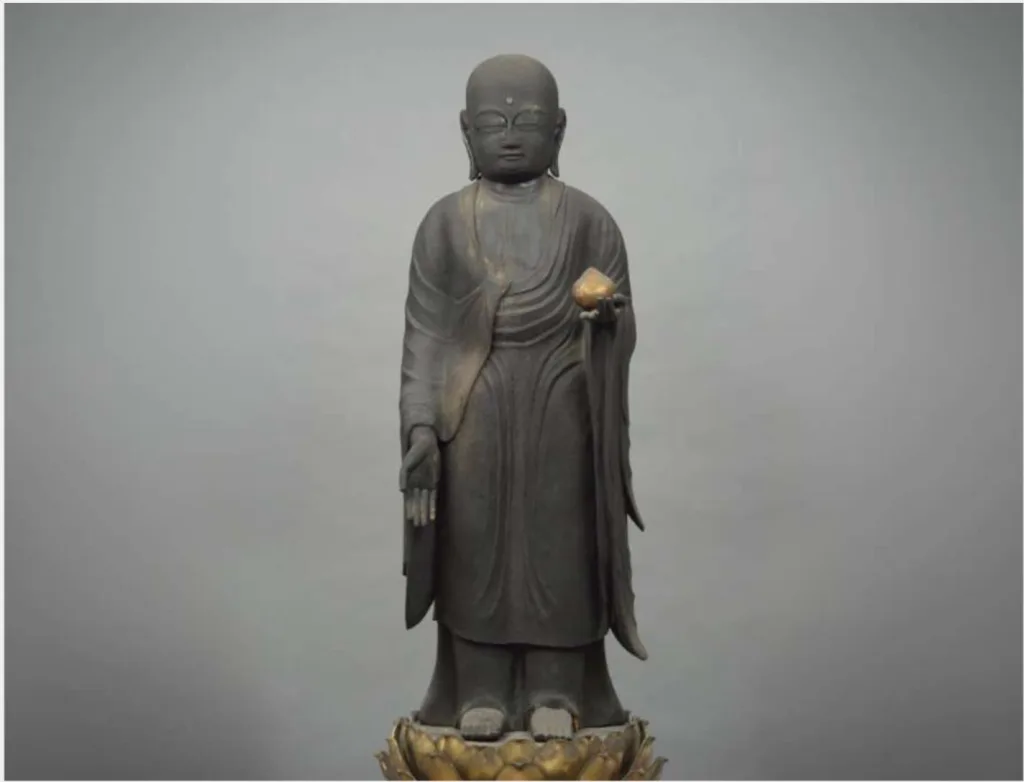
The tenth-century image of the late Heian period holds a wish-granting jewel in the left hand, with the right hand lowered, palm forward. It holds no staff. The Fukuden-ji image, dated to the ninth or tenth century, also has only the jewel. In the thirteenth-century Kamakura image, the left hand holds the jewel and the right hand a shakujō — the ringed staff carried by wandering monks, which sounds when struck against the ground. It is a tool for walking.
The ninth-century Jizō is not yet walking. By the Kamakura period it takes up a staff and sets out. The process by which a form of salvation differentiates into an action was visible in the three of them standing together.
Amida holds nothing. The raised right hand removes fear; the lowered left hand grants wishes. The body itself has become the meaning.
The standing Yakushi Nyorai of Inaba-dō, also on display, holds a medicine jar in the left hand. As an attribute, a vessel with contents is the most literal of all.
A body forming a mudrā and a body holding an implement use the trunk differently. To grip is to have estimated a weight, and to have a posture for supporting it. The statue does not move, but as long as it is gripping, a direction of force remains there.
Descending at an Angle
There were also raigō paintings — depictions of Amida coming to welcome the dying. The composition shows Amida descending at an angle.
Sculpture cannot do this. A standing figure can only stand perpendicular to the floor; the direction of gravity is fixed, so it cannot be tilted. Arrival has to be concentrated within the posture. Painting can depict the tilt itself. And being at an angle means not having arrived yet.
Being at an angle also specifies the position of the viewer. What it descends toward lies outside the picture, and the viewer is on that extension. Sculpture was something to be seen by walking around it; painting fixes the place of seeing to one.
The same subject, Amida, is resolved in opposite ways by two forms.
Mandalas were shown as well: a pair of Womb and Diamond Realm mandalas from the sixteenth century, and an Amida mandala by Morita Shōgen Yasunobu, dated 1850. In both, the fineness of the line seemed to me to surpass what I had seen in Ueno. The first is a diagram of the structure of a world, its deities arranged by direction and rank; the second is a picture of a place, the scene of paradise. Add the raigō painting, and the same paradise is treated from three directions: structure, place, and movement.
What Lay Outside the Hall
What surprised me was that the exhibition did not show only the inside of the hall.
In the study hall there was a standing Fukūkenjaku Kannon, a sixteenth-century work with multiple arms. Kenjaku is a lasso; fukū means that if thrown, it never fails to catch. A vow to scoop up without letting anyone slip through has become the name of a tool. The form of salvation is already differentiated at the level of what is held.
Multiple arms are also a singular way of seeing the body. Amida and Jizō both have forms that hold together as human bodies. A many-armed image has several incompatible actions growing from one torso at once. It looked to me like several points in time laid over a single body.
In the tea room, a Shaka triad. And tigers, lions, even an image of Laozi. From inner sanctuary to study hall to tea room, and in date from the tenth century to the Edo period. What a temple, as a place, had been filled with was simply laid out there.
Seeing It as a Body
From here on, this is the view of a Rolfer.
What stood there that day were all bodies. And they were carved according to what kind of body is doing what. The character of a buddha is expressed not as doctrine but as action. Coming to meet, going on foot, coming to heal, catching and drawing in.
All of it was made under gravity. Ida Rolf said that gravity is the therapist. When a person stands, and when a person walks, the condition is gravity. A wooden statue is under the same condition. To make a solid that holds when walked around is also to search for a form that does not collapse from whichever direction it is supported.
And the body of the one looking is a condition too. In the exhibition room, one could not walk around the images. I came to know the back inside the catalogue. What can be seen is decided by how the viewer can move, and what they cannot do has been carried out, in their place, by copies.
One more thing. People went on making, for centuries, buddhas that do not exist. The clues are limited. Even so, they assembled something that holds together as a body.
Touching people’s bodies as a Rolfer, I think every time that what is visible is only the surface. Neither the skeleton nor the layers of fascia can be seen directly. What the hand touches is skin, and from there the inside is inferred.
What stood there that day looked to me like a record of that same work, continued over centuries.
In Ueno I saw the body carved as a solid; in Nihonbashi I saw the buddha that came down from the mountain. For thinking about Japanese culture as well — how Buddhist sculpture developed — this exhibition let me follow that change at length.