
Why Life Changes When You Receive a Bodywork Session (Part 1 of 4)
Introduction
Most of us have decided at some point to hold ourselves better. Lengthen the spine. Open the shoulders. Ten minutes later the old shape is back. Is that weakness of will?
It is not. There is simply a layer the effort is not reaching.
This series works from the two books of Jeffrey Maitland — a tenured professor of philosophy, a practitioner of Zen, and a Rolfer — and follows this question through four of his words.
The whole layout is set out on the overview page.
This first part takes up the prereflective. The word points at what lies before thinking, and that is where the question of the returning posture belongs.
Why what you felt is so hard to explain
Someone who had finished the ten sessions of Rolfing wrote this.
Perhaps because the body comes into order, thinking gets sorted out as well: it has become clear to me what I need now.
T.U., testimonial
Perhaps because, she writes. She did not set out to sort her thinking out. The body changed, and this followed. She does not herself know why.
Experiences like this are usually hard to explain. You try, and the words do not keep up.
When we talk about the body there is usually only one frame available. What you felt is subjective, and varies from person to person. What can be measured is objective, and is the same for everyone. On that frame, everything felt during a session falls on the subjective side — and the moment it does, it is no longer clear what anyone is looking at.
Where does the frame itself come from?
In seventeenth-century Europe there was a wave of new instruments. Telescopes and microscopes made visible what the eye could not see, and it was no longer possible to say that the senses simply mirror the world. At the same time, treating the motion of bodies in numbers began to carry real power.
What, then, is the relation between what a person sees and what can be measured? The answer that emerged is the one associated with Descartes and Galileo.

An object outside causes an effect on the sense organs and nerves, and the brain forms an image of that object. What the person is in contact with is the image, not the object. Maitland’s Embodied Being: The Philosophical Roots of Manual Therapy has a caricature that puts this on a single page.
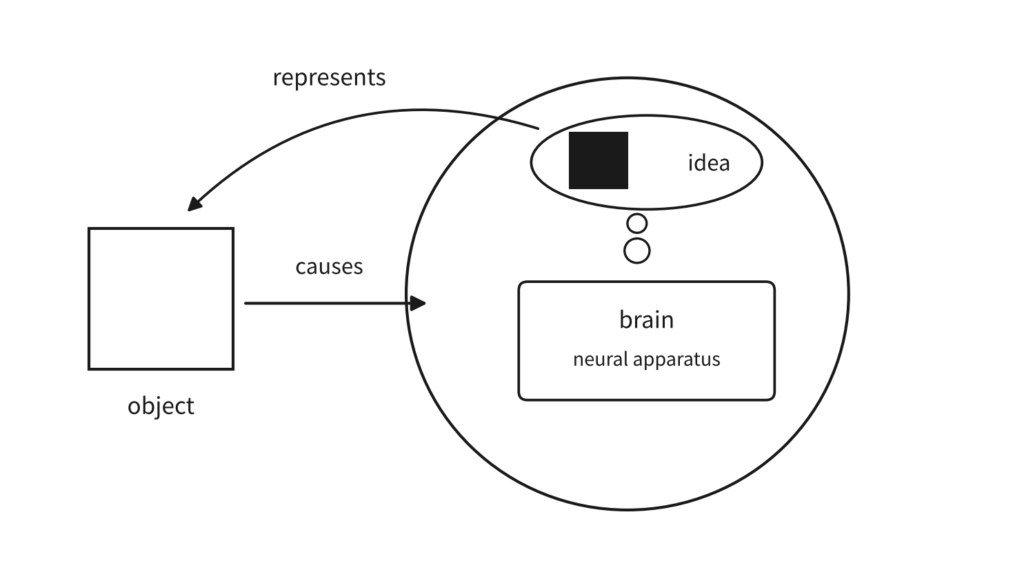
Maitland points out that this account undoes itself. To know whether the image is a copy of the real thing or something the brain made up, you would have to compare image and object. But the account says that the only thing a person can reach is the image. With no comparison possible, knowing the outside world becomes impossible in principle. The explanation makes the thing it set out to explain unexplainable.
About the idea that only what can be measured is real, he makes one further point. What Galileo said was a rule for how to proceed: science should study what can be measured. The move from there to a claim about the world — that only what can be measured exists — is a leap. And if only the measurable is real, what is the act of measuring itself? Can that be measured?
What matters here is not that the account was wrong and therefore discarded. It answered the demands of its time. And when you try to say how a person experiences their own body, it comes up short. The words for what was missing were supplied by other people. That work came to be called phenomenology.
Before thinking, and after
What phenomenology brought in is the prereflective.
Reflective here does not mean looking back in regret. It means stepping one pace away from what is happening and thinking about it. The root sense is a bending back to look. The word itself was in use before Descartes. What was new was the claim that there is something prior to it. Husserl raised the problem that reflection turns an experience into an object; Sartre used the term pre-reflective; Merleau-Ponty extended it to the body. All three are philosophers of the twentieth century.
Maitland gives examples like these. While you are struck by the beauty of a flower, you are not thinking that it is beautiful. The moment you think so, you have already left the experience. In the middle of a basketball play you are not deliberating whether to pass or shoot. The moment you deliberate, you are outside the flow.
The time of being struck, and the time of running, were not times without understanding. That way of understanding is the prior one. Spacious Body has a diagram of how the two stand to each other.
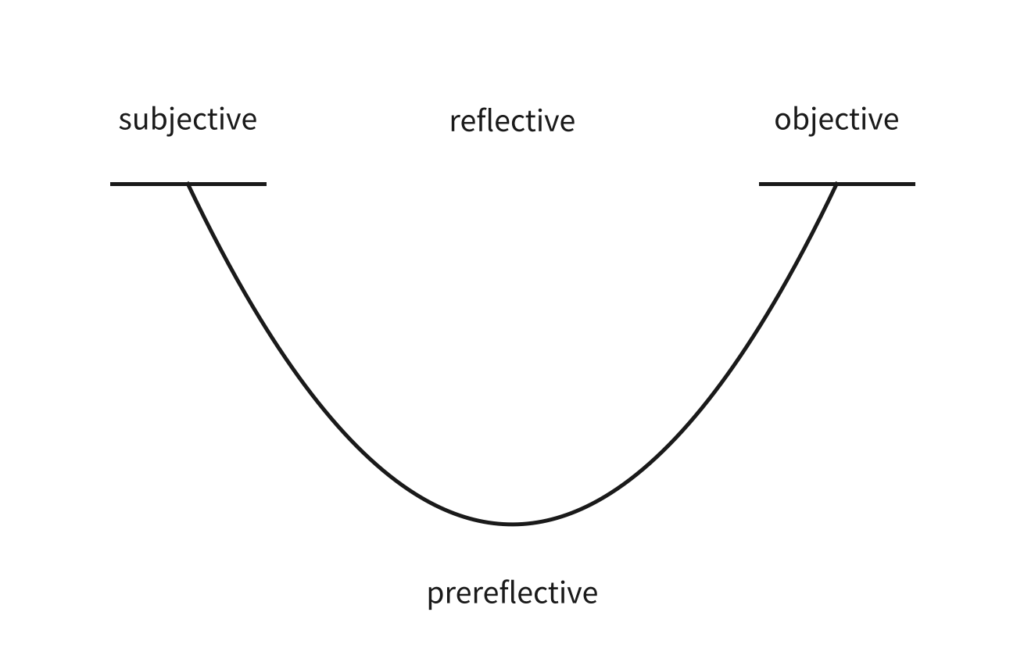
What the diagram shows is that subject and object are two poles that come into being together at the moment of moving into reflection. It is not that there are two of them from the start and experience is sorted into one or the other. When you stop being in the flow and begin to think about it, the one who sees and the thing seen come apart.
So the prereflective is not the subjective. It is prior to the subjective. There is a habit in the West of treating whatever is not objective as subjective, Maitland writes, and that habit has pressed prereflective experience into the subjective box.
Prereflective understanding should not be reduced to the subjective, but seen as a form of understanding that participates with that which is understood. Not only is it a form of understanding, it is also the prior ground or condition of both the subjective and the objective. The reflective experience of subject and object comes into being at the very moment we step out of the flow of prereflective lived experience and begin to think about what we are experiencing.
Jeffrey Maitland, Spacious Body, 1995, p. 75
Why the words come afterwards
The same thing happens during a session.
Partway through, you are asked how it is. Something does feel different. But asked what, nothing comes. After a pause you manage something like lighter, or straighter — and as soon as you have said it, none of it seems right.
Then on the way home, or the next morning, it arrives: ah, it was the soles of my feet spreading onto the floor. What could not be said then can be said now.
What is happening on the table is on the prereflective side. So the moment you are asked how it is and try to put it into words, you have already moved. On the far side of that move there is only the one who sees and the thing seen. You end up looking at your own body as an object, and the flow you were in a moment ago is no longer there.
The words that come on the way home are not a memory returning. What could not be said during the session, because you were inside the flow, can be said once enough time has passed for you to stand where it can be thought about.
And one more thing. With this account you can drop the conclusion that what you felt was subjective and therefore unreliable. It is not subjective. There is no need to put what is prior to the subjective into the subjective box and file it away as a matter of personal variation.
Nor is knowledge enough on its own. Kouki Yamada (physical therapist) — Ten-Session Testimonial describes how things he already understood as a body professional showed up, through the sessions, as change in his own body. Understanding something and having the body change are two different matters.
Why posture returns, however hard you think about it
The same seam runs through the body. And this is where the opening question belongs.
How you stand, how you walk, how deeply you breathe, what your shoulders do when you face another person — none of this is done after thinking. Getting up from a chair, nobody decides which foot to shift the weight onto before extending the knee. It is already settled.
So thinking about having better posture does not change it. Thought works on the reflective side, while standing is settled before thinking. You can lift the chest, but that is a temporary overwrite, and it goes back the moment attention turns elsewhere.
This order has a name on the Rolfing side as well: pre-movement. Before movement begins, how the body sets itself against gravity is already settled, and that settles the quality of the movement. When you reach an arm forward, the first thing to work is not the arm but the calf, taking on in advance the instability that the weight of the arm will create.
The term is Hubert Godard’s. What it was built on was the thinking of Erwin Straus, who argued that the human upright posture itself already settles how a person stands toward the world. Simply standing, a direction is already given. Godard applied this to the body of the dancer and named it pre-movement.
So this term, which came from the side of movement, also comes out of phenomenology. It has the same source as the prereflective.
They are not the same thing, though. What pre-movement handles is one matter: how the body stands toward gravity. The prereflective is wider. It is about how a person understands the world before thinking, and it takes in emotion, relationship, and perception. Pre-movement is one of the things that happen there.
- Our Relationship to Gravity: A Guide to Tonic Function
- What Hubert Godard Saw: Tonic Function Was Born in the Dance Studio
In Yasuko Fukuda’s ten-session testimonial, this is how she describes the state she came in with.
Even when I tried to straighten up, I could not shake the feeling that something was off somewhere.
The intention to straighten up works after thinking. The feeling of being off is on the near side of that. Hence the situation she describes: she is correcting it, and it will not go. The two are working in different places, so the correction does not reach.
This is also why touch produces change. What the hands are working on is not where thought reaches.
In the same testimonial, after the ten sessions, the answer reads like this.
Above all, I can stand upright, and easily. The effort has gone out of my body, in the good sense.
It is not that the power to correct got stronger. The effort is gone, and she is upright. That is what it looks like when the near side of thinking is the thing that has been rearranged.
Another person writes this.
Session by session, I came to feel the axis in my body. Now I understand it through the body.
Not that she built an axis, but that she came to know one. Nothing new was decided on; something already there came into a position where it could be known. That is a different order from deciding by thinking.
The same holds for the practitioner. What the advanced training kept returning to — seeing — was not seeing with the eyes. Touch, and the sense of the inside of one’s own body, are part of it: you listen to the other body with the whole of yourself. Treated as looking, the work takes place where the one who sees and the thing seen have already come apart, and it falls outside the flow that is going on in the other person’s body.
Godard calls this a way of seeing that does not name. Not the kind that picks out details and tells them apart by giving them names, but the kind in which your position and the other person’s are settled within a space. When you are in the space and the space is in you, he says, reading a body becomes easier.
Something becomes invisible at the moment it is named. To name is to cut something out as an object. And once it is cut out, the one who sees and the thing seen have already come apart.
- When a Name Appears, You Stop Seeing — What Phenomenology Changes in Practice
- Beyond “Looking” — On Fundamental Vibration, Right Action, and Neutrality~ Reflections on the Final Days of Training
The prereflective is not the unconscious
There is one thing that gets confused here. Say before thinking, and people hear the unconscious. In the glossary at the back of Spacious Body, Maitland states plainly that the two are not the same.
The prereflective is a distinction from the side of philosophy, and it concerns a way of understanding. It is experience before reflection, and as experience it is being lived. The time of being struck by a flower is not unconscious. If anything, there is no time in which one is more in contact with what is happening.
On his account, what gets called the unconscious is the part of prereflective experience that is misconstrued at the stage of reflection. We read it to suit ourselves, or we lack the capacity to read it, and what was there gets handled as something else. The unconscious, then, does not name a place where there is no experience. It names experience that failed to find the right words.
Once that distinction is in place, what happens in a session looks different. Something surfacing is not a hidden thing being exposed. It is words catching up with what was being lived without them.
The limits of this view
Grant the distinction and it can be put to convenient use.
The first is that it becomes an excuse not to explain. If this is a region that does not come into words, then of course it cannot be explained — and nothing need be answered. In fact Maitland says the opposite. The work includes letting what is happening come forth as it is and then describing it in the right words. Only when it is in words is the whole of it complete, he writes. This is not an argument for ranking thought below experience.
The second is that it can look like a claim beyond checking. The distinction between prereflective and reflective is not the kind of claim you demonstrate by measuring. It is a proposal about where to cut experience. So it can only be judged by what it lets you see. Words arriving late after a session; a posture corrected by thought going back. Whether concrete situations like these can be accounted for is the test of it. When one comes up that cannot, you have to be able to doubt the distinction.
The third is how it is used in the room. If a client is working to put something into words and the practitioner says that this is prereflective, so there is no need for words, the practitioner has closed off the path by which that person reaches their own experience. The distinction is for the practitioner’s understanding, not for use on the person in front of them.
Summary
Talk about the body falls into subjective or objective because a frame built in the seventeenth century is still in place. On the near side of that frame is what comes before thinking. Subject and object come into being together at the moment one steps away from it and starts to think.
Words failing during a session is not a sign that what was felt was vague. Words arriving afterwards is not recollection. Both are the move from prereflective to reflective. That standing and breathing do not change by thinking has the same reason behind it.
Part 2 looks at what is going on in that place before thinking. Before thinking, a person is already directed toward something. And to be directed, there has to be a place to be directed from. Maitland calls these two core and surface. Emotion, and the distance we keep from other people, both appear as the shape of the space they make.
What the four parts move toward is the question of what transformation is: not becoming someone else but becoming more yourself, and how that happens. Part 4 arrives there.
References
Jeffrey Maitland, Spacious Body: Explorations in Somatic Ontology, North Atlantic Books, 1995
Jeffrey Maitland, Embodied Being: The Philosophical Roots of Manual Therapy, North Atlantic Books, 2016