
Rethinking Embodiment and Skill Acquisition Through Artificial Intelligence — Part 1 of 3
You Can Ride a Bicycle. Can You Explain How?
Most of us can ride a bicycle. But could you put the riding into words, and teach it to someone else?
When the bicycle tips, we correct it without thinking. But what is the difference between tipping because you are about to fall and leaning because you are turning? And could you say, before it happens, what you will do at the moment you tip?
Probably not easily. And yet we ride.
Hubert Dreyfus and Stuart Dreyfus open the first chapter of Mind over Machine (1986) with exactly this example.
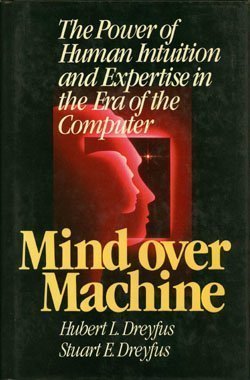
Hubert, the elder brother, was a philosopher. Stuart, the younger, worked in mathematics and computing. Together they questioned the attempt to reproduce human intelligence on a computer.
And the first thing they took up, in order to do that, was how a person acquires a skill and becomes good at it.
Using pilots, chess players and automobile drivers as their examples, they divide skill acquisition into five stages. Why would a book about artificial intelligence spend its first chapter on human expertise?
Because unless you understand how a person becomes expert, you cannot say what it is that artificial intelligence is trying to reproduce.
I work with my hands, as a Rolfer. For me, that first chapter was the most interesting part of the book.
Think About It, and You Get Worse
You are driving a manual car through town without thinking about it. The moment to change gear simply arrives.
Then a thought crosses your mind. Which gear am I in? Is this the right one? And the shift that had been effortless turns clumsy. You miss the timing, or you select the wrong gear.
Why should that happen?
Here the brothers distinguish two kinds of knowledge.
One is knowing that — knowing what is the case. The other is knowing how — being able to do it.
Being able to say “change gear at such and such a speed” belongs to the first. Sensing the moment from the sound of the engine and the feel of the car belongs to the second. A skilled driver is not recalling rules one by one. If anything, becoming conscious of the rule can interrupt what was running smoothly.
There is a second example, which stayed with me.
Drew Poston, an air force captain, had once flown four-engine jet transports with great skill. Later he became an instructor, and then moved on to evaluating the performance of trainees. He flew less and less himself.
One day, on the way back to base, an engine failed.
A pilot who flies daily compensates for the pull to one side without effort. But Poston, out of practice, worked out what to do and then corrected. He overcorrected, and had to correct back the other way. The aircraft landed wobbling from side to side.
What had once been effortless had reverted to something like a beginner’s flying, precisely because he had set out to use the rules deliberately.
What matters here is that a skill is not kept forever once acquired. What experience made effortless can be lost when the practice stops.
And when it stops being effortless, a person reaches back for the rules. So how does anyone come to act without rules in the first place?
Skill Acquisition Comes in Five Stages
Looking at pilots, chess, driving and adults learning a second language, the brothers concluded that skill acquisition passes through five stages that these domains share.
| Stage | Name | What characterizes it |
|---|---|---|
| Stage 1 | Novice | Follows the rules as taught |
| Stage 2 | Advanced beginner | Experience begins to reveal differences in situations |
| Stage 3 | Competent | Chooses what to treat as important, and decides |
| Stage 4 | Proficient | Grasps the situation intuitively, but still deliberates about what to do |
| Stage 5 | Expert | Grasping the situation and acting are no longer separate |
One thing is worth noting. These five stages are not a scale of how much you know or how much technique you have.
Of course you can do more as you improve. But what matters more than that is the change in how the situation in front of you appears.
A novice does not know what to look at. With experience, differences that went unnoticed become available. With further expertise, one look at the whole is enough for what matters to stand out on its own.
Let us take the stages one at a time.
Stage 1: Novice — Learning the Rules First
When we learn something for the first time, we are given rules.
For a manual car: change gear at such and such a speed; keep a certain distance from the car ahead. These can be applied without regard to the actual situation — whether the road is busy, whether there is a signal coming up.
The brothers call such features context-free elements, and the rules applied to them context-free rules.
A novice cannot yet take in the situation as a whole. That is exactly why clear rules, usable by anyone, are needed.
Training wheels make this easy to picture. With them, a child who has no idea how to balance can still move, and accumulate experience. But a child who never leaves the training wheels never learns to balance.
Rules work the same way. They are needed at the start, and improving means moving beyond the stage of relying on them alone.
Here a term appears that matters for the argument about artificial intelligence: information processing. For the brothers, information processing is the manipulation of unambiguously defined elements by precise rules.
Take recognizing the letter E. If you check the number and arrangement of the horizontal and vertical lines, and apply a rule, that is information processing.
But what about recognizing it at a glance, from having seen E countless times? In that case we are not examining the strokes one by one. We recognize the whole, through its similarity to what we have seen before.
That difference leads directly to the critique of artificial intelligence later on.
Stage 2: Advanced Beginner — Experience Reveals Differences
With real experience, things that were invisible to the beginner gradually become available.
A dog owner can pick out her own dog’s bark among many. But asked which features of the bark make it recognizable, she cannot easily answer. She is not analyzing pitch, length and timbre. Hearing it many times is what made the difference available to her.
The smell of coffee is the same. We do not have to work through the chemistry to know it is coffee.
In driving, the moment to change gear becomes available from the sound of the engine, not only from the speedometer.
A nurse learns to hear the difference between the breathing of pulmonary edema and that of pneumonia.
The brothers call features that become recognizable through experience situational elements. At the novice stage, only the features one was taught were available. With experience, differences that cannot be defined in words begin to show.
Rules are still in use at this stage. But the information the rules are applied to has itself become richer through experience.
Stage 3: Competent — Choosing What Matters
With still more experience, a different problem appears. Too much becomes visible.
The beginner did not know what to look at. Now there is too much that asks for attention, and no obvious place to start.
The book gives the example of a nurse.
A new nurse is taught a procedure: take the infant’s vital signs, check the intravenous site, check the ventilator and the monitors. She then follows that order faithfully. But what if there are two infants in front of her and one of them is screaming?
Rather than carrying out every step evenly, she has to judge which infant needs what first. And that is hard for someone new. Knowing the rules and ordering priorities according to the situation are two different things.
At the competent stage, a person starts by choosing a single plan or goal in order to organize the whole, and then attends only to what is important from the point of view of that plan.
A driver in a hurry, for instance, will weigh traffic and congestion rather than the view. And here something changes decisively.
You are now judging for yourself, and are answerable for the result.
The novice follows rules she was taught. If the outcome is poor, she can think that the rule may have been inadequate. The competent performer has chosen the plan herself. So success brings satisfaction, and failure brings regret.
Because feeling is involved, both the successes and the failures are remembered vividly. For the brothers this is a crucial turn on the way to expertise. Improving is not simply becoming calm and rational. Being involved in your own judgment, and bearing its outcome, is what produces the next round of learning.
Stage 4: Proficient — The Whole Situation Comes Into View
At the next stage, understanding the situation no longer requires choosing a plan each time. With experience, one look at what is in front of you is enough for what matters to become apparent.
A boxer is not calculating the angle of the opponent’s arm, the position of the feet and the distance between them in order to decide when to attack. He takes in the whole — the opponent’s movement together with the feel of his own body.
From the connection with similar situations met before, the opening becomes apparent. The brothers call this holistic similarity recognition.
The important point is that the situation is not broken into parts first and understood afterwards.
When we see the face of a close friend, we do not measure the shape of the eyes, the height of the nose and the width of the mouth and then conclude who it is. We see the whole, and know instantly.
The proficient performer’s grasp of a situation is like that.
At this stage, however, understanding the situation and deciding what to do are not yet fully one.
Approaching a curve on a wet day, a skilled driver knows intuitively that the speed is too high. But whether to brake, to lift off the accelerator, or to do something else, he still works out consciously.
In other words, this is the stage where what is happening is grasped intuitively, while what to do is still deliberated.
Stage 5: Expert — Acting Without Deliberating
At the last stage, understanding the situation and acting appropriately become continuous with each other.
An expert driver is not conscious of operating the car. If anything, he feels at one with it, moving along the road.
It is like walking: we do not consider how to move the muscles of the leg.
An expert pilot, too, who at first felt he was flying the aircraft, comes with experience to feel simply that he is flying.
Observing the situation, comparing the options, deciding on an action — in ordinary circumstances that sequence is no longer present to consciousness.
The radiologist in the book is a good example.
A less experienced physician reads an X-ray by identifying several features and combining them into a diagnosis. But a physician of long experience may find that a condition comes to mind the moment the image is in view. Thousands of images have made the pattern itself meaningful to the eye.
If the human chest were made of glass, the brothers write, even an inexperienced physician could see the state of the lungs at once.
What if, for the experienced physician, the X-ray has become something like that glass? Then what has happened is not merely that the judgment got faster.
What formerly had to be interpreted has become directly visible.
None of this means that an expert stops thinking. When something unexpected happens, she will stop and analyze. But within familiar circumstances, rules no longer have to be applied one by one.
Neither Rational nor Irrational
So much for the five stages.
At the start we memorize rules and act on them. With experience, the way the situation appears changes. And at the end the body moves appropriately before we have worked out what to do.
How, then, should we understand that kind of intelligence?
We tend to sort human judgment into the rational and the irrational. Rational means gathering information, analyzing it and drawing a conclusion by rule. Acting on a whim, with no grounds, counts as irrational.
But what the expert driver or pilot does is neither. There is no calculation, and there is nothing arbitrary about it. Long experience is producing the action that fits the moment.
The brothers call this kind of intelligence arational. The word does not mean contrary to reason. It means: not arrived at by calculation or inference.
Human intelligence, in other words, includes not only the work of analysis but also the work of taking in a situation directly through experience. That distinction turns out to matter for thinking about artificial intelligence.
Because the artificial intelligence research of the time was trying to understand human intelligence as the processing of information by rules.
What Becomes of the Rules as You Improve?
Seen across the five stages, there is one more change worth drawing out.
It concerns the rules. The novice does not know what to do without them. The advanced beginner has more available through experience, but is still acting by rule.
The competent performer begins choosing for herself what to treat as important. The proficient performer takes in the whole situation intuitively. And the expert, in familiar circumstances, acts appropriately without rules in mind.
In a phrase: from acting by following rules, to acting without rules in mind. This does not mean that rules become unnecessary.
An expert driver is not free to ignore traffic law. And in unforeseen circumstances, deliberate judgment is required.
What is in question is something narrower: whether each action is settled by a rule held in the head.
The brothers concluded that rules are not enough to explain what an expert does.
They set out the difference as two contrasts. One is between judging at a distance from the situation and acting while deeply involved in it. The other is between using abstract rules and taking in the concrete situation directly.
As we improve, we move from relying on abstract rules toward being involved in concrete situations. Interestingly, the brothers point out that this runs opposite to the direction usually described for children’s cognitive development.
A child first understands the world through concrete experience, and acquires abstract reasoning while growing up. When an adult learns a new skill, the order is reversed: abstract rules first, and a grasp of the concrete situation as experience accumulates.
Being able to think abstractly, in other words, is not necessarily the final stage of expertise. So why is it so easy to assume that intelligence means thinking by rules?
The brothers trace that assumption back to ancient Greek philosophy.
Socrates and Plato — Do Experts Know the Rules?
Socrates went about Athens asking people what it was that they knew.
Plato’s dialogue Euthyphro contains a characteristic scene. Euthyphro was taken to be able to tell which acts were pious and which were not.
So Socrates asks him by what standard he distinguishes a pious act. What Euthyphro offers instead are examples of particular deeds. But Socrates is not asking for instances. He wants the general standard, the one that holds in every case, because with that standard in hand one could judge piety in a situation never met before.
Euthyphro cannot state such a standard. And the brothers see an important problem here.
An expert can look at a situation and judge it well. But asked how the judgment was made, she may offer concrete examples rather than a rule. Socrates put the same question to craftsmen, poets and statesmen, and made it a problem that none of them could state their knowledge clearly.
Plato, as the brothers read him, supplied an explanation for this.
The expert did once know the rules. He has merely forgotten them. The work of the philosopher is therefore to help him remember what he has forgotten. That is the Dreyfus brothers’ reading of Plato.
On this view, even when an expert cannot state the rules behind a judgment, the rules exist somewhere. He is simply unaware of them, while in his head they go on working.
And the brothers considered that the artificial intelligence research of the 1980s rested on the same idea. At the time, work was under way to bring expert knowledge into computers. Ask an expert how she judges. Organize the rules of thumb that come back. Turn them into a program. Then the computer should be able to judge as the expert does.
This is the thinking behind expert systems. But it carries a large assumption. It assumes that an expert’s judgment can be expressed as rules. And that is precisely what the brothers questioned.
When an expert knows at a glance what should be done, is that really because rules are at work in her head?
Or is it because long experience has made the situation itself look different to her? If the latter, then extracting rules from experts and entering them into a computer will not be enough to reproduce human expertise.
That question is the fundamental one the Dreyfus brothers put to artificial intelligence research.
Next: Eleven Years of Rolfing Training
So far I have set out the Dreyfus brothers’ five-stage model.
First you memorize rules. With experience, differences the rules could not capture become available. With further experience, you take in the whole situation and what to do becomes apparent.
Improving is not simply a matter of accumulating knowledge and technique. It is also a change in your relation to the situation, and in the way the world appears. That idea overlaps with my own experience of learning Rolfing.
I began the basic training in 2014, went through supervision and Rolf Movement, and completed the advanced training in 2025.
Looking back on those eleven years, at the beginning I had all I could do to learn anatomy and technique. With experience, what I observed, where I touched, and when I judged a session to be finished all changed.
Looking at the same body, I had come to see something different. In the next part I will look back on those eleven years in the light of the five stages.
And I will consider whether something similar may be happening for the person receiving Rolfing.
Articles in This Series
This is Part 1 of Rethinking Embodiment and Skill Acquisition Through Artificial Intelligence — Reading Dreyfus’s Mind over Machine, a three-part series.
※入稿時に、第2回・第3回の英語版URLをリンクとして入れます。
- Part 1: Why You Get Worse the Moment You Think About It — Dreyfus’s Five Stages of Skill Acquisition (this article)
- Part 2: I Was Never Taught a Procedure — Eleven Years of Training, Read Through the Body
- Part 3: Perception, Not Analysis — Why a Philosopher Was Hired to Evaluate Artificial Intelligence