
Introduction
Fascia has several faces. That it is alive, that it senses, that it springs back, and that it changes — Rolfing lends a hand to that one continuous tissue. What this post explores is one of those faces: that it senses. Fascia is not only a tissue that holds the body up; it is also the body’s richest sensory organ. I want to go one step further into what that means.
When hands-on work engages the body, the practitioner is not physically stretching stiff tissue apart. The practitioner is in dialogue with a nervous system that senses, answers, and regulates itself. So where, specifically, does that dialogue take place?
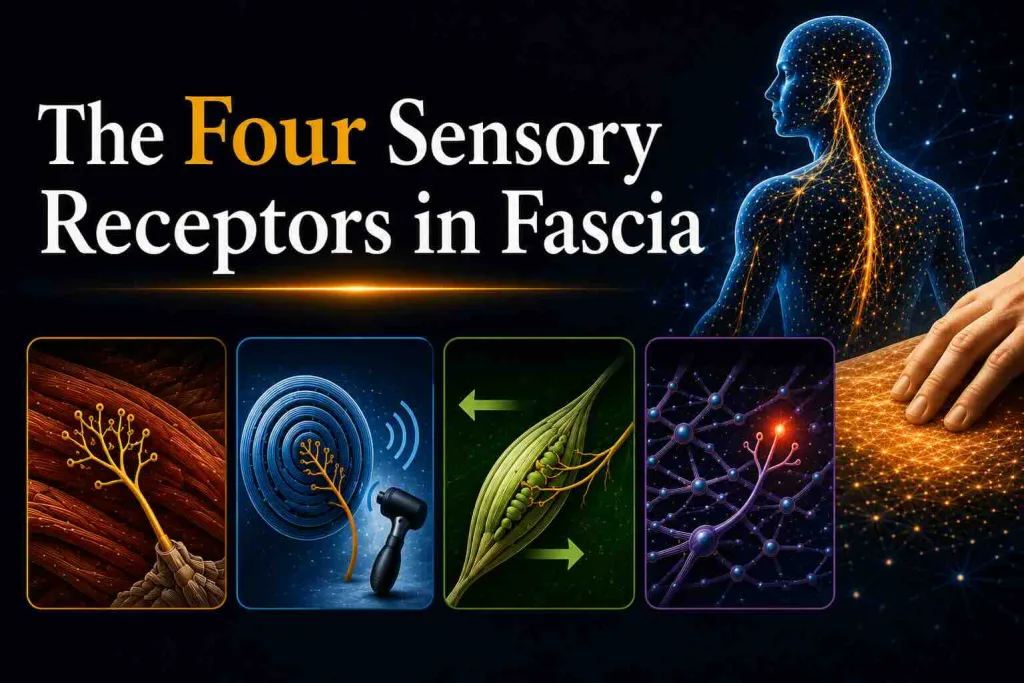
Fascia has several kinds of sensory receptor (mechanoreceptors) embedded in it, each with different properties, and each answering to a different kind of touch. The framework Robert Schleip set out in his 2003 publication “Fascial plasticity” offers one way to re-describe the “how” of touch in bodywork in the language of science.
This post lays out those four receptors — Golgi, Pacini, Ruffini, and interstitial — in terms of location, the stimulus they answer to, the effect, and how they might be approached. I also want to be direct about the fact that this framework still contains hypotheses.
1. Golgi Receptors (type Ib) — Releasing Tension
Main locations: myotendinous junctions, attachment sites of aponeuroses, ligaments of peripheral joints, joint capsules.
Stimulus and effect: The classical Golgi tendon organ responds to muscular contraction and lowers the tone (tonus) of the related striated muscle fibers.
Interestingly, the Golgi tendon organ does not, in fact, fire in response to passive stretch — later research has shown that stretching a muscle passively does not stimulate it, and that it works when active contraction occurs. So how does hands-on work engage it? Schleip points to the possibility that “other Golgi receptors,” located in aponeuroses, ligaments, and joint capsules, respond to strong stretch.
Approach: Apply slow, deep stretch near the attachment sites, combined with the client’s own active movement (Active Movement Participation: AMP). Rather than lengthening passively alone, having the client move sets up the conditions under which Golgi receptors engage. AMP is a method used in Rolf Movement sessions.
→ What Rolf Movement Is — Bodywork That Explores the Quality of Movement
2. Pacini Corpuscles (Paciniform, type II) — Reporting the Coordinates of Movement
Main locations: myotendinous junctions, the deep layers of joint capsules, spinal ligaments, the tissue that wraps muscle.
Stimulus and effect: They do not respond to steady pressure, only to rapid changes in pressure and to vibration. These are used as proprioceptive feedback for controlling movement. Stimulation by a practitioner is thought to heighten proprioceptive attention and self-regulation in that area.
Approach: Rapid adjustments (high velocity), sudden release of pressure, tools that deliver vibration, or techniques involving change and vibration such as rocking, shaking, and rhythmic joint compression. Techniques of the kind exemplified by chiropractic adjustment (high-velocity thrust) are also thought to engage the Pacini corpuscles that answer to abrupt pressure change.
3. Ruffini Corpuscles (type II) — Settling the Sympathetic Nervous System
Main locations: ligaments of peripheral joints, the dura mater, the outer layers of joint capsules, and tissue subject to regular stretch.
Stimulus and effect: Unlike Pacini, these also respond to sustained pressure. They respond in particular to tangential force — lateral shear. That stimulus is said to lead to inhibition of sympathetic activity throughout the body. It is a receptor that works in the direction of releasing tension and settling the mind.
Approach: Apply slow, “melting” pressure that sinks into the tissue, accompanied by lateral shear. Much of what is generally called myofascial release — slow, sustained work — is thought to engage these Ruffini (and interstitial) receptors.
The three so far — Golgi, Pacini, Ruffini — correspond to what the classification of nerve fibers calls type I and type II. But these make up only about 20% of the body’s sensory nerves. The remaining 80% or so is carried by the interstitial receptors (type III / IV) that follow.
4. Interstitial Receptors (type III / IV) — the Most Numerous, the Most Widespread, the Deepest
Main locations: the most abundant receptor type, present nearly everywhere in the body. They are found even inside bone, and their density is highest in the periosteum. Most of them derive from free nerve endings.
Stimulus and effect: They respond to both abrupt and sustained pressure. About half are high-threshold units (responding to strong stimulus); the other half are low-threshold units that respond to even very slight stimulus. Stimulation brings about changes in the fluid dynamics of the tissue, such as local vasodilation and plasma extravasation.
These receptors are involved in both interoception (sensing one’s own internal state) and proprioception, and depending on circumstances they can function as mechanoreceptors or as nociceptors (pain receptors). Their sensitivity is often modulated by neurotransmitters.
Approach: Work with the periosteum, the interosseous membranes, and fascia bound to bone is thought to offer a way into this vast sensory network.
At a Glance: the Four Receptors
| Receptor | Main locations | Stimulus | Effect of stimulation | Approach |
|---|---|---|---|---|
| Golgi (Ib) | Myotendinous junctions, aponeurosis attachments, joint ligaments, joint capsules | Muscular contraction / strong stretch | Lowered muscle tone | Slow, deep stretch near attachments + active movement (AMP) |
| Pacini (II) | Myotendinous junctions, deep joint capsules, spinal ligaments | Abrupt pressure change, vibration | Improved proprioception and motor coordination | Rapid adjustment, vibration, rocking, rhythmic compression |
| Ruffini (II) | Joint ligaments, dura mater, outer joint capsules | Sustained pressure, tangential shear | Inhibition of sympathetic activity | Slow, melting pressure with lateral shear |
| Interstitial (III / IV) | Nearly everywhere, including inside bone; densest in periosteum | Both abrupt and sustained pressure | Vasodilation, changes in fluid dynamics / interoception, proprioception, pain | Work with periosteum, interosseous membranes, fascia bound to bone |
What Does Stimulating a Receptor Change? — Tonic and Phasic
What, in the end, is being changed in the body by the receptor stimulation described so far? In answering this, Schleip brings in another important distinction: two kinds of muscle at work against gravity, the tonic and the phasic.
Our muscular activity has two broad modes. One is phasic — conscious, fast, action-directed movement such as standing up or reaching out an arm. The other is tonic — the slow, sustained, largely unconscious “background tension” that holds posture within gravity. Maintaining posture, and much of what we experience as chronic stiffness, belongs to this tonic layer.
There is also a structural reason why tonic muscle tends to become stiff.
According to research by Schleip and colleagues, the tonic muscles that support posture contain more of the connective tissue that wraps bundles of muscle fibers — the perimysium — than phasic muscles do. The collagen of this perimysium is arranged in a way suited to bearing load, and to that extent tonic muscle is inherently stiffer. Cuts of meat from parts used to maintain posture are sinewy and firm, while those from parts used for quick action are tender — this familiar difference in the world of meat comes from the same difference in perimysial thickness.
This perimysium has also been reported to contain a high density of cells capable of contraction: myofibroblasts.
What I touched on in another post — that fascia may contract slowly, like smooth muscle — connects here. Schleip and colleagues hypothesize that part of the resting stiffness of tonic muscle derives from the contractility of this perimysium. They further note that, left unmoved, the perimysium thickens further. This is part of the background to why chronic stiffness accumulates in postural regions such as the neck and back.
Seen from the side of the nervous system, this corresponds roughly to two motor systems: the alpha motor system, which governs conscious movement, and the gamma motor system, which sets background tension (tonus) by adjusting the sensitivity of the muscle spindles. The tension the gamma system determines is not something that can be controlled by consciously deciding to exert force.
Here is Schleip’s central point. The changes in muscle tone that occur when fascial receptors are stimulated arise not from the conscious alpha motor system, but mainly from a “reset” of the gamma motor system.
This difference matters. Chronic postural habits, and stiffness in the shoulders or back that will not let go, do not change easily by deciding to “hold better posture.” That is because they are a matter of the tonic layer, which works unconsciously — not the phasic layer, which the will can control.
This is why an approach that reaches that layer is needed. Speaking to the gamma motor system and the autonomic nervous system by way of the receptors returns background tension, which the will could not move, to its default. The earlier point — that Ruffini and interstitial receptors settle sympathetic activity and the muscles of the whole body release — can be understood in this same context of “resetting tonic tension.”
Put differently, bodywork can engage posture and chronic tension because it can touch the layer that supports the body unconsciously, rather than the layer that exerts effort.
→ Why Good Posture Is Not a Matter of Muscle Strength — Tonic Function and Its Relationship to Gravity
Knowing This Changes How a Session Is Received — What It Means for the Client
Talking about receptors may look at first like knowledge for specialists alone. But knowing it carries enough meaning to change the quality of the experience for the person actually receiving a session.
First, the perspective shifts from “being fixed” to “being in dialogue.” What the mechanism of the receptors teaches is that a session is not a place where a stiff body is unilaterally repaired. The practitioner’s hands speak, by way of the sensory receptors, to the client’s own nervous system, and change arises because that nervous system answers. The client is not an object of work lying passively, but a participant in the dialogue that produces change. That shift alone changes how a session is received.
Second, it becomes clear why “try moving” is asked for during a session. As seen with the Golgi receptors, there are receptors that do not engage under passive lengthening alone and answer only to active movement. When a practitioner invites slow movement, or asks for attention to the breath or to the place being touched, it is not incidental. That movement and that attention are themselves part of the mechanism of change. Knowing this makes meaningful participation possible, rather than simple passivity.
Third, it becomes possible to understand that slow, fine pressure is not “failing to work.” It is often assumed that deeper and stronger pressure works better, but from the standpoint of the receptors the opposite can hold. The Ruffini receptors that settle sympathetic activity, and the vast interstitial network, answer precisely to slow, sustained, sometimes very slight stimulus.
When a practitioner deliberately takes time and touches lightly, it may not be insufficient; it may be speaking accurately to receptors involved in tension and its settling. Conversely, seeking strong pressure that brings pain can instead provoke the body’s defensive response — a rise in sympathetic activity.
Unexpected responses turn out to have reasons as well. Stimulation of Ruffini and interstitial receptors is linked with sympathetic settling, local vasodilation, and interoception. This is why warmth, deep calm, and sometimes emotional release can occur in places far from where the touch is applied. These are neither strange nor imagined; they are phenomena with a neurophysiological explanation. Knowing this in advance makes them easier to receive with ease.
Finally, expectations can be brought to life size. Since this is a dialogue with the nervous system, change is not a mechanical event in which fascia is broken up and loosened in a single go. It is a process in which the body relearns and adjusts. This is also why Rolfing is often structured as a series, and why daily life between sessions is treated as important. Neither an inflated sense of cure-all nor an easy dismissal, but confirming things in one’s own body — this knowledge supports that active stance.
How to Receive This Framework — Being Honest About the Limits
So far I have looked at the four receptors and at the mechanism by which they engage postural tension. It is a suggestive framework, but there are several points worth keeping in mind so as not to overreach.
First, much of the mapping of “which receptor, touched how, does what” involves plausible inference drawn from animal experiments and basic research. It has not been rigorously shown in clinical settings that a given technique selectively stimulates a given receptor alone. In actual practice, it is more natural to think that several receptors respond at once, in combination.
Second, as Schleip himself presents these as a “new neurobiological explanation” and as hypotheses, this is a model still under investigation rather than conclusive proof. The relationship between the stiffness of tonic muscle and the contractility of the perimysium also remains a hypothesis. This is exactly why research into measurement methods for testing such theories objectively is now under way.
Even taking these limits into account, the framework has real value. What is described here renews the way of understanding the tissue the hands touch; it does not promise any particular result. Even so, there is genuine significance in having opened the “how” of touch in bodywork — long discussed mainly in terms of strong or light pressure — into several dimensions of speed, depth, duration, and direction, and in having shown that each may be speaking to a different part of the body.
Summary
Setting the four receptors side by side, one fact comes into view: fascia is not a mere “background” wrapping the body, but a vast network full of sensation. The fascial network of the whole body is estimated to hold some 250 million nerve endings, making it the body’s richest sensory organ.
Bodywork remains a fine-grained craft because of this richness. Where, at what speed and depth, and in which direction the touch is applied — each of these speaks to a different receptor in a different language. Hands-on work is one dialogue held with this sensory organ.
“Sensing” is only one of the faces fascia has. Living, springing back, and changing within gravity — seen together with the other faces, the body appears not as an assemblage of parts but as one continuous system.
References
- Schleip R. Fascial plasticity — a new neurobiological explanation. Part 1. J Bodyw Mov Ther. 2003;7(1):11–19.
- Schleip R. Fascial plasticity — a new neurobiological explanation. Part 2. J Bodyw Mov Ther. 2003;7(2):104–116.
- Schleip R. Fascial Fitness — Practical Exercises to Stay Flexible, Active and Pain Free in Just 20 Minutes a Week, 2nd Edition, 2020.
- Schleip R, Naylor IL, Ursu D, Melzer W, Zorn A, Wilke HJ, Lehmann-Horn F, Klingler W. Passive muscle stiffness may be influenced by active contractility of intramuscular connective tissue. Med Hypotheses. 2006;66(1):66–71.
- European Rolfing Association: Fascia Expertise & Scientific Research
- Fascia Research Society
Related Articles
- Fascia as a Way of Seeing — What Is Rolfing Actually Touching?
- Fascia Is Alive — and Because It Is Alive, It Long Resisted Direct Observation
- Fascia Is Sensing — the Other Sense That Feels the Body from Within
- Fascia Is Resilient — Movement Is What Keeps It Flexible
- Fascia Is Adaptable — In Gravity, the Body Is Rewoven
- Why Good Posture Is Not a Matter of Muscle Strength — Tonic Function and Its Relationship to Gravity
- What Rolf Movement Is — Bodywork That Explores the Quality of Movement
- Rolfing Is Studied in University Laboratories──Doctoral Research on Fascia at the Technical University of Munich
Hidefumi Otsuka, Ph.D. | Certified Advanced Rolfer™ / Rolf Movement Practitioner
Completed his doctorate at the University of Tokyo Graduate School of Medicine. After working in medical marketing at an international pharmaceutical company, he has offered Rolfing® sessions in Shibuya since 2015. His work centers on the integration of science and practice.