
The explanation now moves to session 8 as well. The main questions of sessions 8–10 are:
- What should be done toward the closing?
- What has been learned so far?
- In what direction to proceed from here?
In other words, in sessions 1–7 the focus had been on organizing each region, but in sessions 8–10 the consideration turns to what to do so that the whole body can move organically.
In session 8, the two Girdles — the shoulder girdle (around the scapulae and clavicles) and the pelvic girdle (around the pubis, sit bones, ilium, and pelvic floor) — are approached and organized so that they can move freely in linkage with each other. The shoulder girdle and the pelvic girdle form the foundation, respectively, for the movement of the upper limbs (shoulder–elbow–hand) and the lower limbs (thigh–shin–foot).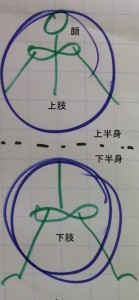
For example, in my own case there are issues such as:
- Shoulder girdle: a blockage around the clavicles and sternum, a feeling of compression from behind the clavicle–sternum area, and neck tension.
- Pelvic girdle: a lack of awareness of pushing the sit bones upward (and so the force in the psoas major is not released).
In particular, as shown in the figure below, when sitting on a chair and lengthening the spine up from the sit bones, force goes into the abdominal muscles, and as a result, force goes into the muscles nearby (the psoas major and the muscles around the clavicle and sternum).

How to release the excess tension in the abdominal muscles? That helps in releasing the force of the whole body, so in the remaining three sessions, I’d like to move toward a solution together with the Rolfer.

In session 8, the following treatment was carried out on the pelvic girdle and the shoulder girdle.
Pelvic girdle: holding the awareness that the sit bones and the spine (sacrum–lumbar–thoracic–cervical) connect to the head
Lying on the side of the body, releasing the ligaments connecting the sit bones and the sacrum; working on the muscles connecting the pelvis and the ribs (around the quadratus lumborum) to release the fascia (improving the linkage between the pelvic girdle and the shoulder girdle).
Sitting on a chair and spreading the sit bones to release the sacrum → while releasing the abdominal muscles, lengthening the spine up from the sternum.
Placing the lower limbs against the wall, bending the body to 90 degrees, and placing both hands on a chair → spreading the sit bones to release the sacrum → while releasing the abdominal muscles, lengthening the spine up from the sternum (in yoga terms, the Downward Dog pose).
Shoulder girdle: releasing the feeling of compression around the clavicles and sternum
- Lying supine, releasing the fascia from the thoracic to the cervical vertebrae.
In particular, having the body learn the movement of sitting on a chair, spreading the sit bones, and lengthening the spine without using the abdominal muscles helps in releasing the force of the whole body. However, since this is a new pattern, I think it needs time. Even after session 10 ends, this is a movement I’d like to keep practicing.
As a result of the treatment, the following were observed:
- Neck tension eased.
- The area around the chest became freer.
- The sit bones spread, and a widening of awareness of the sacrum came to be felt.
The neck tension remains to the end, but interestingly, I noticed a sense of discomfort on the left side as an vestibular sense.
In sessions 9 and 10, how can the inner-ear sense and the neck tension come to improve? I’d like to work on it while enjoying the process.
Note, August 2026
This piece covers the first of the integration sessions — the one that brings the two girdles, shoulder and pelvic, into linkage.
A short observation stands at the close. The neck tension remained to the end, and a sense of discomfort appeared on the left side as a vestibular sense. That one line reaches forward eleven years.
A record of the left side
A week before this piece, receiving Session 7, I had also written about a left-right difference. Releasing the muscles at the surface of the face, the fascia of the oral cavity, the inside of the nose, and the area around the crown of the head, the left side took longer than the right to let go of its effort (see “Session 7: The Head and the Face“).
One of the principal aims of Session 7 was the vestibular sense, which adjusts the balance with gravity. And the inner ear sits within the temporal bone.
In this piece, that has been put into words as a sense of discomfort on the left, in the vestibular sense. Within a week, a difference between regions had been taken up again as a difference in sensation.
Since December 2025 I have been receiving the Safe and Sound Protocol (SSP), based on Polyvagal Theory. It uses specially filtered music to regulate the autonomic nervous system, and the key lies in the middle ear muscles.
What a week of it first brought was a sense of the balance between left and right inner ear — not a balance worked out in the head, but one available in fine detail as bodily sensation (see “The Safe and Sound Protocol (SSP) and Polyvagal Theory — a Reunion with Takami Kamata“).
What was noticed eleven years earlier as discomfort had become, eleven years on, something available in fine detail.
Session 7 approached it from the side of the fascia; SSP approaches it from the side of hearing. The middle ear and the inner ear sit within the same temporal bone. The entrance differs; the place being handled overlaps.
A new pattern takes time
This piece holds the following.
“Having the body learn the movement of sitting on a chair, spreading the sit bones, and lengthening the spine without using the abdominal muscles helps in releasing the force of the whole body. However, since this is a new pattern, I think it needs time. Even after session 10 ends, this is a movement I’d like to keep practicing.”
The phrase new pattern comes from a piece written four days earlier (see “Phase II (24) — Old Patterns and New Patterns“). It is the new habit of movement born as a result of the work, treated as one option standing alongside the old pattern.
And the piece says the practice will continue after the ten sessions end.
In the 2025 Advanced Training, one of the five Principles of Rolfing turned out to be CLOSURE — giving an appropriate ending to a process. The reason was given this way: one of the reasons closures are important is because it allows what is next to happen (see “Journey to Becoming an Advanced Rolfer — A Summary of the Road to Certification“).
Ending at ten, and continuing after. This piece writes both. Because there is an ending, what comes after can begin. As a student, that had already been set down as something felt.