Introduction
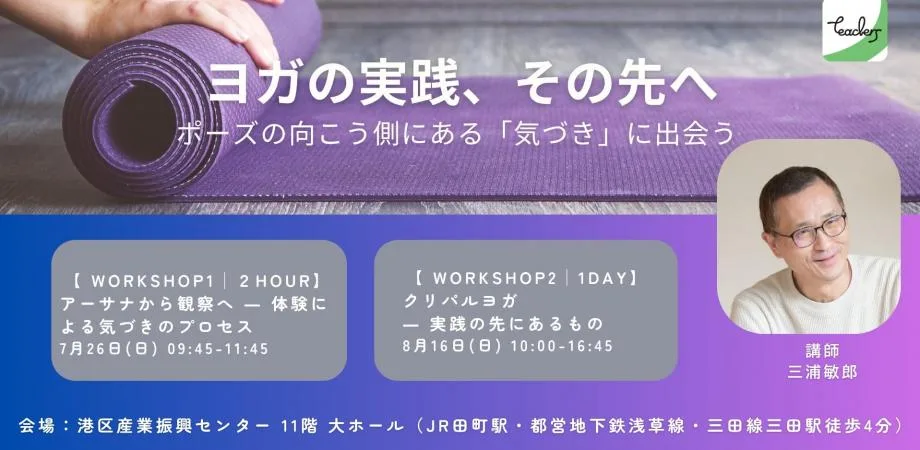
On August 16, 2026, after a long interval, I took part in a yoga workshop led by Toshiro Miura — known to everyone as Toshi-san. I first met him in 2011. That is fifteen years ago now.
The workshop was titled:
Beyond the Practice of Yoga — The Process of “Awareness” Deepened by Two Approaches
It was hosted by Teachers and held at a public facility in Tokyo.
Looking back now, “beyond the practice of yoga” is the very theme I have been exploring through yoga for more than fifteen years.
Before describing what happened on the day, I want to write about how I began yoga, why I came to look for methods other than Ashtanga Vinyasa Yoga (hereafter Ashtanga), and how, in that process, I met Toshi-san.
2008 — Meeting Ashtanga Vinyasa Yoga
I began practicing yoga in earnest in April 2008.
My teacher at that time was Tarik Thami.
I started attending the Mysore Class he led (Mysore Tokyo), and while continuing to work full time, came to practice five days a week. Mysore Tokyo closed, unfortunately, in July 2020.
Ashtanga has the characteristic of repeating a fixed sequence of postures, linking breath and movement. Because the same sequence is repeated, what could not be done yesterday becomes possible today, or conversely a movement that was easy yesterday feels heavy today. With the body as a single fixed point, one can observe one’s own changes.
For me at that time, this method was highly appealing. And Tarik valued self-direction, treated enjoying the practice as more important than anything, and was not particularly strict about the alignment of postures — about which shape is correct and which is wrong. I could practice freely.
A large part of why I could keep practicing was that I could be myself there. I felt the breadth of Tarik’s character, and the sense that anything was accepted. He also created an atmosphere in which it was easy to talk.
👉 Related: On Exercise and Yoga — How the Encounter Happened
Yoga — Nearly Twenty Years of Practice, and a Summary of Forty-Five Days of Training
“Is This Method Alone Enough?”
But as the years of practice went on, questions began to arise little by little.
One was physical.
Seen as bodily movement, the Ashtanga primary series has a great deal of movement in the sagittal plane — forward and backward, through forward bends and backbends. Rotation in the transverse plane, and side-to-side movement in the frontal plane, are relatively few.
That is not in itself a bad thing.
But if the same movement pattern is repeated over a long period, and at high frequency, the body adapts to that pattern. Later, once I began studying Rolfing and fascia, I came to think about this from the viewpoint of a bias in movement being written into the fascia.
This became one of the openings through which my interest widened toward Rolfing and other bodywork. The other, larger one, was coming to know the history of yoga itself.
Looking at the Person, Not the Lineage
From around 2011, I became interested in forms of yoga other than Ashtanga.
Then, on May 25, 2013, taking part in a training with Leslie Kaminoff at Under the Light Yoga School (UTL) became an occasion for looking seriously into the history of modern yoga.
What I encountered was the thinking of Tirumalai Krishnamacharya, sometimes called the father of modern yoga.
Kaminoff’s teacher — and Krishnamacharya’s son — T.K.V. Desikachar, expresses the essence of his father’s teaching in The Heart of Yoga as follows.
The essence of my father’s teachings is this: it is not that the person needs to accommodate him- or herself to yoga, but rather the yoga practice must be tailored to fit each person.
This was a large discovery for me.
Sri Pattabhi Jois, B.K.S. Iyengar, and T.K.V. Desikachar all studied under Krishnamacharya.
And yet the yoga that came out of them is entirely different.
- A dynamic practice that draws out the physical capacity of young men (Ashtanga)
- A method that looks precisely at the alignment of the body (Iyengar Yoga)
- Yoga therapy, built to fit illness and each individual condition (Yoga Therapy)
If so, then asking “which lineage is correct” may itself be slightly beside the point.
What matters is what practice this one person, in front of me, needs now.
That is how I came to think.
👉 Related: Yoga — Nearly Twenty Years of Practice, and a Summary of Forty-Five Days of Training
To Under the Light Yoga School
Wanting to learn methods other than Ashtanga in a systematic way, I decided to take the RYT200 teacher training at UTL. I was certified as RYT200 in January 2013.
There, the teachers came from different backgrounds: Mayumi Kondo, a fellow Ashtanga practitioner; Naoto Nakamura, a physical therapist; Shizuka Gozu, of Kripalu Yoga; Keiko Okuno and Yuki Nishioka, of Iyengar Yoga; Hiroko Kusuhara and Kranti, of Ashtanga; Hikaru, of Sivananda Yoga; and Kiyoshi Naruse, of yoga philosophy.
Rather than learning one “yoga,” it was:
learning multiple viewpoints — lineages — from which to see yoga.
That is what that time was, I think.
Among them, one that made a strong impression on me was the approach of Kripalu Yoga.
May 2011 — First Meeting with Toshiro Miura
In May 2011, introduced by a fellow Ashtanga practitioner, I took a three-day intensive in Phoenix Rising Yoga Therapy, offered at Kripalu Japan, which Toshiro Miura led in Shimokitazawa at the time.
That was my first meeting with Toshi-san.
I wrote about the experience then under the title “When Coaching and Yoga Come Together.” Because the method felt to me like coaching done through the body.
With support from a practitioner, one enters a yoga posture and approaches one’s own Edge. Edge here does not mean forcing past a limit; it is the physical and psychological boundary at which one feels “I could go a little further, and at the same time something is beginning to happen.”
There, one is asked: “What is happening now?”
The teacher does not give the answer.
One feels what is happening in the body and, giving words to that sensation, notices for oneself.
Having already been studying CTI coaching at the time, I felt a strong commonality with this way of thinking.
Coaching holds the premise that
the client is originally whole, and holds the capacity to find their own answers.
Yoga therapy held a very similar idea.
What differs is the entrance.
- In coaching, one enters mainly from words.
- In yoga therapy, one enters from bodily sensation.
Noticing from words.
Noticing from the body.
In 2011, I was very interested in the difference between these two approaches.
👉 Related: Yoga — Nearly Twenty Years of Practice, and a Summary of Forty-Five Days of Training
And Fifteen Years Later
Fifteen years have passed since then.
In that time I have studied not only yoga but Rolfing, Rolf Movement, coaching, meditation — various methods concerned with body and mind.
That is exactly why I wanted to take part in Toshi-san’s workshop again, on August 16, 2026.
This time the theme was:
awareness.
Fifteen years ago, I was interested in the difference between noticing from the body and noticing from words.
But taking part this time, another question came into view.
It was:
“How does a field in which a person can notice come into being in the first place?”
A teacher teaches something to the participants.
A fixed program proceeds in order.
It was a little different from that kind of ordinary workshop.
The program of the day itself is shaped by the people taking part.
The facilitator moves things along.
But does not control the field too much.
Within that, one watches what happens between one person and another.
The “noticing from the body” I felt fifteen years ago had widened, this time, into noticing that arises within relationship.
Next time, looking back at what actually took place on August 16, 2026, I want to consider:
How is a field in which awareness arises created?