
Introduction — “How Is the Field Created?”
On August 16, 2026, I took part in Toshiro Miura’s workshop, Beyond the Practice of Yoga — The Process of “Awareness” Deepened by Two Approaches.
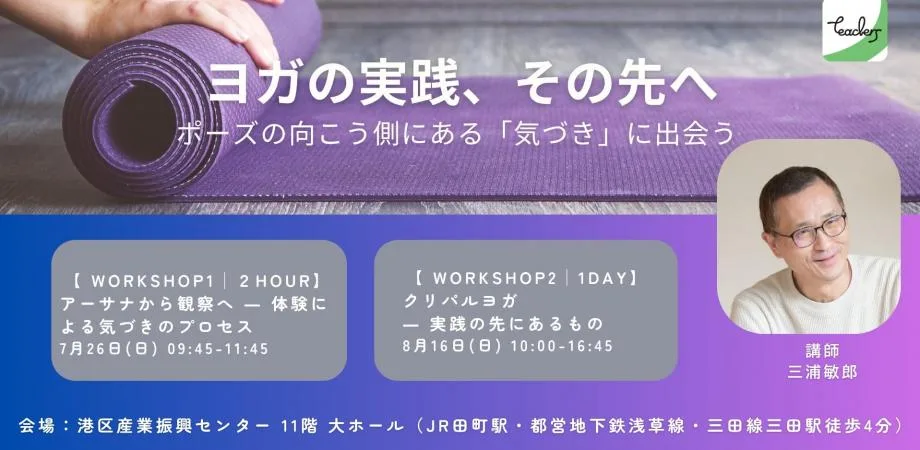
In Part 1, I wrote about beginning Ashtanga Vinyasa Yoga (hereafter Ashtanga) in 2008, widening my interest from there toward various methods of yoga, and meeting Phoenix Rising Yoga Therapy, which Toshi-san was teaching, in 2011. Taking part in his workshop again after fifteen years, what stayed with me from the start was the question: how is the field created?
In the notes I wrote on my iPad that day, there remain the lines: “the people who take part create the program” and “I move things along, but…” In other words, this is not a way of thinking in which a teacher delivers a finished program in order. Toshi-san does move the whole thing along. But what happens on the day changes according to the people gathered there.
Who is taking part. What state their bodies are in. What words come out in that room. What reactions arise. Watching these, the field of that day takes shape. This stance ran through the whole workshop, I think.
“Creating a Field” Is Not Controlling It
Generally, “creating a field” brings to mind a facilitator designing a detailed program in advance and leading participants into it. What I felt this time was that setting a field in order and controlling a field are different.
What will be done, how much time will be used, what to attend to in order to do it safely. Such a framework is laid out with care. On the other hand, it is not decided that “you must feel this way” or “from this experience you must notice that.” Rather, a margin is left in which participants search out for themselves: “what is happening in me now?”
What I felt was important for this was the use of words. Toshi-san’s guidance is very careful; rather than instructing strongly, he places words so that participants can turn attention toward what is happening inside their own bodies. What matters is feeling what is happening inside the body, more than completing the shape of the body.
Less moving the body with words than inviting attention to the body with words. Receiving Toshi-san’s guidance this time, that difference stayed with me strongly.
What It Shares with Embodiment in Rolf Movement
Listening to Toshi-san guide the yoga postures, several times I felt: this is close to the Embodiment we do in Rolf Movement.
Rolf Movement is the approach within Rolfing in which, rather than changing the body through hands-on technique, one comes to notice how one uses one’s own body, through movement and bodily sensation. Rather than teaching correct movement from outside, it values exploring, while actually moving, what is happening in one’s own body.
When I was taking the Rolfing Basic Training in Munich in 2014, I could not understand the content of the sessions through the usual translation of the word Embodiment. So I asked Giovanni Felicioni, my instructor at the time, and was told that Embodiment is easier to grasp as sense, or as experience.
Etymologically too: em is “into,” body is the body, and ment is a nominalizing ending. Embodiment is easier to understand as taking sensation and experience into the inside of the body.
In the Rolfing Basic Training and the Rolf Movement Training, an Embodiment Session is always held at the start of class. It is time for feeling — inside the body rather than understanding with the head — the upper and lower body, front and back, left and right, and the central axis, while actually moving. Sometimes movements resembling those of animals are done, and how the body’s axis developed over the course of evolution is learned not as knowledge but as bodily experience.
How to build and offer such an Embodiment Session is something I learned in the Rolf Movement Training.
What matters is not “memorizing correct posture” but “experiencing that sensation within oneself.” When a Rolfer touches a client’s body, without a similar sensation or experience inside one’s own body, it is difficult to catch what is happening inside theirs. In that sense Embodiment was not a mere warm-up but one of the important pillars of Rolfing training, alongside the Practicum in which hands-on technique is practiced.
👉 Related: Phase II (13) — Bodily Sensation: What Is Embodiment?
Becoming a Certified Rolfer in Europe — The Certification Training of the European Rolfing Association
Becoming a Rolf Movement Practitioner in Europe — The Path to Certification
Rolf Movement and the Feldenkrais Method
Rolf Movement has been strongly influenced by the Feldenkrais Method. So its idea of learning through movement overlaps in many places with Feldenkrais.
In Feldenkrais, as I have heard it, rather than giving the correct answer from outside with “move correctly,” one explores using the body: “if I move it this way, what happens inside me?” Move a little. Move in a different direction. Compare left and right. Let the force go, and feel what changes. And discover the difference for oneself.
That is, rather than a teacher teaching “correct movement,” the person’s own sensation teaches the person. In Toshi-san’s guidance this time, I felt something close to that.
Kripalu Yoga, Rolf Movement, and the Feldenkrais Method differ in history and in aim. At the level I experienced this time, I felt a commonality in the stance of discovering the possibility of change through one’s own sensation, rather than correcting the body into a right shape from outside.
Morning — Moving the Body with a Partner
Within this flow, the morning moved into partner work. In pairs, we did yoga postures and stretches that can be done with two people. And rather than staying with one partner throughout, we changed partners partway, working with three people in total.
This was more interesting than I had imagined. Doing yoga alone, it is enough to turn attention to one’s own breath, one’s own body, one’s own sensation. With two people, that is not enough. How much does the other person want to move? How much force is comfortable for them? How close may one come? At the same time, one needs to notice whether one is straining oneself.
And when the partner changes, all of it changes. Size of body, flexibility, sense of distance, speed of movement, way of communicating — all different. There, a question surfaced in me: how does one build trust with another person?
Caring for Oneself While Respecting the Other
What I felt doing partner work was the balance between respecting the other person and caring for oneself.
Try too hard to do something for the other, and one strains oneself. Conversely, concentrating only on one’s own bodily sensation, the person in front of one disappears from view. Not losing oneself. And yet turning attention toward the other. Both are needed.
For instance, when supporting another person’s body, if excess force is in one’s own body, that tension transmits to them. Conversely, minding only their reactions and no longer feeling one’s own body does not make a natural relationship either. What is needed, I think, is turning attention to oneself while at the same time widening awareness to include the other.
Yoga carries a strong image of practice that turns attention inward. But in this partner work, I experienced another direction: feeling one’s own inside while widening attention to the person in front of one, and to the surrounding space.
Edge — the Boundary of “Neither Too Much nor Too Little”
In the morning we also explored deeply one of the characteristics of Kripalu Yoga, the Edge. In Richard Faulds’s Kripalu Yoga: A Guide to Practice On and Off the Mat, the Edge is put this way:
“a place of neither too much nor too little stretch.”
That is, a place where the stretch is neither too strong nor too weak. Faulds explains that going too far from the Edge leads to boredom and stagnation, while going past it leads to injury. And that without finding the Edge, no growth, no learning, and no change arise.
Taking this explanation, the Edge is not simply a limit point of “how far can the body stretch.” It is easier to think of it as a boundary that is safe, and where something begins to happen.
Stretching a little. A little strong. But one can still be there. One can still breathe. Staying in that place, one feels “what is happening in the body now?”
Rather than moving on to the next posture right away, one stays at that Edge for a set time. Then, beyond the stretch of muscle felt at first, many things come into view: changes in the breath, tension, restlessness. The Edge is, I think, less a place for searching out a physical limit than a place for observing oneself.
The Mind Works Too Much
In my case, however, a problem arose here. Even having reached the Edge, the mind — the head — starts working immediately.
“Which muscle am I using now?” “What does this posture mean physically?” “How would this look from the viewpoint of Rolfing?” While thinking such things, concentration on the body breaks off. Even while intending to turn attention to bodily sensation, before I notice it I am analyzing it.
Feeling and thinking are different. Through the morning, I felt that difference vividly.
In the sharing after the work, someone said “practicing together with everyone deepens concentration more than practicing alone.” I see, I thought. Though in my case it was not a matter of that — the mind was running around, and simply staying at the Edge was work enough.
Afternoon — the Mind Grows Quiet
After lunch, we moved further into exploring the Edge through postures. This time the postures were stronger than in the morning. And yet something strange happened.
The mind grew quiet, incomparably so. In the morning thoughts had come one after another; in the afternoon, my head became astonishingly still. So still, in fact, that I began to get sleepy.
Toshi-san’s guiding voice was very comfortable, and drowsiness came over me several times. But at those moments, feel the breath again. Search out the Edge once more. Return attention to the sensation of the body. With such guidance entering, I could return to the body rather than falling into the sleepiness.
It Felt More Intense Than Ashtanga
Here was another unexpected discovery. I usually practice Ashtanga, which contains postures that are physically quite difficult.
Even so, this Kripalu Yoga practice felt more intense than my usual Ashtanga. Not, of course, in the sense that the postures themselves were harder.
The difference was staying within that posture and continuing to feel what is happening there. In Ashtanga, one proceeds through a fixed sequence, linking breath and movement. In this practice, one stays at a single Edge and keeps feeling “what is happening now?”
Then it becomes a strong experience in a sense other than the outer shape of the posture. Closer to the intensity of continuing to turn attention to the inside of the body than to physical intensity.
There came the discovery: ah, practicing yoga this way, one can go further into the inside of one’s own awareness.
From “Can or Cannot” to “What Am I Feeling”
Practicing Ashtanga over a long time, an element of “can do or cannot do” inevitably enters the postures. Deeper than yesterday. Today I could do this one. I moved on to the next.
That is not in itself a bad thing. Because the same sequence continues, one can confirm the changes in one’s own body. But in this practice of the Edge, the question was a little different.
Not “how far could I go?” but “what am I feeling there?”
This connects with what was said earlier about the Embodiment Session. More than completing the posture, one keeps feeling oneself within that posture. And when awareness leaves the body, one comes back again.
When I experienced Toshi-san’s yoga therapy in 2011, accessing the inner life through the body was itself new to me. Fifteen years later, it had become visible as something connected with my own experience of learning Rolf Movement and Feldenkrais. Even with the same experience, when the experience on one’s own side increases, what is visible changes too. That was another of this day’s interests.
Morning Outward, Afternoon Inward
Looking back on the day, there was an interesting contrast between morning and afternoon.
In the morning’s partner work, awareness widens from oneself to the other, and further to the surroundings. In the afternoon’s exploration of the Edge, the ceaselessly moving mind is quieted, and attention deepens toward the inside of one’s own body.
At a glance, opposite directions. But without being able to feel one’s own body, the sense of distance to another cannot be known either. And closed only within one’s own inside, one cannot feel the person in front of one.
Deepening inward, and widening outward. Going back and forth between the two was, I think, the process of “awareness” this time.
The Gathering Afterward — Looking Back on Fifteen Years
After the workshop there was a gathering, where I could exchange views with various participants. There I could hear about the history of how Kripalu Yoga training has been carried out.
Knowing history by reading books matters too, but hearing from people who have actually studied and practiced within that culture holds a different kind of interest.
Fifteen years since I first received Toshi-san’s yoga therapy in 2011. In that time I continued Ashtanga and studied Rolfing, Rolf Movement, coaching, meditation, and various other methods. That is exactly why, this time, I think I saw what I had not seen fifteen years ago.
Conclusion — Creating the Conditions in Which Awareness Arises
Fifteen years ago, experiencing Toshi-san’s Phoenix Rising Yoga Therapy, what interested me was the method of noticing from the body. This time, another viewpoint was added.
It is the question: how does one set in order the field in which awareness arises?
Rather than the facilitator giving the answer, making it possible for each person to discover from their own body. For that, choosing words with care and setting the necessary framework, while not controlling too much what happens.
That I recalled the Embodiment Session of Rolf Movement and the Feldenkrais Method while experiencing Kripalu Yoga was, probably, this point. Different in method, but rather than our “changing” the other person, creating the conditions in which that person can discover something through their own sensation.
This connects, I think, not only to yoga but to Rolfing, Rolf Movement, coaching, and other work that involves being with people.
Thought of that way, the phrase “creating a field” sounds a little different. A field is not a finished product that someone provides. The facilitator sets the necessary conditions in order. Within that, participants feel themselves and feel one another. And through that interaction, a field that exists only on that day, in that place, rises up.
The question fifteen years ago was “what does one notice from the body?” And the question newly added this time was:
“What kind of field can be set in order, so that a person notices themselves?”
What lies beyond the practice of yoga. It may be not only deepening the postures further, but widening awareness from one’s own body, to the other person, and to the field that arises between them.