The Science of Posture and Movement Series — Examining the Relationship Between Gravity and the Body | Part 5
Introduction
“I keep up with both yoga and Pilates, yet my stiff shoulders and lower-back pain never get any better.”
It is a remark heard often in sessions. The superficial muscles are loosened, yet something deeper does not change — and the reason is that the approach is reaching a different “layer.”
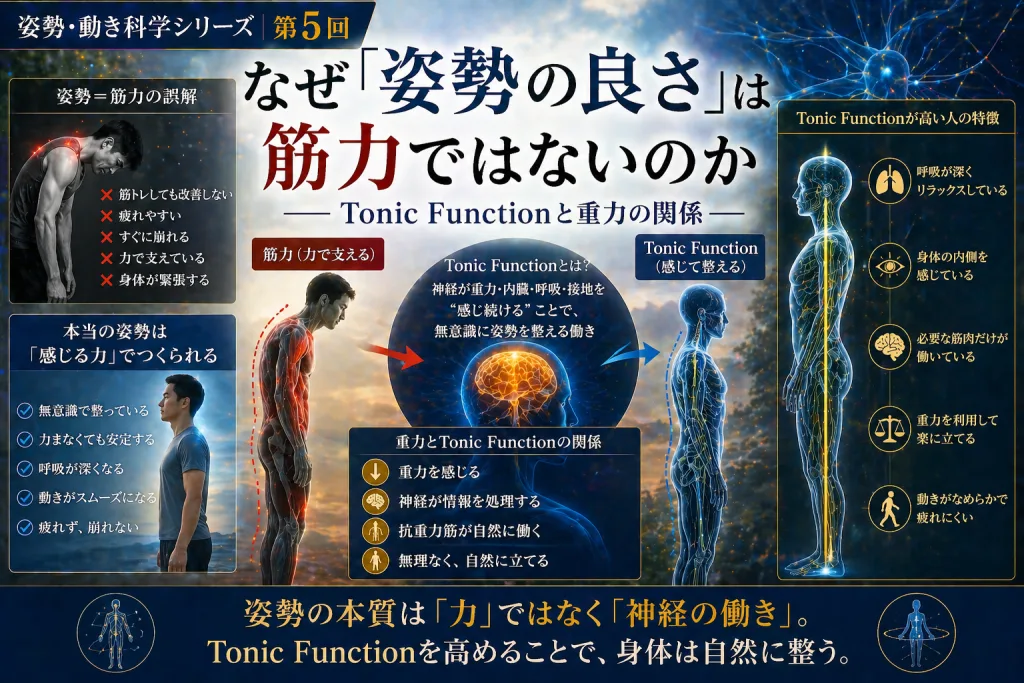
What supports posture is not “muscle strength” but “the body’s response to gravity.” The concept that gave this question a scientific answer is “Tonic Function,” proposed by Hubert Godard, the French Rolfer and neuroscientist.
Tonic Function and Phasic Function — Two Ways the Body Works
Under the conditions of gravity, muscles operate in two ways.
Phasic Function — muscles that work “transiently” — handle conscious movements such as lifting an object or sprinting. They draw on glucose for energy and are governed by the alpha motor nervous system; in other words, they are muscles the brain can control directly. They are concentrated in the superficial layers, tire easily, and contract under stress and tension as well. Much stiff-shoulder and lower-back pain is the state in which these muscles have taken on the work of “maintaining posture,” a job that is not properly theirs.
Tonic Function — muscles that work “continuously” — are the deep muscles that hold posture around the clock, unconsciously. They draw on oxygen for energy and are governed by the gamma motor nervous system; rather than conscious will, they are handled by the unconscious, habitual nervous systems of the cerebellum and the medulla oblongata. They resist fatigue and engage automatically the moment gravity is detected.
The key to this automatic action is the muscle spindle. Deep muscles are rich in spindles, which sense the stretching and shortening of the muscle. When the body detects gravity, the spindle switches on, and the tonic muscles begin to work naturally without any conscious effort.
| Phasic (transient) | Tonic (continuous) | |
|---|---|---|
| Nervous system | Alpha motor system | Gamma motor system |
| Control | Conscious / voluntary | Unconscious / automatic |
| Location | Superficial | Deep |
| Fatigue | Tires easily | Resists fatigue |
| Energy source | Glucose | Oxygen |
When yoga or Pilates is slow to produce results, it is often because the superficial layer (Phasic) has not been released, so the spindles of the deep layer (Tonic) never switch on. Releasing the superficial layer first is the order of operations for restoring Tonic Function.
So What Kind of Exercise Should You Do?
There is a question I am often asked in sessions.
“What kind of exercise should I be doing?”
The gym, Pilates, yoga. All of them are said to be good for the body. But where each one reaches in the body is different. Seen through the contrast of Phasic and Tonic, that difference becomes clear.
The Gym — Training Phasic
What the gym works with is mainly the Phasic domain. Set the load, count the repetitions, add weight. Muscles that can be consciously controlled, trained consciously.
What is gained there is considerable.
Endurance is less the ability to run for a long time than the power to return. The higher the cardiopulmonary capacity, the faster the recovery from load. The breath deepens, and a margin is born on the inside.
Strength is less the ability to lift something heavy than the power to support oneself within gravity. A body that can stand firmly, legs that can hold ground, hands that can grip. Without our noticing, these build the sense that “I am supported.”
However, no matter how much Phasic is trained, Tonic does not begin to work automatically. If anything, when the surface stays in excess tension, the switch in the depth is harder to turn on.
Pilates — The Central Axis, and the Precision of Movement
What Pilates works with is closer to the domain of Coordination. It raises the precision of movement and sets the central axis in order. It is designed so that awareness can enter the depth.
But here too, the question of order appears. If the surface stays hardened and one consciously “engages the core,” that becomes a command to Phasic. It is the state of trying to have Phasic substitute for the work Tonic is meant to do.
Yoga — Breath, and Perception
Yoga is, in its origin, one of the practices preparing for meditation. Moving together with the breath, quieting thought, the asanas are built so that sensitivity turns inward.
So what yoga reaches is not muscle alone. It reaches the layers of Perception and Meaning as well. How space is felt changes, and the body’s judgment that “this place is safe” changes with it.
Even so, yoga too cannot reach the depth if the surface has not softened. “I keep doing yoga and my shoulders are still stiff” is often this question of order.
Stability Is the Hub That Connects the Three
Endurance may be there, strength may be there — but if the structure has collapsed, the force disperses.
Stability is Tonic Function itself. And it becomes the hub that connects everything else. When posture comes into order, the breath changes and the efficiency of force transmission rises. With the same training, where it reaches changes.
So the answer to “what kind of exercise should I be doing” is not a choice of discipline. It becomes a question of order: which layer do you want it to reach, and is the body right now in a state where it can reach that layer?
When the surface has softened and Tonic Function has recovered, the same discipline is used differently by the body. That Rolfing is sometimes described as something to do “before exercise” is a matter of this order.
Tonus (Muscle Tone) — A Sustained State of Readiness
The physiological basis of Tonic Function is “Tonus” (muscle tone).
Tonus means “keeping the tone of the muscle” — the sustained state of readiness that exists before a muscle moves. Where the alpha motor nerves issue the command “move,” the gamma motor nerves issue the command “stay ready to move at any moment.”
The quality of this muscle tone determines the quality of posture. What Rolfing aims for is to activate the gamma motor nervous system appropriately, so that the tonic muscles can reclaim their proper work — a natural response to gravity.
→ Tonic Function ②: Tonus and Bidirectionality
Why Trying to “Improve Posture” Backfires
“Straighten your spine,” “pull your shoulders back,” “tighten your core” — these are all commands to the Phasic system (conscious, quick to tire).
They attempt to substitute the Phasic system for a domain that the Tonic system (unconscious, sustained) is meant to handle. It is only natural that holding posture by conscious effort is tiring, because it asks the wrong muscles to do the wrong job.
There is a phrase, “let go of tension.” But it means nothing without knowing which muscle’s tension to release. The answer is to undo the over-tension of the phasic muscles. Releasing the state in which the Phasic system substitutes for the Tonic system’s job, so that the tonic muscles can reclaim their proper work — this is the essence of “letting go of tension.”
The Four Perspectives of Tonic Function
What Hubert Godard demonstrated is that Tonic Function is not simply a “muscle problem.” The body’s posture and tone are influenced from four perspectives.
① Coordination — How the body’s parts coordinate their movement determines the quality of Tonic Function. Habits and quirks of movement become engraved as patterns of muscular tension.
② Perception — How space, gravity, and environment are perceived directly alters the tonic state. The sense of peripersonal space (the personal space surrounding oneself) is directly linked to posture. This is precisely why Rolfing emphasizes not only “a direct approach to the fascia” but also a change in perception — how the body is felt within space.
③ Meaning — The meaning assigned to a situation affects the body’s tonic state. The meanings “this place is safe” or “there is a threat” change the body’s patterns of tension. It is a perspective that overlaps deeply with the trauma and attachment theory covered in the Somatic Psychology series.
④ Structure (Rolfing’s distinctive focus) — Working on the very structure of the body — its relationship with fascia, posture, and gravity — ripples out to all three perspectives above. When the body’s center comes into order, Coordination, Perception, and Meaning all change.
| Perspective | Content |
|---|---|
| Coordination | Patterns and habits of movement |
| Perception | How space and gravity are sensed |
| Meaning | Interpretation of, and emotion toward, a situation |
| Structure | Aligning the body’s center ← Rolfing’s distinctive focus |
Rolfing is said to “integrate the body” rather than “correct posture” because a direct approach to structure ripples out to all four of these.
Gravity and the Tonic Muscles — The Mechanism That Keeps the Body Balanced
There is a perspective deepened through a workshop with Gael Rosewood, a Rolf Movement trainer.
Gravity acts on the body at all times, and the tonic muscles make ceaseless, minute adjustments against it, continually supporting the body so that it does not fall. This process is not a conscious effort but an automatic dialogue between the nervous system and the muscles.
Trouble arises when the tonic muscles fall into over-tension, under-tension, or a mistaken pattern of activation. Much chronic shoulder stiffness, lower-back pain, and neck tension can be understood as a dysfunction of the tonic muscles. Rather than “kneading what feels tight,” what is needed is to ask anew, from the perspective of Tonic Function, “why was this pattern formed?”
→ How Do the Gravity-Related Tonic Muscles Keep the Body in Balance?
Movement and Tonic Function — A Rolf Movement Perspective
Tonic Function is directly linked not only to “static posture” but also to “the quality of movement.”
When Tonic Function works properly, the body can produce maximum efficiency with minimum force. An athlete’s “smooth movement” or a martial artist’s “relaxed power” is born not from the muscular strength of the Phasic system but from the natural response of the Tonic system. Conversely, when Tonic Function is disrupted, excess tension arises within movement, and the burden concentrates on particular regions of the body.
→ How to Relate the Body’s Movement to Tonic Function?
To Study Tonic Function More Deeply
- Tonic Function ①: The Foundations of Rolfing’s Scientific Theory
- Tonic Function ②: Tonus and Bidirectionality
- Tonic Function ③: Space (Its Relationship with Spatial Awareness)
- How Do the Gravity-Related Tonic Muscles Keep the Body in Balance?
- How to Relate the Body’s Movement to Tonic Function?
Posture and Movement Science Series — The Science of the Relationship Between Gravity and the Body (All 6 Parts)
Part 1: What Is the Difference Between Squatting and Sitting — The Influence of Chair Culture on the Body
→ Read Part 1
Part 2: Why Sitting for Long Periods Is Bad for the Body — The Science of Visceral Fat, Chronic Inflammation, and Stress
→ Read Part 2
Part 3: Why Is “Standing” Not Tiring? — The Mechanism of Gravity and the Antigravity Muscles
→ Read Part 3
Part 4: Why “Walking” Is Fundamental to the Human Being — The Science of Bipedal Walking, Weight Shift, and Gravity
→ Read Part 4
Part 5: Why Good Posture Is Not a Matter of Muscle Strength — Tonic Function and Its Relationship to Gravity (this article)
Part 6: Why Does an “Easy Posture” Exist? — From the Perspective of Gravity, Fascia, and Rolfing
→ Read Part 6
Understanding posture and movement scientifically is one entry point for updating the “Recognition OS.” The theme of integrating thought, emotion, and body is explored in greater depth in the “Recognition OS” series at Mind and Bodywork Lab.
→ Mind and Bodywork Lab: How to Navigate This Site (only in Japanese)
A trial session is a place to begin by confirming what is happening within the body.
Hidefumi Otsuka, Ph.D. | Certified Advanced Rolfer™ / Rolf Movement Practitioner
Completed the doctoral program at the University of Tokyo Graduate School of Medicine. After a career in the pharmaceutical industry, has offered Rolfing® sessions in Shibuya since 2015, working under the theme of “the integration of thought, emotion, and body.”