
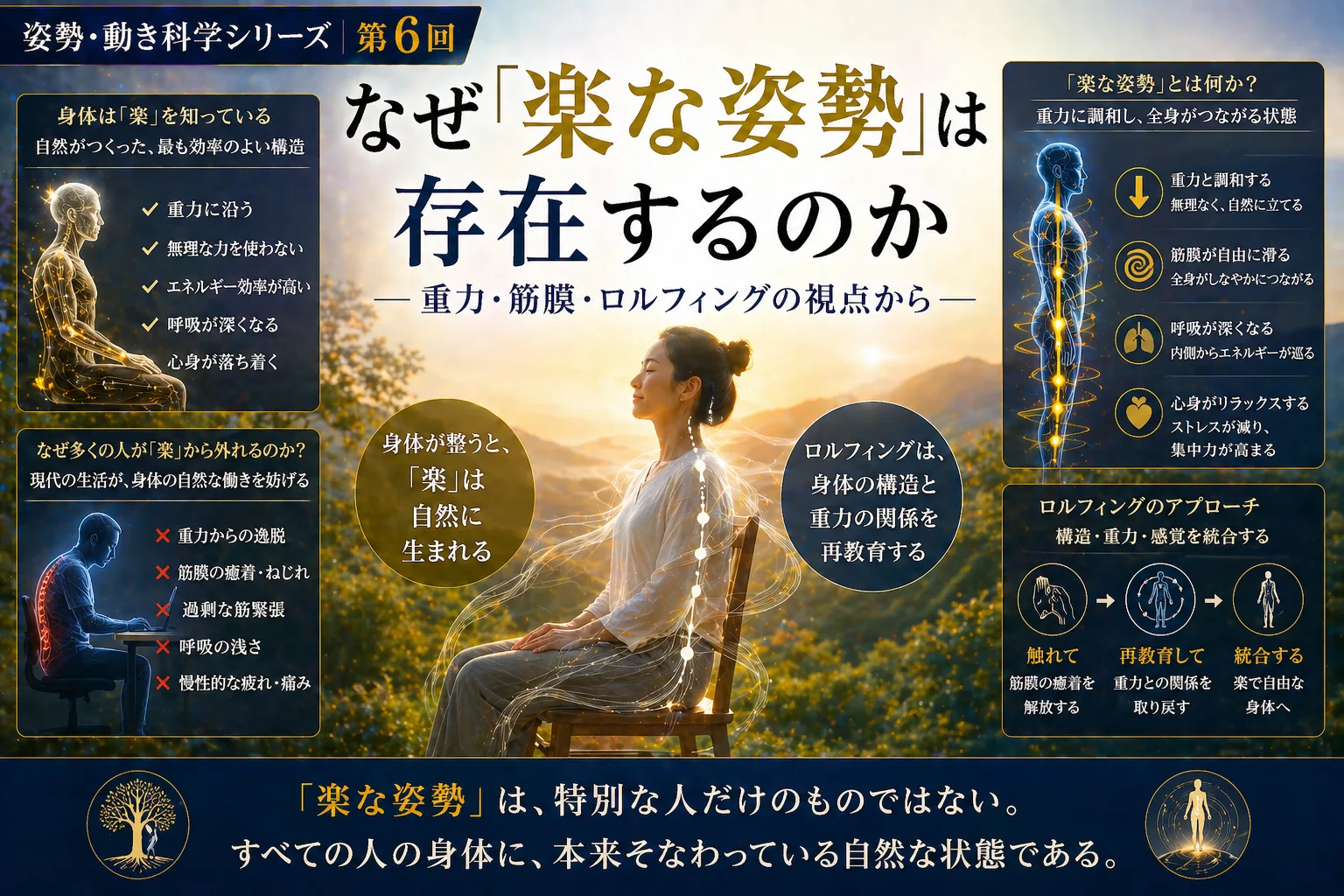
Posture and Movement Science Series — The Science of the Relationship Between Gravity and the Body | Part 6 (Final)
Introduction
In Part 1, through the 300-odd ways of sitting classified by the anthropologist Gordon Hewes, I explored how diversely humans had made contact with the ground, in many postures, until chair culture appeared. I looked at how Japan’s bodily culture of direct connection with the floor — squatting, seiza, sitting cross-legged — changed with the spread of the chair.
In Part 2, I showed scientifically what sitting for long periods triggers inside the body. The accumulation of visceral fat, the decline in the metabolism of blood sugar and triglycerides, a rise in cortisol, the inactivation of muscles — I made clear that the essence of the problem is not “sitting” but “a motionless state continuing for a long time.”
In Part 3, starting from the question common to modern people, “just standing is tiring,” I explained the mechanism of gravity and the antigravity muscles. If the Tonic Muscles work correctly, standing is not tiring. Through the concept of Palintonicity (two-directionality), I showed the sensation not of “standing by trying hard,” but of “floating up within gravity.”
In Part 4, I explored how the action of “walking” is not merely a means of locomotion, but an act in which human evolution, the activation of the brain, and the integration of the whole body are concentrated. I looked at the conversion of gravitational energy through the inverted-pendulum model, the linkage of pelvic rotation and arm swing, and the effects that walking has on cognitive function and mood.
In Part 5, I presented the four viewpoints that support Tonic Function — Coordination, Perception, Meaning, and Structure. Here lies the reason Rolfing is said not to “correct posture” but to “integrate the body.”
In Part 6 (the final part), I answer the question that runs through this whole series. What is a “comfortable posture”? Why does it exist? And by organizing the body, what changes?
A “Comfortable Posture” Is Not Slacking Off
There must be many people who grew up being told “don’t take a comfortable posture.” Leaning against the backrest, crossing the legs, slouching — these have been treated as “sloppy.”
But as has been seen throughout this series, there is a limit to “correcting posture by trying hard.” Consciously straightening the back is the work of the superficial action muscles (Phasic Muscles); it is tiring and does not last.
A true “comfortable posture” is a state in which the body remains naturally organized even when force is released. The deep antigravity muscles (Tonic Muscles) respond to gravity, the skeleton stacks up in its natural position, and the body is supported with minimal energy — this state is the true nature of a “comfortable posture.”
“Comfort” is not laziness, but the height of efficiency.
Gravity Is Not an Enemy, but an Ally
Much of the idea of “improving posture” grasps gravity as a “force to be overcome.” Training the back muscles to resist gravity, tightening the core to prevent collapse — this is the idea of fighting gravity.
Rolfing’s originator, Ida Rolf, held the opposite idea. Gravity is not an enemy; if the body is correctly organized, it becomes the greatest ally — this is Rolfing’s fundamental thought.
The “inverted-pendulum model” seen in Part 4 is the typical case. When walking, the body converts the energy of gravity into the propulsive force of the next step. Not resisting gravity, but moving using gravity — this is the most efficient way of moving. It is the same when standing: if the body is organized so that gravity stacks the skeleton naturally, standing requires almost no energy.
Fascia Remembers Posture
Why, even when “correct posture” is consciously held, does it return to the original before being noticed?
The answer lies in the fascia. Fascia is a whole-body network that wraps the muscles, bones, viscera, and nerves, and it “remembers” habitual postural patterns. If a forward-leaning posture continues through desk work, that shape is inscribed into the fascia. If a long time is spent with the pelvis tilted backward, that shape is registered as “normal.”
Even when trying to change posture with consciousness, the pattern inscribed in the fascia pulls it back to the original shape. This is the structural reason for “posture not changing no matter how hard a person tries.”
By working directly on the fascia, Rolfing rewrites this pattern itself. By changing the structure rather than the consciousness, it recovers “a posture that organizes naturally even when force is released.”
What Is Integration — From the Perspective of Daniel Siegel
What Rolfing aims for is “integration (Integration).” I’d like to organize the meaning of this word from the thinking of the neuroscientist and psychiatrist Daniel Siegel.
Siegel defines “integration” as “connecting differentiated parts.” Body, emotion, thought, memory — these are each “differentiated parts” with different functions. When these differentiated parts remain isolated, a person falls into either “rigidity” or “chaos.” Rigidity is a hardened state unable to respond to change, and chaos is a state that has lost control and become scattered.
When integration occurs, a person enters a state of “Flexible, Adaptive, Coherent, Energized, and Stable (FACES).” Siegel calls this the “River of Integration.” The river’s flow runs freely between one bank of rigidity and the other bank of chaos — healthy integration flows down the center of that river.
Rolfing activates this very integration from the structure of the body.
The tension pattern of the fascia is the body’s “rigidity”: a state in which a particular area is over-tense and unable to move. On the other hand, a state in which the nervous system is over-activated and has lost its calm is “chaos.” When the fascia is organized and the skeleton is brought onto the axis of gravity in Rolfing, the body enters an “integrated state” that is neither rigidity nor chaos. When the body is integrated, emotion, thought, and perception also change in linkage — this completely overlaps with what Siegel says: “The body is the foundation of the mind.”
The very structure of Rolfing’s ten-session series is a process of integration. Sessions 1–7 “differentiate” and carefully treat each area, and the integration sessions, 8–10, connect the whole. Differentiation and integration — this is the reason Rolfing differs fundamentally from mere massage or correction.
The Three Integrations Needed for a “Comfortable Posture”
Integrating what has been shown throughout this series, it becomes clear that a “comfortable posture” needs three conditions.
The integration of structure. That the pelvis, spine, and head stack up naturally along the axis of gravity. This is the Structure treated in Part 5: a state in which the iliopsoas, the diaphragm, and the pelvic-floor muscles coordinate, and the foundation on which the deep Tonic Muscles can work is in place.
The integration of movement. That within the basic actions of sitting, standing, and walking, Tonic Function works automatically. Not making a still “good posture,” but the posture being kept naturally even within movement — this is the “automation of gait” seen in Part 4.
The integration of perception. That the sensation of the body within space (Perception) is accurate. Where gravity comes from, where the floor is, how the body is moving — when this perception is organized, the Tonic Muscles can respond correctly and automatically.
When these three are in place, posture becomes not “something to make” but “something that naturally comes to be.”
To Close the Series — Posture Is the Body’s Self-Expression
What has been shown repeatedly in this series is that posture is not “something to make consciously.”
Humanity has, over seven million years, evolved a body that coordinates with gravity. Hunter-gatherers stand, walk, and squat for hours, yet are strangers to low-back pain and stiff shoulders. Chair culture, desk work, the smartphone — lifestyle habits of just a few hundred years, a few decades, are damaging the legacy of that evolution.
What Rolfing seeks to recover is this “original way of using the body.” It organizes the fascia, brings the skeleton onto the axis of gravity, and restores a state in which the deep muscles can work automatically. Beyond that lies a “comfortable posture.”
A comfortable posture is not the result of laziness, but the self-expression of an organized body.
Posture and Movement Science Series — The Science of the Relationship Between Gravity and the Body (All 6 Parts)
Part 1: What Is the Difference Between Squatting and Sitting — The Influence of Chair Culture on the Body
→ Read Part 1
Part 2: Why Sitting for Long Periods Is Bad for the Body — The Science of Visceral Fat, Chronic Inflammation, and Stress
→ Read Part 2
Part 3: Why Is “Standing” Not Tiring? — The Mechanism of Gravity and the Antigravity Muscles
→ Read Part 3
Part 4: Why “Walking” Is Fundamental to the Human Being — The Science of Bipedal Walking, Weight Shift, and Gravity
→ Read Part 4
Part 5: Why Good Posture Is Not a Matter of Muscle Strength — Tonic Function and Its Relationship to Gravity)
→ Read Part 5
Part 6: Why Does an “Easy Posture” Exist? — From the Perspective of Gravity, Fascia, and Rolfing (this article)
Understanding posture and movement scientifically is one entry point for updating the “Recognition OS.” The theme of integrating thought, emotion, and body is explored in greater depth in the “Recognition OS” series at Mind and Bodywork Lab.
→ Mind and Bodywork Lab: How to Navigate This Site (only in Japanese)
A trial session is a place to begin by confirming what is happening within the body.
Hidefumi Otsuka, Ph.D. | Certified Advanced Rolfer™ / Rolf Movement Practitioner
Completed the doctoral program at the University of Tokyo Graduate School of Medicine. After a career in the pharmaceutical industry, has offered Rolfing® sessions in Shibuya since 2015, working under the theme of “the integration of thought, emotion, and body.”