
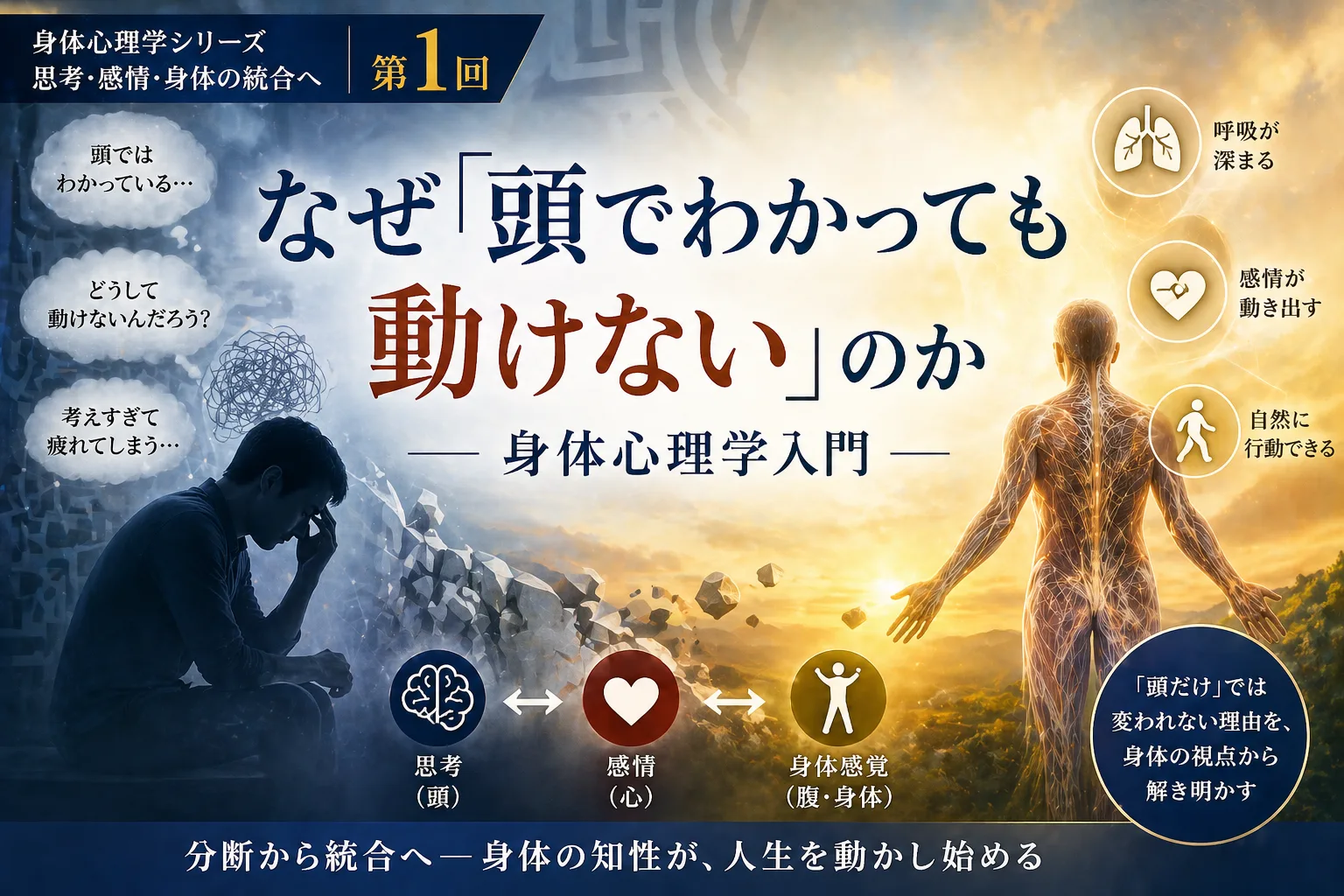
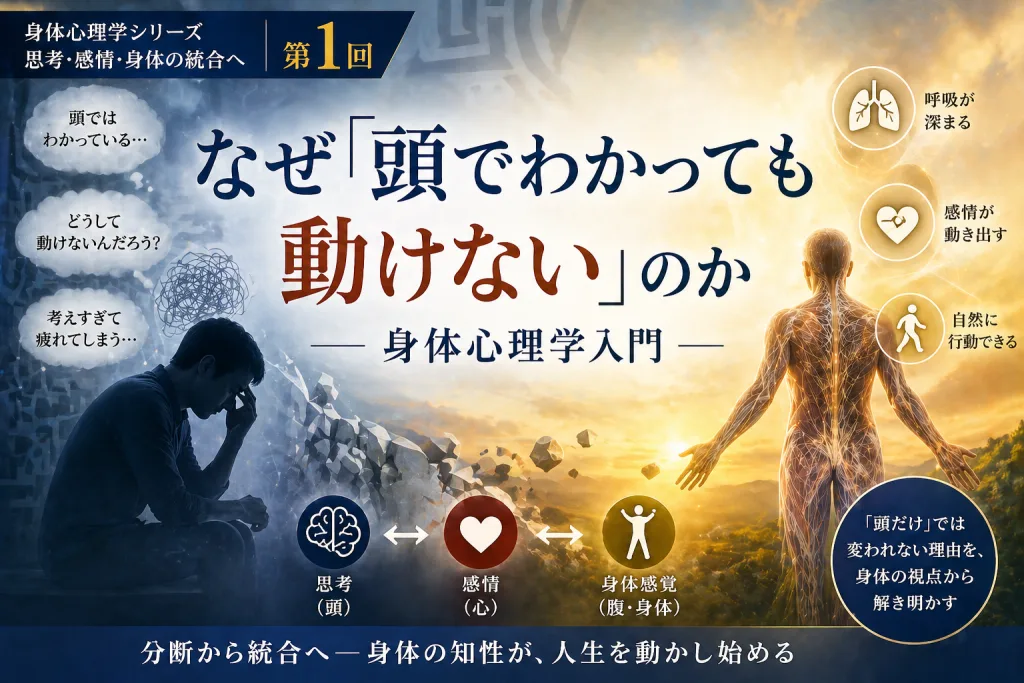
Somatic Psychology Series — Toward the Integration of Thought, Emotion, and Body | Part 1. Updated 2026.
Introduction
“I understand it in my head. But somehow, I can’t move.”
It is a phrase heard repeatedly from clients over the course of continuing sessions. The thought of needing to change jobs. The thought of needing to change a relationship. The thought of needing to rest more. There is enough information, and enough reason. Even so, the body does not go forward.
This experience of “unable to move even though it is understood” is neither weakness of will nor a problem of mentality. It is a structural problem that arises when body and mind are divided.
A Physical Therapist’s Experience
A man in his thirties working as a physical therapist (Mr. Kouki Yamada) began receiving Rolfing, carrying knee pain, low-back pain, insomnia, and weight gain. As a specialist in the body, he “understood his own condition with his head” — what the problem was, and what he ought to do. Even so, he could not change.
After completing the ten sessions, he wrote this:
“When I became honest with my own feelings, I noticed that my body, too, became easier. Conversely, I also felt that when I do things I don’t much want to do, a sense of discomfort appears in my body, and I truly felt the connection between mind and body.”
His bodily pain almost disappeared, the insomnia cleared, and his weight also decreased by 10 kg. What changed was not “information,” but “the relationship between body and emotion.”
→ Mr. Kouki Yamada’s Testimonial
What Is Somatic Psychology
Somatic psychology is an approach that handles psychological processes without cutting them off from the state, movement, and sensation of the body.
The word “somatic” derives from the Greek “soma (body).” It takes the standpoint that not only the brain and language, but the muscles, fascia, the autonomic nervous system, breathing, and posture — all of these participate in the “psychological.”
Whereas conventional psychotherapy is an approach of “noticing and changing through talking,” somatic psychology emphasizes the reverse path: “by changing from the body, thought, emotion, and behavior change.”
The “Mind” Does Not Dwell in the Brain Alone
Conventional psychology has operated on the premise of “mind = brain.” It has tried to explain emotion, thought, and judgment all as workings of the brain.
But from the latter half of the 20th century, research overturning this premise from the ground up came one after another.
The neuroscientist Antonio Damasio proposed the somatic-marker hypothesis: “without the body, decision-making is not possible.” Peter Levine showed that trauma is stored not as “memory of the brain” but as “memory of the body.” Stephen Porges, through Polyvagal Theory, made clear that the autonomic nervous system and the body’s state directly govern emotion, cognition, and judgment.
In Japan, An Introduction to Somatic Psychology by Yutaka Haruki and others introduces this field systematically, and the viewpoint of the integration of body and mind is entering the mainstream of psychology as well.
What these bodies of research point to in common is one thing — the “mind” dwells in the whole body.
Where Did the Current of Handling the Mind from the Body Come From?
The approach of “changing the mind from the body” began in the early 20th century with Wilhelm Reich.
Reich, who was a disciple of Freud, proposed “character analysis,” in which repressed emotion is fixed in the body as “body armor (chronic muscular tension).” He thought that emotion could be released not by handling it with language, but through breathing and the body’s movement.
Alexander Lowen, who carried on this current, developed “Bioenergetics” and systematized the relationship between the body’s tension patterns and psychological defense. Furthermore, Stanley Keleman, from the viewpoint of “somatic process,” reconceived the body not as a fixed structure but as a process that is continually being formed, and held that a person’s life history appears in the shape and mode of organization of the body.
And Peter Levine, from observations in ethology, developed “Somatic Experiencing (SE)” and clarified the mechanism by which trauma is stored as the body’s “frozen response.”
Wilhelm Reich(character analysis; body armor)
 ↓
Alexander Lowen(Bioenergetics)
 ↓
Stanley Keleman (somatic process)
 ↓
Peter Levine(Somatic Experiencing)
Rolfing developed independently of this lineage. Ida Rolf set out as a biochemist and built her approach from the structural viewpoint of gravity and fascia. But the core of the practice — “when the body’s structure changes, the psychological, the emotional, and behavior change” — resonates deeply with the lineage of somatic psychology.
→ The History of Rolfing and Alternative Medicine
The Integration of “Head, Heart, and Gut,” Proven by a Silicon Valley Leader
This is not only a matter of scholarship and history. At the front line of business, too, there is a figure who has arrived at the same conclusion.
That figure is Joe Hudson, an executive coach known as the mentor of OpenAI CEO Sam Altman. Having supported top Silicon Valley leaders for many years, he proposes the concept of “Head, Heart, and Gut.”
The Head is logic, analysis, thought, and strategy — the domain AI is best at. The Heart is emotion, empathy, connection, and meaning — the power to resonate with others. And the Gut (hara / tanden) is bodily sensation, intuition, resolve, and decision — the “Yes / No” before it becomes words.
Hudson says this:
“A desire from the head requires willpower. But a desire from the heart — the body moves for it naturally.” “When anxiety is felt, its true nature may be excitement that has been held down.”
“Understanding with the head yet being unable to move” is because only the head is moving, and the heart and gut are left behind. What Hudson conveys at the front line of Silicon Valley, and the insight that somatic psychology has built up over a hundred years, point to the same single point — without the integration of thought, emotion, and body, there is no true transformation.
Altman speaks of Hudson this way: “One of his superpowers is a deep understanding of emotional clarity and the way to reach it. This will become one of the most important skills in the post-AGI world.”
Why “Just Talking” Does Not Bring Change
So, how does the integration of head, heart, and gut occur? Here, the limit of “talking” becomes important.
Even with the realization in counseling or coaching that “the reason it became so is now understood,” behavior does not change — there must be many who have had this experience. This is not a problem of ability. It is because the “language area” and the “motor system and autonomic nervous system that govern behavior” operate as separate circuits within the brain. An approach through language reaches “understanding.” But it has trouble reaching the “patterns soaked into the body” — chronic tension, defensive reactions, frozen breathing.
Bessel van der Kolk, a leading authority in trauma research, pointed out that “the body keeps the score (The Body Keeps the Score).” Past experience is recorded not as verbal memory, but as the body’s tension patterns, posture, breathing, and reactions.
This is the structural cause of “unable to change even though the head understands.” So, what does it mean to change from the body rather than the circuit of language?
What Is the Holistic (Whole) That Rolfing Aims For
Body therapy has three paradigms.
Relaxation aims to ease pain and tension and return to a comfortable state. Much of massage and seitai belongs here. Corrective aims to return distortion and poor posture to a “correct state.” Chiropractic and postural correction fall here.
And Holistic (whole) aims at the integration of the whole human being, without cutting apart body, emotion, thought, and relationship. Rolfing stands on this paradigm.
In the Holistic (whole) approach, stiff shoulders are not “a problem of the shoulders alone.” That person’s breathing pattern, the way of holding emotion, the history of how the body is used, the relationship with gravity — all function as a single system. That is precisely why, when the fascia is released, clients often say this: “Somehow tears came,” “I suddenly remembered something from long ago,” “the blockage in my chest feels as if it has come off” — this is not coincidence.
Receptors of the autonomic nervous system exist densely in the fascia, and the release of the fascia directly changes the state of the autonomic nervous system. By the body’s tension coming undone, the patterns of emotion, cognition, and judgment change. The experience of Mr. Yamada at the opening — “when I became honest with my own feelings, my body, too, became easier” — expresses precisely what the Holistic (whole) approach brings.
The Point of Contact Between Somatic Experiencing (SE) and Rolfing
Somatic Experiencing (SE), developed by Peter Levine, holds that, just as an animal, after escaping danger, trembles its body and “completes” the stress response, human trauma too heals by releasing the body’s “frozen response.”
The core of SE is attention to the “felt sense” — the sensation felt from the inside of the body. By directing awareness not to narrating “what happened” in language, but to “what is happening inside the body now,” the frozen response is released little by little.
Rolfing and SE are independent approaches, but they resonate deeply on the following points:
- Taking bodily sensation, rather than language, as the main medium of change
- Releasing “a response that did not complete” in a safe environment
- Change occurring through the regulation of the autonomic nervous system
- The “safe relationship” between therapist and client being the foundation
When the fascia is released in a Rolfing session, the body often trembles, or a deep breath arises naturally. This is a sign of the frozen nervous system being released — what SE calls “discharge.”
→ Trauma Workshop – Lael Keen — How to Incorporate the Thinking of Trauma into a Session?
Attachment Theory and the Body — A Safe Relationship Supports Transformation
The Attachment Theory proposed by John Bowlby showed that true growth and transformation occur in the human being only within a “safe relationship.” When stable attachment with a caregiver is formed in infancy, subsequent emotional regulation, interpersonal relationships, and stress tolerance change fundamentally.
Conversely, unstable attachment patterns are inscribed in the body. The repetition of the experience “if I get close, I will be hurt,” “if I rely on someone, I will be rejected” remains in the body as chronic bodily tension, hyperarousal, and dissociation. This, even when “understood” in language, has trouble changing as a bodily pattern.
At the foundation of the transformation that occurs in a Rolfing session, too, there is this “safe relationship.” The relationship in which the practitioner, while touching the body, carefully receives the client’s responses functions as a new experience of attachment. When the body feels “here is safe,” tension that had been frozen for many years begins to be released for the first time.
→ Attachment Is Inscribed in the Body
Somatic Psychology Series — Toward the Integration of Thought, Emotion, and Body (All 4 Parts)
Somatic Psychology Series — Toward the Integration of Thought, Emotion, and Body (All 4 Parts)
The question “unable to move even though the head understands” is unraveled from four angles.
Part 1: Why “the Head Understands, but the Body Won’t Move” (this article)
Part 2: Why Trauma Does Not Heal Through Words — The Mechanism of Fascia, the Autonomic Nervous System, and Body Memory
→ Read Part 2
Part 3: Why Organizing the Body Raises Judgment and Performance — From the Perspective of Rolfing and Brain Science
→ Read Part 3
Part 4: The Three Approaches That Break Through “Understanding Yet Unable to Change” — The Difference Between Therapy, SE, and Rolfing
→ Read Part 4
For Those Who Want to Update the Recognition OS “From the Body”
Handling the questions “why do I think this way” and “why does my judgment waver” from the perspectives of philosophy, brain science, and cognitive bias is Mind and Bodywork Lab’s “Recognition OS” series. An approach from the body, and an approach from thought. By knowing both, transformation becomes deeper.
→ Mind and Bodywork Lab: How to Navigate This Site (in Japanese)
For Those Who Want to Change from the Body
It is possible to begin by confirming, in a trial session, what is happening in the body.
→ Applying for a Trial Session
Hidefumi Otsuka (Ph.D.) | Certified Advanced Rolfer™ / Rolf Movement Practitioner
Completed a doctoral program at the Graduate School of Medicine, the University of Tokyo. After a career in the pharmaceutical industry, has offered Rolfing® sessions in Shibuya since 2015. Works under the theme of “the integration of thought, emotion, and body.”